
Vitiligo Treatment Selector
Find the right treatment approach for your vitiligo. This tool helps you determine if Benoquin Cream or alternatives might be appropriate for your specific situation.
Benoquin Cream isn’t just another skin product. It’s a powerful, permanent solution for people with vitiligo who want to even out their skin tone by removing pigment from unaffected areas. But it’s not for everyone. And it’s not the only option out there. If you’re considering Benoquin, you’re probably weighing whether the trade-offs are worth it - and if there’s something safer, gentler, or more reversible.
What Benoquin Cream Actually Does
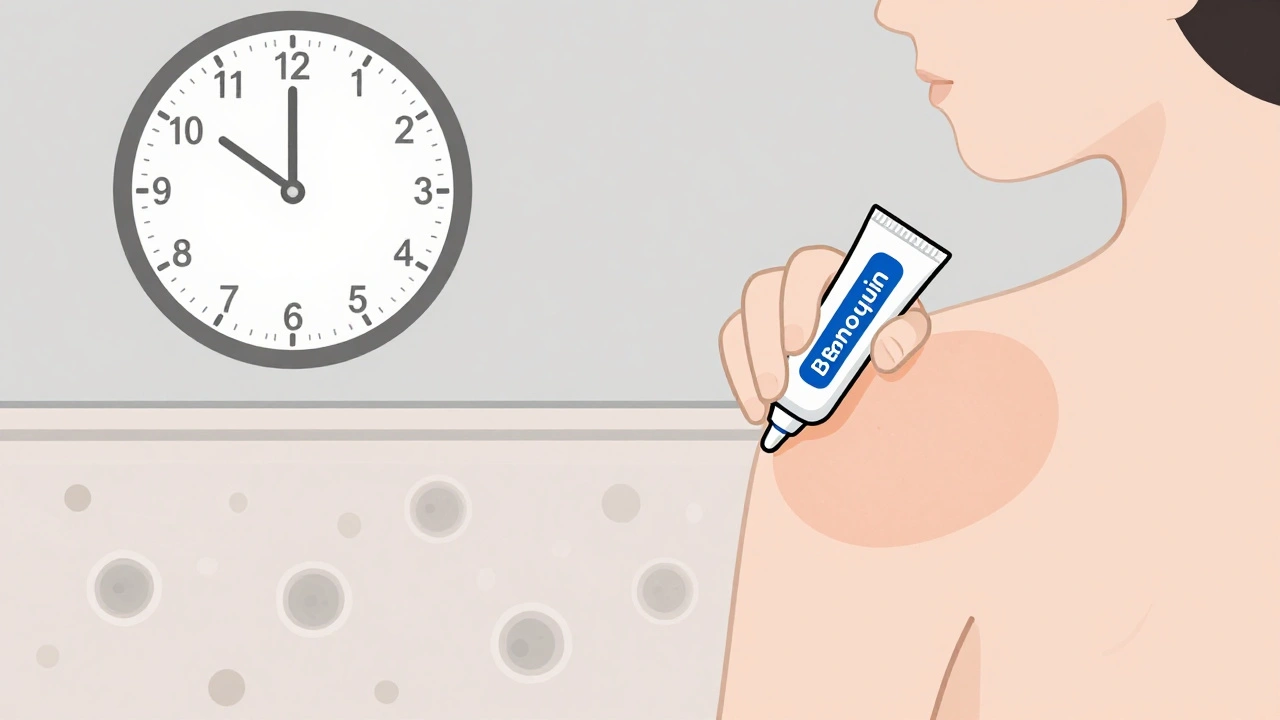
Benoquin Cream contains monobenzone, a chemical that destroys melanocytes - the cells that make skin pigment. Unlike topical steroids or light therapies that try to restore color, Benoquin works the other way: it removes color from healthy skin to match the white patches caused by vitiligo. The goal isn’t to cure vitiligo. It’s to make it less noticeable by creating a uniform skin tone.
This isn’t a quick fix. It takes months - sometimes over a year - to see full results. And once the pigment is gone, it’s gone for good. There’s no turning back. That’s why doctors only recommend it for people with extensive vitiligo covering more than 50% of their body. It’s not meant for small patches or people still trying to regain color.
Why People Look for Alternatives
Many people start with Benoquin because it’s one of the few treatments that offers permanent results. But the side effects are serious. Skin can become extremely sensitive to sunlight. Redness, itching, and burning are common. Some users report permanent damage to the eyes if the cream gets near them. And because it’s so strong, it can spread to unintended areas if not applied carefully.
Plus, Benoquin is hard to get. In many countries, including Australia, it’s only available by prescription. Some online pharmacies sell it without a script, but that’s risky. You don’t know what you’re getting - or if it’s even real monobenzone.
That’s why people start looking for alternatives. They want something that gives control, safety, or reversibility - even if it takes longer.
Alternative 1: Hydroquinone Creams
Hydroquinone is the most common alternative. It’s a milder pigment-lightening agent used for melasma, sun spots, and mild vitiligo. Unlike monobenzone, hydroquinone doesn’t destroy melanocytes. It just slows down pigment production. That means results are temporary. If you stop using it, your skin color comes back.
It’s available in 2% over-the-counter formulas and up to 4% by prescription. Many dermatologists use it in combination with retinoids or corticosteroids to boost effectiveness. It’s much safer for small areas and doesn’t carry the same risk of permanent depigmentation.
But it’s not perfect. Long-term use can cause ochronosis - a bluish-black discoloration - especially in darker skin tones. It’s also banned in some countries for cosmetic use. Still, for people with less than 20% body involvement, it’s often the first choice.
Alternative 2: Topical Corticosteroids
Corticosteroids like clobetasol or betamethasone are used to stop the immune system from attacking melanocytes in early-stage vitiligo. They’re not depigmenting agents - they’re restorative. They help color return to white patches, not remove it from healthy skin.
Studies show that about 40-50% of people using potent steroids for 3-6 months see partial or full repigmentation. Results are best when started early and used with UV light therapy.
The downside? Long-term use thins the skin. Stretch marks, acne, and visible blood vessels can appear. It’s not something you use for years. But for people with limited patches and a desire to restore color, it’s often the go-to starting point.
Alternative 3: Calcineurin Inhibitors (Tacrolimus, Pimecrolimus)
Tacrolimus (Protopic) and pimecrolimus (Elidel) are non-steroidal creams that calm the immune response without thinning the skin. They’re FDA-approved for eczema but used off-label for vitiligo, especially around the face and eyes where steroids are too risky.
Research from the University of California found that 60% of patients using tacrolimus twice daily for six months had noticeable repigmentation. Results are slower than steroids, but safer for long-term use. No permanent skin damage. No risk of depigmenting healthy skin.
They’re pricier than steroids and not covered by all insurance plans. But for sensitive areas or children, they’re often the preferred option.
Alternative 4: Narrowband UVB Phototherapy
This isn’t a cream - it’s a light treatment. Narrowband UVB (NB-UVB) uses specific wavelengths of ultraviolet light to stimulate melanocytes to produce pigment again. It’s one of the most effective treatments for vitiligo, especially when combined with topical therapies.
Clinical trials show that after 6-12 months of twice-weekly sessions, up to 70% of patients get significant repigmentation. It works best on the face, neck, and trunk. Arms and legs respond slower.
The catch? You need to go to a clinic 2-3 times a week. It’s time-consuming. And while it’s generally safe, there’s a small risk of sunburn or skin cancer with long-term use. Still, for people who want to restore color - not remove it - this is often the most reliable method.
Alternative 5: Ruxolitinib Cream (Opzelura)
Opzelura is the first FDA-approved topical treatment specifically for vitiligo. It contains ruxolitinib, a JAK inhibitor that blocks the immune attack on melanocytes. It’s not a depigmenting agent - it helps restore color.
In clinical trials, 30% of patients achieved 75% or greater repigmentation after 24 weeks. Results continued to improve over a year. It’s applied twice daily, like a regular cream.
It’s expensive - over $1,000 per tube in the U.S. - and not yet widely available in Australia. But it’s a game-changer. It’s targeted, non-steroidal, and doesn’t cause skin thinning. For people with moderate vitiligo who want to regain pigment without light therapy, it’s the most promising new option.

Alternative 6: Cosmetic Camouflage
If you’re not ready to commit to chemical or light treatments, camouflage makeup can be a powerful tool. Products like Dermablend, Covermark, or even high-coverage foundations can perfectly match your skin tone and last all day.
Some brands now offer custom-mixed shades for vitiligo patients. Others use color-correcting primers to neutralize white patches before applying foundation. It’s temporary, but it’s immediate. No side effects. No waiting. No permanent changes.
For many, especially those with visible patches on the hands or face, this is the most practical solution. It gives control back without medical risk.
What’s Right for You?
There’s no one-size-fits-all answer. Your choice depends on three things:
- How much of your skin is affected? If it’s over half your body, Benoquin might be the only realistic option. If it’s small patches, go for repigmentation therapies.
- What’s your goal? Do you want to remove pigment? Restore it? Or just hide it?
- How much time and risk are you willing to take? Benoquin is permanent. UV therapy takes months. Ruxolitinib is new and expensive. Camouflage is instant.
Most dermatologists recommend starting with repigmentation treatments - steroids, calcineurin inhibitors, or UV therapy - before considering depigmentation. Benoquin should be a last resort, not a first step.
What You Should Never Do
Don’t buy monobenzone online without a prescription. Many products sold as "Benoquin" on eBay or Amazon are fake, diluted, or contaminated. Some contain mercury or hydroquinone in unsafe doses.
Don’t use Benoquin on your face, hands, or near your eyes. The skin there is thinner. The risk of accidental spreading is too high.
Don’t skip sun protection. Depigmented skin burns easily and has no natural defense against UV damage. Always use SPF 50+.
Final Thoughts
Benoquin Cream works - but it’s a blunt instrument. It’s not a cure. It’s a radical choice. And for most people with vitiligo, it’s not the best first move.
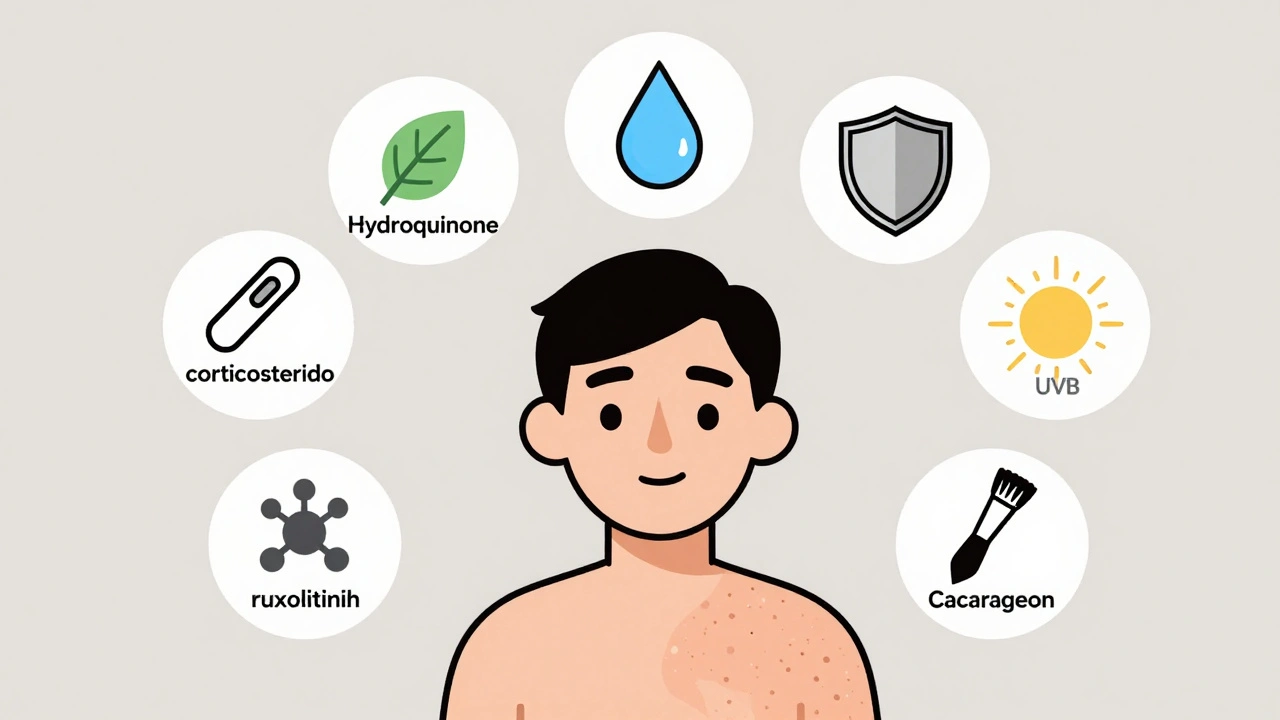
There are better, safer, and more reversible options. Hydroquinone for mild cases. Steroids and calcineurin inhibitors for early-stage vitiligo. UV therapy for broader patches. Ruxolitinib for those who can afford it. Camouflage for immediate confidence.
What you need isn’t just a treatment. It’s a plan. Talk to a dermatologist who specializes in pigmentation disorders. Ask about your options. Test small areas first. Give yourself time. Your skin - and your peace of mind - will thank you.
Is Benoquin Cream safe for long-term use?
No, Benoquin Cream is not meant for long-term use. It causes permanent depigmentation and increases sun sensitivity. Once pigment is lost, it cannot be restored. Long-term use also raises the risk of skin irritation, burns, and eye damage if the cream spreads. It should only be used under medical supervision and typically for a limited period to achieve full depigmentation.
Can hydroquinone be used instead of Benoquin?
Yes, hydroquinone can be used as an alternative, but it works differently. Hydroquinone lightens skin temporarily by reducing pigment production, while Benoquin permanently destroys pigment cells. Hydroquinone is safer for small areas and reversible, making it better for people with limited vitiligo. It’s not effective for widespread depigmentation like Benoquin.
Does ruxolitinib cream (Opzelura) work for vitiligo?
Yes, ruxolitinib cream (Opzelura) is FDA-approved for non-segmental vitiligo in adults and children 12 and older. In clinical trials, 30% of users achieved at least 75% repigmentation after 24 weeks. It works by blocking immune signals that destroy pigment cells. It’s one of the most effective non-depigmenting treatments available today.
Is narrowband UVB better than Benoquin for vitiligo?
It depends on your goal. Narrowband UVB helps restore pigment to white patches - it doesn’t remove pigment from healthy skin. Benoquin does the opposite. UVB is better for people who want to regain color and have less than 50% body involvement. Benoquin is only recommended for those with extensive vitiligo who want to remove pigment entirely. UVB is reversible and safer long-term.
Can I use Benoquin on my face?
No, you should never use Benoquin on your face, hands, or near your eyes. The skin in these areas is thinner and more sensitive. Accidental spreading can cause irreversible depigmentation in unwanted areas, leading to uneven, unnatural-looking skin. Dermatologists strongly advise against facial use due to high risk and poor cosmetic outcomes.
Are there natural alternatives to Benoquin for vitiligo?
There are no proven natural alternatives that replicate Benoquin’s effect. Some people try herbal creams or supplements like ginkgo biloba or polypodium leucotomos, but studies show minimal or no effect on depigmentation. Vitiligo is an autoimmune condition - it doesn’t respond to herbal remedies the way acne or eczema might. Stick to medically tested options.
How long does it take to see results with Benoquin?
It typically takes 4 to 12 months to see full results with Benoquin Cream. Most people start noticing lightening after 2-3 months of daily use. The process is slow and requires consistent application. Results vary based on skin tone, body area, and how often the cream is applied. Patience and strict adherence to instructions are critical.
Can I use Benoquin with other vitiligo treatments?
No, Benoquin should not be used with other depigmenting agents like hydroquinone or chemical peels. Combining them increases the risk of severe irritation, burns, or uncontrolled depigmentation. It also shouldn’t be used with phototherapy or steroids, as those aim to restore pigment - the opposite goal. Always consult a dermatologist before mixing treatments.
If you’re considering Benoquin, remember: the goal isn’t to change who you are. It’s to help you feel more comfortable in your skin. That’s why choosing the right treatment - and the right support - matters more than any cream.
Comments (14)
Benoquin? More like Beno-quit-your-life. Permanent depigmentation isn't a treatment-it's a surrender. And you're telling me people are buying this off eBay like it's a discount vape? Get a prescription or get a life.
The metaphysical weight of depigmentation isn't just dermatological-it's ontological. Monobenzone doesn't alter pigment; it erases identity. We're not talking about a cream here. We're talking about the voluntary annihilation of biological uniqueness in service of a social ideal of homogeneity. The body becomes a canvas for cultural conformity. And yet-how many of us have stared into the mirror and wished we could just disappear? The tragedy isn't the cream. It's that we need it at all.
Opzelura is the only real answer. JAK inhibitors > ancient chemist voodoo. Benoquin is for people who gave up. I'm not even mad, I'm just disappointed. 🤡
In India we call this ‘skin bleaching culture’-and it’s not just vitiligo. Everyone wants lighter skin. Benoquin? More like Beno-privilege. You think this is medical? Nah. It’s colonialism in a tube.
wait a sec-so ruxolitinib is FDA approved but not in australia? that’s sus. they’re hiding it because big pharma hates poor people. also i heard monobenzone was originally developed by nazi scientists to erase ‘undesirable’ traits. not saying it’s true but…
Don’t trust any doctor who says “just use camouflage.” That’s what they say when they don’t know what else to do. And don’t even get me started on “natural remedies.” Ginkgo biloba? Please. You’re not healing your skin-you’re feeding your delusion.
Hydroquinone is bad. Steroids are bad. UV light is bad. Ruxolitinib is expensive. Benoquin is permanent. Camouflage is temporary. So what do you do? Nothing. Just stay inside. Avoid the sun. Don't look in the mirror. That's the real treatment.
just wanna say i tried hydroquinone for 6 months and nothing happened. then i got opzelura and my arms started coming back. not 100% but enough to wear shorts again. if you’re on the fence-try the science, not the fear.
For anyone reading this and feeling alone-please know you’re not. I’ve had vitiligo since I was 10. I used camouflage for years. Then I tried tacrolimus. Took 8 months. My neck came back. It’s not perfect. But it’s mine. You don’t have to choose between being erased or being seen. You can just… be. And that’s enough.
It is imperative to underscore that the psychosocial implications of depigmentation therapies extend far beyond the epidermal plane, permeating the very fabric of self-perception and societal integration. The decision to utilize monobenzone, therefore, must be approached with the gravitas befitting a life-altering existential choice, not as a cosmetic convenience. One must contemplate the ontological ramifications of self-erasure as a strategy for social acceptance, and whether such a path truly leads to liberation-or merely assimilation into an aesthetic norm that is, at its core, heteronormative and colorist.
Let’s be real: Benoquin is the last resort of people who’ve been failed by the medical system. Hydroquinone? Too slow. Steroids? Too scary. UV therapy? Too expensive. Ruxolitinib? Too rich-kid stuff. So you end up with this nuclear option because nobody gave a damn about your skin until it was too late. The system doesn’t care. The cream does.
I respect the honesty here. My brother used Benoquin. He’s 42 now. He wears long sleeves in summer. He doesn’t go to the beach. He doesn’t post selfies. I don’t blame him. But I wish someone had told him about tacrolimus before he made the choice. He’s not broken. He’s just tired.
bro i tried the cream for 3 months and my hand got lighter but my face stayed the same. then i got scared and stopped. now i just use covermark. no side effects. no stress. just me. you dont need to fix yourself to be worthy.
That last comment? That’s the truth they don’t put in clinical trials. The real metric isn’t repigmentation percentage-it’s whether you can look in the mirror and not flinch. Some of us don’t want to be fixed. We just want to be seen. Benoquin doesn’t heal. It just makes the silence louder.