

When you or a loved one is admitted to a hospital or nursing home, you expect the right medication at the right time. But what happens when the doctor prescribes one drug, and the pharmacist gives you another? This isn’t a mistake-it’s often part of a formal system called an institutional formulary. These aren’t just lists of approved drugs. They’re tightly regulated policies that let healthcare facilities swap one medication for another, as long as it’s expected to work the same way. And in places like Florida, this isn’t optional-it’s the law.
What Exactly Is an Institutional Formulary?
An institutional formulary is a living list of medications that a hospital, nursing home, or clinic has officially approved for use. But it’s more than just a catalog. It’s a decision-making tool that tells pharmacists and clinicians which drugs can be swapped in for others, under strict rules. The goal? To improve safety, cut waste, and make sure patients get effective treatments without paying more than necessary. In Florida, Statute 400.143 (2025) defines it clearly: it’s a system where a pharmacist can replace a prescribed drug with another that’s chemically different but expected to have the same clinical effect. This is called therapeutic substitution. Unlike insurance formularies that decide what’s covered and how much you pay out-of-pocket, institutional formularies control what drugs are actually given inside a facility. They’re not about billing-they’re about clinical care. These lists aren’t static. They’re updated regularly based on new evidence. A team of experts-pharmacists, doctors, and nurses-reviews data on effectiveness, side effects, and cost. If a generic version proves just as safe and effective as a brand-name drug, it moves to the top tier. If a new drug shows no real benefit over an existing one, it gets bumped out.How These Policies Work: The Rules Behind the Scenes
In Florida, the law doesn’t leave this to chance. Every facility that uses a formulary must have a formal committee with three mandatory members: the medical director, the director of nursing services, and a certified consultant pharmacist. This team writes the rules, sets evaluation criteria, and tracks outcomes every three months. The process is methodical:- They evaluate drugs using real-world data-not just manufacturer claims.
- They assign drugs to tiers: preferred (lowest cost to patients), non-preferred (higher cost), and restricted (requires special approval).
- They document every decision and keep records available for state auditors.
- They monitor outcomes: Are patients having fewer falls? Fewer ER visits? Fewer bad reactions?
Why Institutions Use Formularies: Safety Over Savings
It’s easy to assume formularies are just about saving money. And yes, they do. But studies show their biggest win is safety. Research published in the American Journal of Health-System Pharmacy found that hospitals using well-managed formularies saw a 15% to 30% drop in adverse drug events. Why? Because they eliminate unnecessary duplicates, remove outdated or risky drugs, and reduce confusion from too many options. Take nursing homes. A 120-bed facility in Tampa reported that after implementing Florida’s formulary rules, they caught seven dangerous drug interactions in the first year alone-interactions they’d never have noticed without structured monitoring. That’s not luck. That’s system design. Formularies also help reduce polypharmacy-the dangerous habit of giving elderly patients too many pills. By standardizing choices, facilities can cut down on cluttered medication lists and make care more predictable.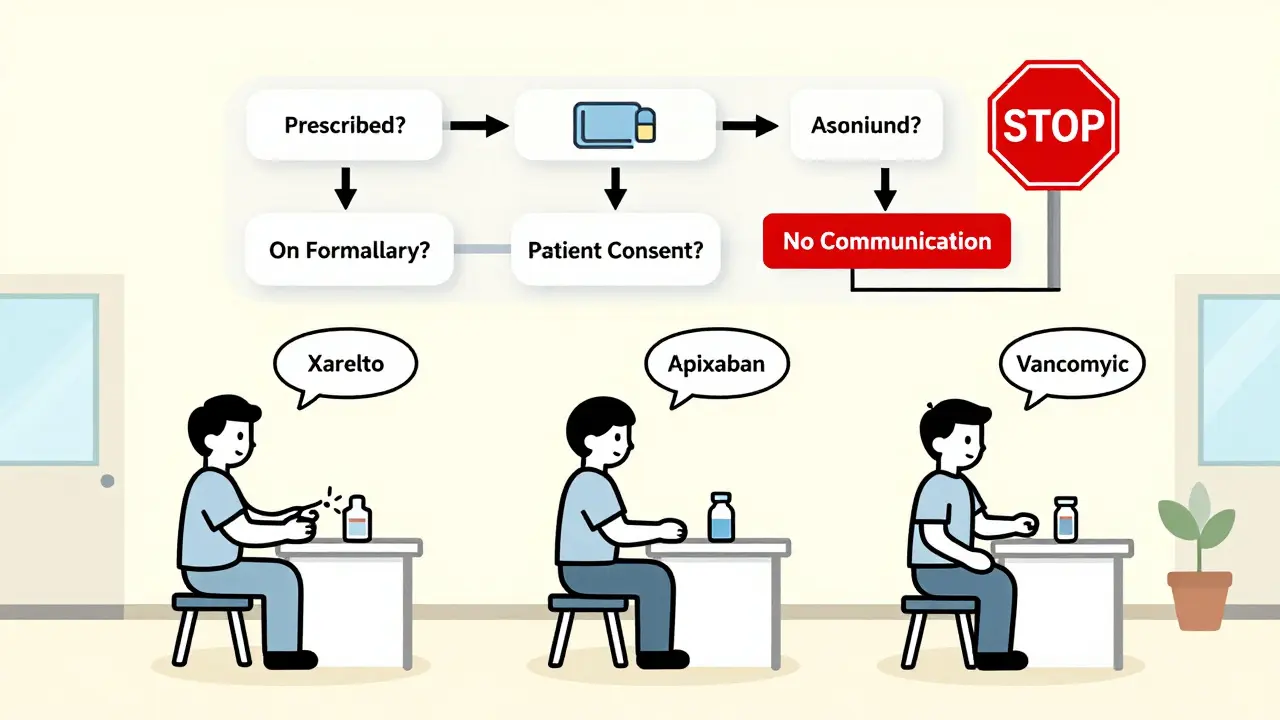
The Dark Side: When Substitutions Cause Confusion
But it’s not all smooth sailing. Patients moving between facilities often get hit with conflicting substitution rules. A patient might be switched from Xarelto to apixaban in a nursing home. Then, when they go back to the hospital, they’re put back on Xarelto-because the hospital’s formulary is different. The patient doesn’t know why. Their family doesn’t know why. And sometimes, neither does the doctor. Pharmacists on Reddit and hospital forums describe cases where patients ended up on the wrong drug because no one communicated the substitution. One nurse shared a story where an elderly man was given a different anticoagulant after a transfer-and ended up in the ER with internal bleeding because his INR levels weren’t checked. Doctors aren’t always happy either. A 2023 AMA survey found that 78% of physicians worry about bureaucratic delays when they need a non-formulary drug for a complex case. Imagine a patient with rare kidney disease who needs a specific medication that’s not on the formulary. Getting approval can take days. In acute situations, that delay can be dangerous. And then there’s consent. AARP points out that most patients in long-term care don’t even know they’ve been switched. They’re not told. They’re not asked. That’s a problem. Informed consent isn’t just a legal buzzword-it’s part of ethical care.How Facilities Make It Work: Training, Tech, and Teamwork
Implementing a formulary isn’t just about printing a list. It’s about changing how an entire facility operates. In Florida, staff need 4 to 8 weeks to adjust. Nurses, who are often the ones handing out pills, need special training on when substitutions are allowed and when they’re not. Pharmacists must learn how to flag exceptions. Doctors need to understand how to request non-formulary drugs without getting lost in paperwork. Electronic health records (EHRs) play a huge role. Sixty-eight percent of facilities had trouble integrating formulary rules into their systems at first. Now, smart alerts help: if a doctor prescribes a non-formulary drug, the system pops up a message: “Apixaban is preferred. Reason for override?” The best-run programs involve pharmacists sitting in on rounds. They don’t just fill prescriptions-they help shape them. A pharmacist might say, “This patient’s creatinine level is dropping. Let’s switch from vancomycin to daptomycin-it’s safer here.” That’s how formularies become clinical tools, not just policy documents.What’s Changing in 2025 and Beyond
The rules are tightening. As of January 1, 2025, Florida’s Statute 400.143 expanded monitoring requirements. Now, facilities must track not just whether substitutions happened, but what happened to patients afterward. Did their kidney function change? Did they get readmitted? Did they have a fall? The Centers for Medicare & Medicaid Services (CMS) announced in March 2024 that institutional formulary compliance will be part of Nursing Home Compare ratings starting in Q3 2025. That means hospitals with poor formulary practices could see their public ratings drop-directly affecting referrals and funding. Meanwhile, the American Society of Health-System Pharmacists updated its guidelines in April 2024, recommending bi-monthly (every two months) reviews instead of quarterly. That’s a big shift-more frequent checks mean faster corrections. The future? AI. Gartner predicts that by 2026, 80% of healthcare systems will use AI to adjust formularies in real time. Imagine a system that learns: “When we switch this drug in patients over 75 with heart failure, readmissions go up by 12%. Let’s change the policy.” Some facilities are already testing pharmacogenomics-using a patient’s DNA to decide which drug works best. If your genes make you a slow metabolizer of warfarin, the system could automatically prefer apixaban. That’s the next level.
Who Benefits? Who Gets Left Behind?
The system works best when it’s transparent and patient-centered. Nursing homes benefit the most. Stable patients, long-term care, predictable routines-these are perfect conditions for formularies to shine. Insurance companies love them too-they reduce overall drug spending. But patients with complex conditions? Those with rare diseases, multiple chronic illnesses, or those who’ve tried dozens of drugs? They’re the ones who suffer when formularies become rigid. A patient with autoimmune hepatitis might need a specific immunosuppressant. If it’s not on the formulary, and the doctor can’t get approval in time, the disease flares. That’s not policy failure-it’s system failure. The answer isn’t to scrap formularies. It’s to make them smarter. Add exceptions. Build fast-track approvals. Train staff to ask, “Is this substitution helping-or hurting?”What Patients and Families Should Know
If you’re in a hospital or nursing home:- Ask: “Is this the same drug my doctor ordered, or was it switched?”
- Ask: “Why was it changed?”
- Ask: “Will this affect how I feel or what side effects I get?”
- Request a written explanation if you’re unsure.
Final Thoughts: Formularies Are Tools, Not Rules
Institutional formularies aren’t good or bad. They’re tools. And like any tool, they work best when used with care. Used well, they prevent harm, cut waste, and improve consistency. Used poorly, they create confusion, delay care, and ignore individual needs. The best systems don’t just follow the law-they follow the patient. They listen to nurses who see the real effects. They trust pharmacists who know the drugs. They empower doctors who know the person. The goal isn’t to control costs at all costs. It’s to control risk-so that when someone is sick, they get the right drug, the right way, the first time.What is therapeutic substitution?
Therapeutic substitution is when a pharmacist replaces a prescribed medication with another drug that is chemically different but expected to have the same clinical effect. For example, switching from brand-name Xarelto to generic apixaban. This is allowed under institutional formularies only if the substitute is proven equally safe and effective, and it’s done under strict guidelines.
Are institutional formularies the same as insurance formularies?
No. Insurance formularies determine which drugs are covered and how much you pay out-of-pocket. Institutional formularies control which drugs can be given inside a hospital or nursing home and when substitutions are allowed. One affects billing; the other affects clinical care.
Can a patient refuse a drug substitution?
Yes. While formularies allow substitutions, they don’t force them. If a patient or their legal representative objects, the original prescribed drug must be used. The pharmacist must document the refusal and notify the prescribing clinician.
Why do different hospitals have different formularies?
Each facility develops its own formulary based on its patient population, available resources, and local regulations. A nursing home in Florida may have different priorities than a trauma center in California. This can cause confusion when patients transfer between facilities, especially if substitutions aren’t clearly communicated.
Do formularies save money, or just shift costs?
They do both. Formularies reduce overall drug spending by favoring generics and eliminating low-value drugs. But costs don’t disappear-they often shift to patients through higher co-pays for non-formulary drugs, or to facilities through increased administrative work. The real savings come from preventing adverse events, which are far more expensive than drug costs.
What happens if a hospital doesn’t follow its formulary rules?
In states like Florida, non-compliance can lead to regulatory penalties, loss of licensure, or exclusion from Medicare/Medicaid. Starting in 2025, CMS will also use formulary compliance as a factor in Nursing Home Compare ratings, which affects funding and reputation.
Comments (12)
So let me get this straight - they’re swapping life-saving meds like trading cards while the bureaucrats sip lattes and call it ‘clinical efficiency’ 😏
Meanwhile, Grandma’s INR’s in the toilet and no one’s got the guts to say ‘wait, this ain’t science - it’s cost-cutting with a PhD.’
Formularies? More like corporate puppet shows with white coats.
And don’t even get me started on AI ‘optimizing’ drug choices next year - soon we’ll be getting meds based on a spreadsheet that’s never met a human.
They’ll say ‘evidence-based’ but the evidence is written by reps who paid for the study.
And yes, I’ve seen the charts. The ones they don’t show you.
It’s not about safety. It’s about shareholders.
And if you dare ask why your dad got switched from Xarelto to some generic with 3x the bleeding risk? ‘It’s protocol.’
Protocol. Like it’s a religion.
Well I got news for you - when the system’s rigged, the protocol is a lie.
And we’re all just lab rats in a lab coat factory.
Next thing you know, they’ll algorithm your death certificate too.
💀
You think this is about safety? Please. This is institutionalized medical authoritarianism disguised as ‘best practices.’
Who gave these pharmacy committees goddamn authority to override a physician’s clinical judgment?
It’s not about evidence - it’s about control.
And don’t pretend these ‘expert’ panels aren’t full of pharma-sympathizers who’ve got ties to generics manufacturers.
They don’t care about falls or ER visits - they care about formulary compliance metrics.
And when a patient dies because they got the ‘cheaper’ drug? Oh, it’s ‘an unfortunate outcome.’
It’s not a system - it’s a liability shield with a stethoscope.
And the worst part? You’re supposed to be grateful.
Grateful they didn’t give you the brand name.
Grateful they didn’t ask you.
Grateful they didn’t tell you.
And if you complain? You’re ‘anti-science.’
Wake up. This isn’t medicine. It’s management theater.
And the patients? Just line items.
😭
bro honestly i just want my meds and i dont care what they call it
as long as it works
if i get apixaban instead of xarelto and i dont drop dead
then cool
why are we making this a drama?
they’re not giving me sugar pills
they’re giving me another blood thinner
same class
same mechanism
if it’s cheaper and safer
why not?
also why does everyone act like pharmacists are robots
they’re trained professionals
they know what they’re doing
stop being so paranoid
just trust the system
or don’t go to the hospital
idk
✌️
So if i read this right, a pharmacist can switch my meds without my consent? That’s not a policy, that’s a violation of bodily autonomy.
And then they say ‘but we document it’ - like documentation fixes consent.
Like signing a form makes it ethical.
And the doctors? They’re stuck in EHR hell, trying to fight a 3-day approval process for a drug that could save a life.
And the worst part? No one ever tells the patient.
My aunt got switched from digoxin to a ‘similar’ drug - ended up in the ER with arrhythmia.
They didn’t even call the family.
Just ‘it was on the formulary.’
That’s not healthcare.
That’s negligence with a checklist.
And the FDA? Silent.
And CMS? They’re just gonna slap a rating on it.
Like a Yelp review for dying.
💀
And they wonder why people don’t trust the system.
It’s because they’re not treating us like humans.
Just data points.
With IVs.
And co-pays.
And no one’s talking about this.
Why?
Because the system works for them.
Not us.
🫠
I’ve worked in long-term care for 18 years.
And I’ve seen formularies save lives.
Not because they cut costs - because they cut clutter.
Older patients on 15+ meds? We cut it down to 6 - all evidence-based, all monitored.
Falls dropped 40%.
ER visits? Halved.
And yes - we told families. We explained why we switched.
And we listened.
When a daughter said ‘my mom’s always been on Xarelto,’ we didn’t say ‘policy.’ We said ‘let’s call the doctor together.’
That’s the difference.
It’s not about the list.
It’s about the conversation.
When you treat patients like people - not line items - formularies become tools.
When you treat them like numbers? You get tragedies.
So don’t hate the system.
Fix the culture around it.
And always - always - ask: ‘Who’s this for?’
Not the spreadsheet.
Not the budget.
Not the audit.
But the person.
❤️
Hey I just want to say - I’m not a doctor or anything but my grandpa was in a nursing home and they switched his meds and he was fine!
He didn’t even know it happened lol
And he’s been doing great for a year now!
So maybe the system works better than we think?
I mean, if the drugs are the same class and the docs approve it
why make a big deal?
Also I think AI is gonna be AWESOME for this stuff
imagine if your meds just auto-adjusted based on your bloodwork
no more guesswork!
and pharmacists could focus on the real sick people
not the paperwork
so yeah
keep it simple
trust the process
and hey - if it ain’t broke don’t fix it 😊
also i love how they’re doing bi-monthly reviews now
that’s so smart
👏
There is a critical distinction here between policy and practice.
Formularies, when implemented with transparency, patient-centered protocols, and robust communication, are among the most effective tools we have to reduce harm in complex care environments.
But when they are applied as rigid, top-down mandates - without clinician autonomy or patient inclusion - they become instruments of systemic neglect.
The solution is not abolition.
It is refinement.
Require explicit patient notification.
Integrate real-time feedback loops from frontline nurses.
Allow emergency overrides without bureaucratic delay.
And most importantly - empower pharmacists to be clinical partners, not just dispensers.
Because when a pharmacist says, ‘I’m switching this because your creatinine is dropping,’ - that’s not a policy.
That’s medicine.
And that’s what we should be scaling.
Not fear.
Not suspicion.
But competence.
With care.
🩺
look i get the fear
but honestly
if you’ve ever had to take 10 pills a day
and half of them do nothing
or make you dizzy
or cost a fortune
then maybe a little standardization isn’t the worst thing
we’re not talking about swapping insulin for candy
we’re talking about swapping two blood thinners that both work
and one costs 1/5th
and one has less side effects
and yes
the system messes up sometimes
but that’s not the fault of the formulary
that’s the fault of bad communication
and lack of training
so fix that
not the whole system
and maybe… just maybe
we can make this work for everyone
not just the rich
or the powerful
or the loud
peace out
✌️
Let’s analyze the empirical data.
Per the American Journal of Health-System Pharmacy, a 15–30% reduction in adverse drug events correlates directly with formulary standardization.
Further, the 2023 AMA survey cited 78% of physicians expressing concern - not about substitution, but about administrative delay.
Which is a process issue - not a policy one.
Additionally, Florida’s Statute 400.143 mandates tripartite oversight - medical director, nursing director, certified pharmacist - a structure that exceeds federal minimums.
Moreover, CMS’s inclusion of formulary compliance in Nursing Home Compare ratings creates a measurable incentive for quality - not cost reduction.
Therefore, the narrative of systemic malice is unsupported.
The real problem: inconsistent implementation.
Not the framework.
Fix the workflow.
Not the formulary.
And stop conflating bureaucracy with malice.
It’s a statistical fallacy.
📊
OH MY GOSH I JUST READ THIS AND I CRIED
MY MOM WAS SWITCHED IN THE HOSPITAL AND NO ONE TOLD HER
SHE THOUGHT SHE WAS ON THE SAME DRUG FOR 3 WEEKS
THEN SHE GOT A BLOOD TRANSFUSION BECAUSE HER INR WAS 8.2
AND THEY SAID ‘OH IT WAS A FORMULARY SWITCH’
LIKE THAT’S A GOOD EXPLANATION?
NO
NO NO NO
IT’S A TRAGEDY
AND NOW SHE’S AFRAID OF EVERY MEDICATION
AND I’M SO MAD
WE NEED TO CHANGE THIS
RIGHT NOW
NO MORE SECRET SWITCHES
NO MORE ‘IT’S STANDARD’
WE NEED TO KNOW
WE NEED TO SAY NO
AND WE NEED TO BE HEARD
PLEASE
PLEASE
PLEASE
JUST LISTEN
😭😭😭😭😭
They’re not gonna fix this.
They’ll just make more rules.
And the patients? They’ll keep getting the short end.
And the pharmacists? They’ll just shrug and say ‘it’s not my call.’
And the doctors? They’ll keep writing scripts they know won’t get filled.
And the families?
They’ll keep asking ‘why?’
And no one will answer.
Because the system doesn’t want to be fixed.
It wants to be obeyed.
And that’s the real drug.
And it’s killing us.
Slowly.
Quietly.
Every day.
🫠
Thank you for sharing your story - that’s exactly why we need better communication protocols.
Not just ‘notification’ - but dialogue.
If a patient’s family is left in the dark, that’s a failure of the team - not the formulary.
Let’s use this moment.
Let’s push for mandatory patient/family education sessions when substitutions occur.
Let’s train nurses to say: ‘This was changed because your labs improved - here’s what that means.’
Let’s stop hiding behind ‘policy’ and start living by ‘purpose.’
You’re not alone.
And your mom’s story? It’s not just a tragedy.
It’s a call to action.
And we’re listening.
❤️