
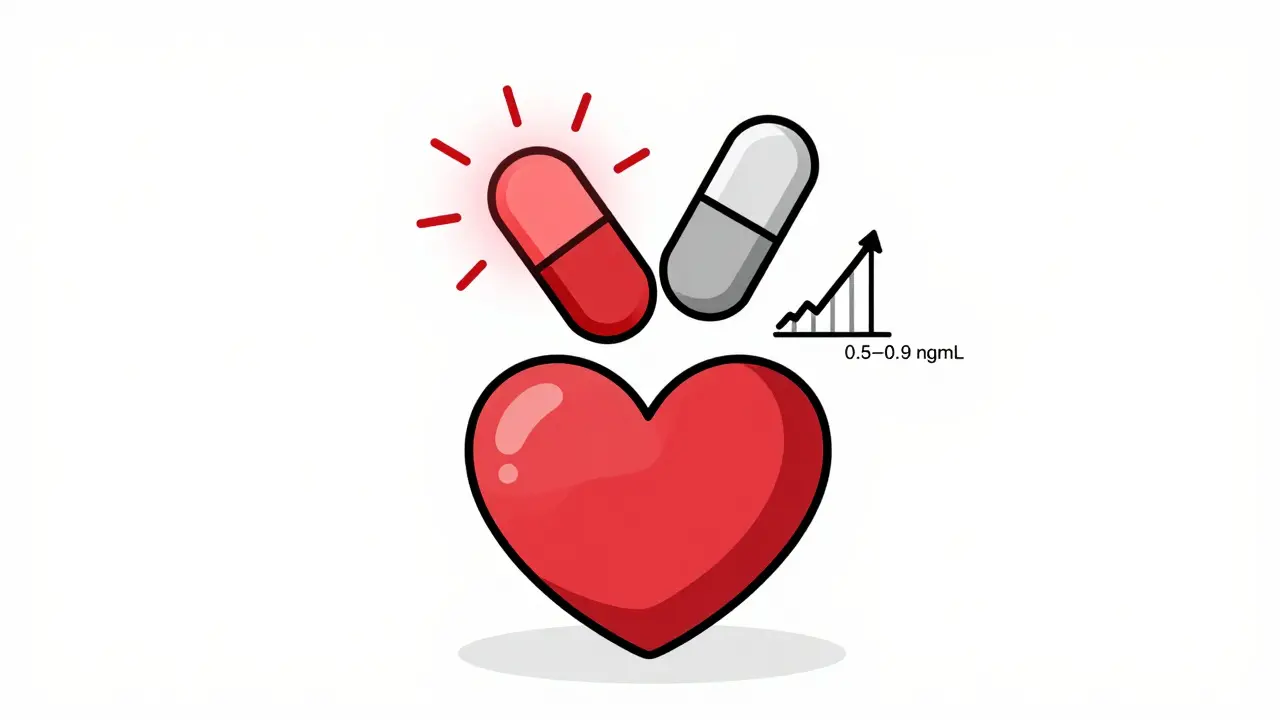
Digoxin-Amiodarone Dose Adjuster
Prevent Life-Threatening Toxicity
This calculator determines safe digoxin dosing adjustments when starting amiodarone. Based on 2024 guidelines and the DIG-AMIO trial data.
Critical Monitoring Timeline
Check digoxin levels at:
• 72 hours after starting amiodarone
• 1 week after starting
• 2 weeks after starting
Danger Signs to Watch For
- Nausea, vomiting
- Yellow-green halos around lights
- Severe bradycardia (slow heart rate)
- Dizziness or fainting
- Visual disturbances
These are late signs of toxicity. Monitor closely!
Why This Drug Combo Can Kill You
Imagine you’re on digoxin to control your irregular heartbeat. Your doctor adds amiodarone because your arrhythmia isn’t under control. Everything seems fine-until you start feeling nauseous, your vision gets blurry, and your heart slows down dangerously. You end up in the ICU. This isn’t rare. It happens because digoxin and amiodarone interact in a way that can spike digoxin levels by over 100%, pushing you straight into toxic territory.
Digoxin is a heart medication with almost no room for error. Its safe range? 0.5 to 0.9 ng/mL. Go above that, and you risk fatal arrhythmias. Amiodarone, a powerful antiarrhythmic, doesn’t just add to the problem-it multiplies it. When you take both, your body can’t clear digoxin properly. The result? Toxic buildup. And because amiodarone sticks around for months-even after you stop taking it-the danger doesn’t go away quickly.
How the Interaction Actually Works
This isn’t just a simple drug clash. It’s a multi-layered pharmacological trap. Amiodarone blocks a protein called P-glycoprotein, which normally pumps digoxin out of your cells and into your urine. When that pump is shut down, digoxin stays in your bloodstream longer. Studies show this alone accounts for 60-70% of the interaction.
Amiodarone also slows down how your liver breaks down digoxin. Together, these effects cause your digoxin levels to rise sharply. In one landmark 1984 study, patients on digoxin who started amiodarone saw their blood levels jump from an average of 0.97 ng/mL to nearly 2.0 ng/mL-more than double the safe limit. And it doesn’t happen right away. Peak levels show up in 1 to 2 weeks, so many doctors miss it because they’re checking too soon.
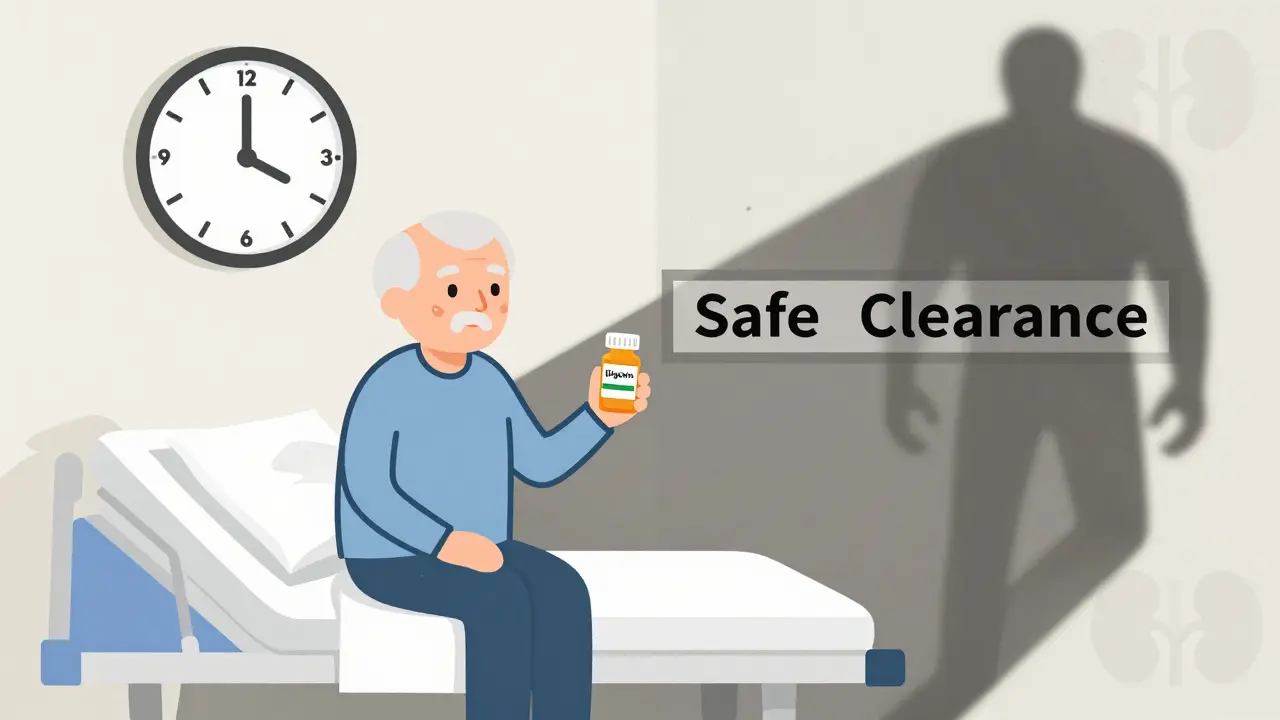
Even worse, amiodarone’s metabolite, desethylamiodarone, lingers in your body for up to 60 days after you stop the drug. That means if you were on amiodarone six weeks ago and now your doctor prescribes digoxin, you’re still at risk. This isn’t a one-time warning-it’s a long-term hazard.
Who’s Most at Risk?
This interaction doesn’t affect everyone the same. The biggest danger zones are:
- Patients over 75
- Those with kidney problems (creatinine clearance under 50 mL/min)
- People with heart failure who rely on digoxin because other drugs won’t work for them
- Anyone taking other drugs that affect kidney function or electrolytes
One study found that 35% of patients who developed digoxin toxicity from this combo had chronic kidney disease. Another showed that elderly patients on full-dose digoxin alongside amiodarone had a 27% higher chance of dying within 30 days. The numbers don’t lie: if you’re older and your kidneys aren’t working well, this combo is a ticking bomb.
Even in hospitals, mistakes happen. A 2022 study across 15 U.S. academic centers found that only 44% of patients had their digoxin dose lowered when amiodarone was started. In community hospitals, the error rate was nearly 70%. That means most patients are getting the wrong dose-and they don’t even know it.
The Right Way to Manage This Interaction
There’s a clear, proven protocol-and it’s not complicated. But it’s rarely followed.
- Check digoxin levels before starting amiodarone. Don’t assume your current dose is safe. Baseline matters.
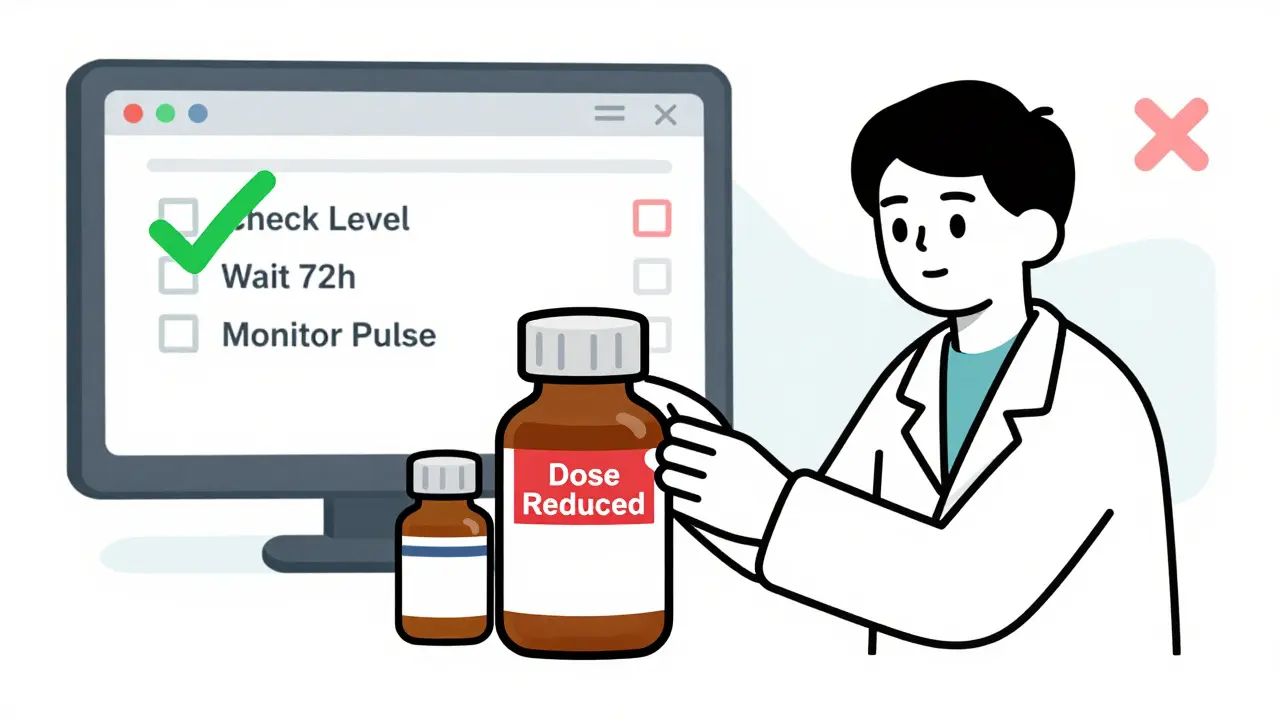
- Reduce digoxin by 50% the day you start amiodarone. This isn’t optional. It’s mandatory. For patients with poor kidney function, drop it to 33%.
- Recheck digoxin levels at 72 hours. Levels peak around 1-2 weeks, so you need to monitor again at one week and again at two weeks.
- Don’t wait for symptoms. Nausea, vomiting, yellow-green halos around lights, dizziness, or a slow pulse are late signs. By then, you’re already in danger.
Some hospitals have made this foolproof. The University of Michigan implemented a mandatory protocol: all patients starting amiodarone get an automatic dose reduction, a pharmacist review, and a repeat lab test within 72 hours. Their digoxin toxicity rate dropped from 12.3% to 2.1%.
Even better, when pharmacists lead the process, the rate of incorrect dosing falls from 58% to just 12%. This isn’t about doctor error-it’s about systems failing. The fix is simple: make the safe choice the automatic one.
What Happens If You Don’t Adjust the Dose?
The consequences aren’t theoretical. They’re deadly.
In one documented case, a 72-year-old woman with atrial fibrillation and mild kidney disease was started on full-dose digoxin (0.125 mg daily) along with amiodarone. Three days later, her potassium spiked to 6.8 mEq/L (normal is 3.5-5.0). She developed a dangerously slow heart rhythm and needed ICU care for four days. Her digoxin level? 3.1 ng/mL-more than three times the upper limit.
Another study tracked over 1,000 patients on both drugs. Those who didn’t reduce digoxin had a 38% higher risk of dying within a year. The risk of stroke also doubled. Why? High digoxin levels make your blood more likely to clot. And because amiodarone affects the heart’s electrical system, the combo can trigger new arrhythmias-even while trying to treat them.
The FDA requires a boxed warning on both drugs for this exact reason. But warnings on a label don’t save lives. Action does.
Why This Interaction Is Still a Problem
You’d think this would be a solved issue by now. But it’s not.
Despite guidelines from the American Heart Association, European Society of Cardiology, and ASHP, doctors still miss it. Why? Because amiodarone is often prescribed for urgent arrhythmias, and digoxin is seen as a “safe” old drug. Many assume it’s fine because they’ve used it for years.
But the data is clear: digoxin use has dropped 32% since 2010-not because it’s ineffective, but because the risks have become too hard to manage. When you add amiodarone, the risk skyrockets. In fact, the 2024 European guidelines now recommend avoiding digoxin altogether in patients who might need amiodarone. Beta-blockers or calcium channel blockers are safer first choices for rate control.
Still, digoxin isn’t going away. For some heart failure patients, it’s the only drug that helps. That’s why the interaction matters so much. It’s not about banning digoxin. It’s about using it safely.
What’s Changing in 2026?
The field is evolving. New studies are refining the rules.
The DIG-AMIO trial (NCT05217891), currently underway, is comparing whether reducing digoxin by 50% or 33% is safer for patients with kidney impairment. Results are expected in late 2025. Early data suggests that for those with creatinine clearance under 40 mL/min, 33% reduction may be the new standard.
Hospitals are also upgrading their systems. The Veterans Health Administration installed EHR alerts that pop up when both drugs are prescribed together. Since then, digoxin toxicity events dropped by 41%. That’s not luck. That’s technology saving lives.
And pharmacists are taking a bigger role. In many hospitals now, the pharmacist reviews every new amiodarone prescription and automatically adjusts digoxin doses before the patient even leaves the pharmacy. No waiting. No guesswork.
What You Should Do Right Now
If you’re taking digoxin and your doctor wants to start amiodarone:
- Ask: “Will I need a digoxin dose change?”
- Ask: “Can we check my digoxin level before and after you start amiodarone?”
- Ask: “What symptoms should I watch for?”
- Don’t accept: “It’s been fine for others.”
If you’re a clinician:
- Always reduce digoxin by 50% when starting amiodarone.
- Check levels at 72 hours, 1 week, and 2 weeks.
- Consider alternatives like diltiazem or metoprolol if possible.
- Use EHR alerts if your system has them.
- Involve your pharmacy team. They’re your best safety net.
This isn’t a complicated problem. It’s a neglected one. And the cost of neglect is measured in hospital stays, strokes, and deaths.
Comments (11)
Wow. This is one of those posts that makes you realize how many people are basically playing Russian roulette with their hearts. I’ve seen this happen in my own family - my uncle was on digoxin for AFib, then got amiodarone after a hospital stay, and they didn’t adjust the dose. He ended up in the ER with a heart rate of 38. They thought it was just ‘old age’ until the labs came back and his digoxin was over 3.0. They didn’t even check it before starting the new med. It’s insane. This isn’t just medical knowledge - it’s survival knowledge. Please, if you’re on either of these, demand a level check. Don’t wait for the blurry vision or the nausea. By then, it’s too late.
Typical US healthcare. Doctors don’t read. Nurses don’t double-check. Pharmacies are understaffed. This happens because no one wants to do the work. You think a warning on the label fixes this? Please. It’s the same reason people die from opioid interactions. No system. No accountability. Just blame the patient when they crash.
In India, this is even more dangerous. Many patients buy digoxin over the counter without prescription. Amiodarone is often prescribed by general practitioners who have never seen a digoxin level. I once saw a 78-year-old man with CKD on full-dose digoxin and amiodarone - he was given both by a clinic that didn’t even have a lab. No monitoring. No follow-up. He died two weeks later. This is not just an American problem - it’s a global failure of basic pharmacology education.
It’s funny how we treat digoxin like some ancient relic while treating amiodarone like a miracle drug. Both are toxic. Both require precision. But we romanticize the ‘old-school’ meds and demonize the ‘modern’ ones. The real issue? We’ve outsourced clinical judgment to algorithms and guidelines, then blame the doctors when the algorithm fails. The truth? No protocol replaces a clinician who actually thinks.
So let me get this straight - you’re telling me that in 2024, doctors are still not reducing digoxin when adding amiodarone? 😂 And you’re shocked? This is why I don’t trust the medical system. If you can’t follow a 3-step protocol for a drug that kills people, you shouldn’t be licensed. The fact that 70% of community hospitals mess this up? That’s not negligence. That’s malpractice on an industrial scale.
Okay but like… why do we still use digoxin at all? 🤔 Like, it’s literally a poison from foxglove plants. We’ve had beta-blockers, calcium channel blockers, SGLT2 inhibitors, and now GLP-1s - and we’re still letting people take a 200-year-old drug that requires a PhD to dose safely? 🙄 The fact that we haven’t phased it out completely is just… lazy medicine. Also, if your doctor doesn’t mention the 50% dose reduction, walk out. Seriously.
My cousin in Kerala was prescribed this combo, and the doctor said, 'It's fine, I've done this for 20 years.' He didn't check levels. He didn't reduce the dose. He didn't even ask about kidney function. He died in 12 days. His family didn't even know what digoxin was. This isn't just about guidelines - it's about access, education, and power. Who gets safe care? Not the poor. Not the elderly. Not the rural. We need systemic change, not just more bullet points.
Just wanted to add - the desethylamiodarone half-life is insane. I had a patient who stopped amiodarone in January and got digoxin in March. Toxicity hit at week 5. No one saw it coming because the amiodarone was ‘off’ the chart. Pharmacists need to flag this like a red alert - not just a footnote. Also, if your eGFR is under 50, you’re not getting 50% reduction - you’re getting 60-70%. And if you’re on spironolactone or NSAIDs? Double down on monitoring. This isn’t just one interaction - it’s a cascade.
I’m from a small town in Punjab. We don’t have pharmacists on rounds. We don’t have EHR alerts. We have one doctor who sees 80 patients a day. He doesn’t have time to check every lab. But he does know this interaction. He reduces digoxin by half every time. He writes it on the prescription. He tells the patient: ‘If you feel weak or see yellow lights, come back immediately.’ Simple. Human. Effective. Maybe the answer isn’t more tech - maybe it’s more respect for the doctor who still remembers to care.
So we’ve got a drug that’s been around since 1785… and another that’s basically a chemical sponge that stays in your body longer than your ex’s trauma… and we’re still surprised people die? 😒 Like… maybe we’re just not meant to mix ancient plant poisons with synthetic time bombs? Maybe the real solution is… not prescribing both? Just a thought. Also, the FDA warning is in 8pt font. That’s not a warning. That’s a dare.
So let me get this straight - you wrote a 2000-word essay on how to not kill people with two drugs… and the solution is… ask your pharmacist? 🤦♂️ That’s it? The entire medical system is built on trust - and you’re saying the only safety net is a pharmacist who might be overworked, underpaid, and not even in the room when the script is written? Cute. I’ll take my chances with the 70% error rate. At least it’s a story to tell my grandkids. ‘Back in my day, we didn’t need alerts. We had faith.’