

Proton pump inhibitors (PPIs) are powerful drugs that silence stomach acid. For many people, they’re a lifeline-relieving heartburn, healing ulcers, and stopping damage from acid reflux. But what happens when you take them for months or years? The truth is, these medications aren’t harmless. While they work incredibly well in the short term, long-term use comes with real risks that many patients-and even doctors-don’t fully understand.
How PPIs Work and Why They’re So Popular
PPIs like omeprazole, esomeprazole, and pantoprazole block the final step of acid production in your stomach. They’re not quick fixes like antacids. It takes 1 to 4 days for them to reach full strength, which is why they’re not good for sudden heartburn. But once they kick in, they’re the most effective acid reducers available. That’s why they’re prescribed for GERD, peptic ulcers, and to protect the stomach from NSAIDs like ibuprofen.
They’re also wildly popular. In the U.S., over 15 million people take prescription PPIs daily. Another 7 million buy them over the counter, often continuing far beyond the FDA’s recommended 14-day limit. Many assume they’re safe because they’re available without a prescription. But that’s a dangerous myth. The FDA has issued multiple safety warnings since 2010, and experts now agree: PPIs should be used at the lowest dose for the shortest time possible.
The Proven Long-Term Risks
Not all risks are created equal. Some are rare. Others are well-documented and affect thousands.
Fractures-especially hip fractures-are one of the clearest dangers. A 2017 study found that people who took PPIs for 4 to 8 years had up to a 55% higher risk of breaking a hip. Why? PPIs reduce stomach acid, which is needed to absorb calcium properly. Over time, this weakens bones. The good news? This risk drops back to normal within two years of stopping the drug.
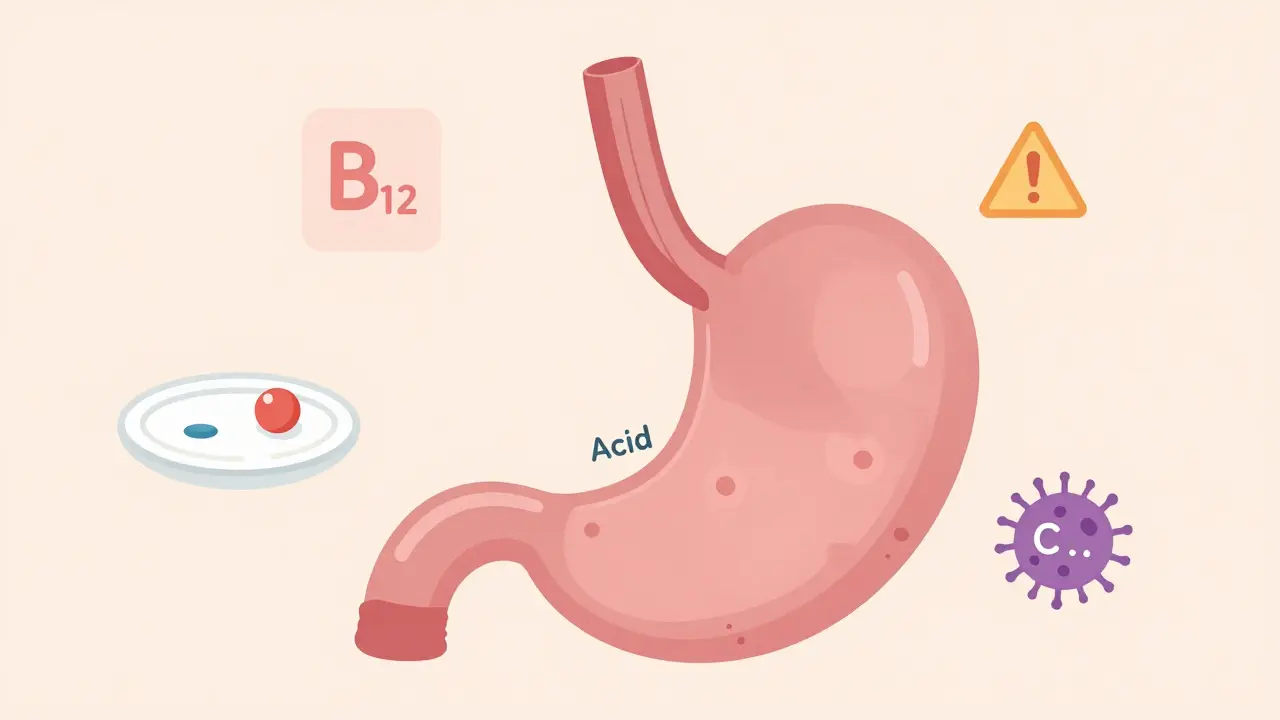
Magnesium deficiency is another confirmed risk. The FDA added this warning in 2011 and strengthened it in 2022. Long-term PPI users can develop low magnesium levels, which can cause muscle cramps, irregular heartbeat, and even seizures. It’s rare-only about 0.5% to 1% of users-but it’s serious. If you’ve been on PPIs for more than a year, your doctor should check your magnesium levels.
Vitamin B12 deficiency affects 10% to 15% of long-term users. Stomach acid helps release B12 from food. Without it, your body can’t absorb enough. Symptoms like fatigue, numbness, and memory problems can be mistaken for aging or stress. A simple blood test can catch this early.
C. difficile infection is a bacterial gut infection that causes severe diarrhea. PPIs increase your risk by 1.7 to 2 times. This is especially dangerous in hospitals or nursing homes, where the bacteria spread easily. If you develop sudden, watery diarrhea while on a PPI, tell your doctor right away.
Acute interstitial nephritis is a rare but serious kidney inflammation. The FDA flagged this in 2014. While most people recover if caught early, some go on to develop chronic kidney disease. The link isn’t fully proven, but the timing and case reports are concerning enough that doctors now watch for it.
The Controversial Risks-What the Science Really Says
Some headlines claim PPIs cause dementia, heart attacks, or stomach cancer. But the science behind those claims is shaky.
Observational studies have linked PPIs to higher rates of dementia. One 2023 paper said users had a 44% higher risk. But these studies don’t prove cause. People on long-term PPIs often have other health problems-diabetes, high blood pressure, obesity-that also raise dementia risk. When researchers adjusted for these factors, the link disappeared in higher-quality studies.
Same goes for heart disease and stroke. Early studies suggested a connection, but later, larger trials found no increased risk when controlling for other conditions. The same is true for chronic kidney disease. While acute kidney injury is real, progression to long-term kidney failure isn’t clearly tied to PPIs.
Even the fear of stomach cancer is overblown. PPIs reduce acid, which can cause the stomach to make more gastrin-a hormone that stimulates acid production. In rare cases, this leads to harmless cell growth in the stomach lining. Only one documented case exists of a tumor developing after 15+ years of use. The risk is extremely low.
Bottom line: Stick to the proven risks. Don’t panic over headlines. But don’t ignore the real dangers either.
When Should You Stop Taking PPIs?
If you’re on a PPI and don’t have a clear medical reason, it’s time to talk to your doctor. Here are the signs you might be taking it longer than needed:
- You’ve been on it for more than 8 weeks for simple heartburn
- You’re taking it daily without a diagnosis of GERD or ulcers
- You’re using over-the-counter PPIs longer than 14 days, more than once every 3 months
- You’ve been on it for over a year without a follow-up
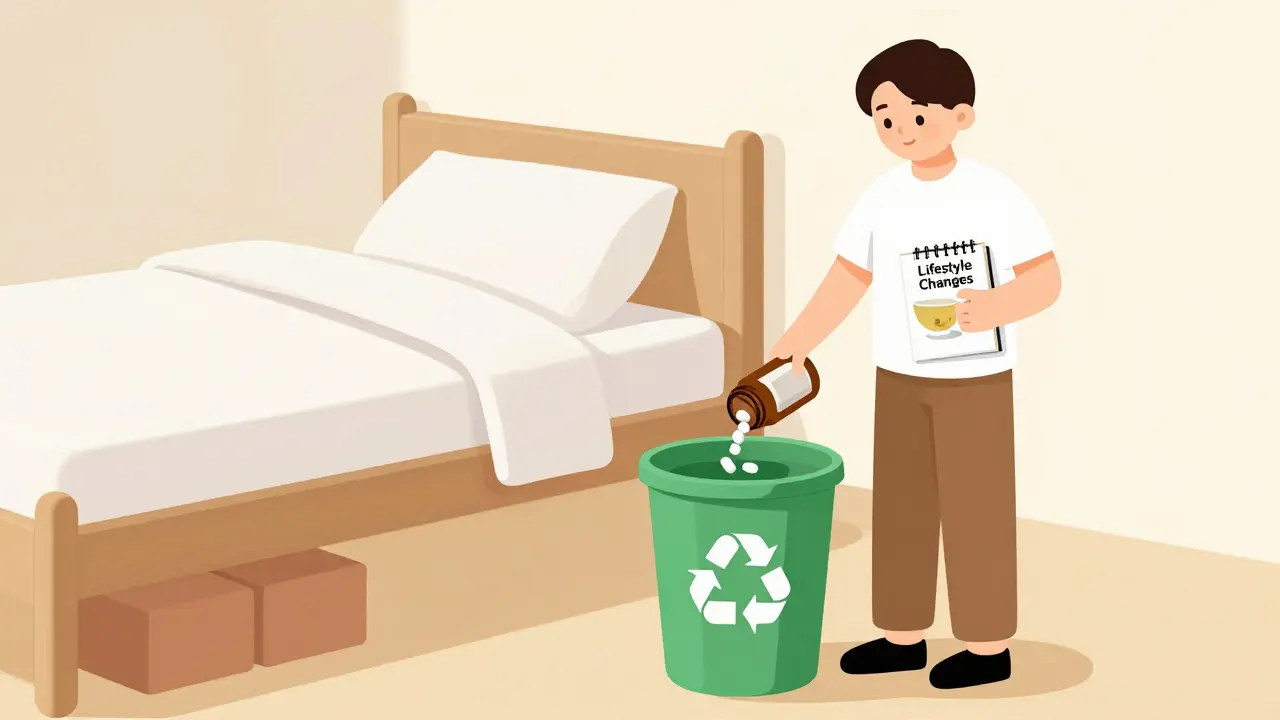
For many people, lifestyle changes work better than pills. Losing weight, avoiding late-night meals, cutting out caffeine and alcohol, and raising the head of your bed can reduce reflux significantly. H2 blockers like famotidine are also a gentler option for occasional heartburn.
But stopping PPIs isn’t as simple as just quitting. About 40% to 80% of people who stop suddenly get worse heartburn-called rebound acid hypersecretion. Your stomach overcompensates because it’s been suppressed for so long.
Here’s how to stop safely:
- Work with your doctor. Don’t quit cold turkey.
- Reduce your dose by half every 1 to 2 weeks.
- Switch to on-demand use-take it only when you have symptoms.
- Try H2 blockers like famotidine for breakthrough symptoms.
- Use antacids like Tums or Rolaids for immediate relief.
- After 4 to 6 weeks, try stopping completely. If symptoms return, you may need to stay on a low dose.
Some people need to stay on PPIs long-term-those with severe esophagitis, Barrett’s esophagus, or recurrent ulcers. For them, the benefits outweigh the risks. But even then, the dose should be the lowest possible. Annual check-ins are a must.
What to Do If You’re on a PPI Right Now
Don’t panic. But do take action.
First, ask yourself: Why am I on this? Is it for a confirmed diagnosis, or just because I had heartburn once? If it’s the latter, it’s time for a reassessment.
Second, check your pills. Are you using over-the-counter PPIs daily? That’s not what they’re for. The label says 14 days max. If you’ve been taking them longer, you need medical advice.
Third, schedule a review. Bring your full medication list to your doctor. Ask: "Is this still necessary?" "Can we try to taper off?" "Should I get my magnesium or B12 checked?"
Many people successfully stop PPIs with the right plan. Studies show 30% to 50% of long-term users can quit without symptoms returning-especially if they taper slowly and use lifestyle changes.
The Bigger Picture: Overuse Costs Lives and Money
Overprescribing PPIs isn’t just a health issue-it’s a financial one. In the U.S. alone, inappropriate PPI use costs an estimated $12 billion a year. That’s billions spent on drugs that aren’t needed, plus extra visits, tests, and hospitalizations for side effects.
Why does this happen? Doctors sometimes prescribe them "just in case." Patients demand them because they’re easy fixes. Pharmacies sell them like candy. And the belief that they’re harmless? That’s the biggest problem of all.
PPIs are not vitamins. They’re powerful drugs with real consequences. They should be used like antibiotics-only when needed, for as short a time as possible.
What’s Next? New Drugs on the Horizon
Researchers are developing alternatives. Potassium-competitive acid blockers (P-CABs) like vonoprazan work faster and may have fewer long-term side effects. They’re already used in Japan and are under review in the U.S. and Europe. But long-term safety data is still limited. For now, PPIs remain the gold standard-when used correctly.
The message is simple: PPIs save lives when used properly. But they can harm when used carelessly. If you’ve been on them for more than a few months, it’s time to have a conversation-with your doctor, not your pharmacist or Google.
Comments (15)
I’ve been on PPIs for 7 years because my GERD was brutal-thought I’d never sleep again. Last year, I tapered off slowly with H2 blockers and lifestyle tweaks. No more midnight acid burns, no more bone scans. I lost 30 pounds, stopped eating after 7 PM, and raised my bed 6 inches. It’s not magic, but it works. Don’t panic, but don’t ignore it either. Your stomach isn’t a broken faucet.
As a board-certified gastroenterologist, I can confirm that the risks outlined in this post are clinically accurate. PPI overuse is a systemic issue in primary care. I routinely deprescribe these medications in patients with no documented indication, and over 60% of them remain symptom-free after 12 weeks of non-pharmacological management. Always prioritize lifestyle modification before maintenance therapy.
So let me get this straight-you’re telling me that people who take a pill for heartburn are now responsible for preventing fractures, B12 deficiency, and C. diff? What’s next? Should we ban aspirin because it causes tinnitus? This is fearmongering dressed up as medical advice. If you’re worried about side effects, don’t take the drug. But don’t guilt-trip millions of people who actually need it. The real problem is lazy doctors prescribing blindly, not the medication itself.
Actually, the 55% hip fracture risk is misleading. That’s relative risk. Absolute risk? Like 0.2% to 0.3% per year for someone over 65. And magnesium deficiency? You’d have to be on PPIs for 5+ years without a single blood test. Also, the FDA warning on acute interstitial nephritis? Less than 1 in 10,000 cases. Meanwhile, uncontrolled GERD can lead to Barrett’s esophagus-which *does* turn into cancer. So yes, PPIs have risks, but so does ignoring reflux. Context matters.
If you’re taking PPIs over the counter for more than 14 days, you’re not just being irresponsible-you’re being selfish. You’re not just risking your own kidneys and bones; you’re contributing to the $12 billion waste in our broken healthcare system. This isn’t about convenience. It’s about accountability. If you can’t manage heartburn with diet and sleep posture, then you’re not trying hard enough. Stop treating your body like a vending machine.
OMG I JUST REALIZED I’VE BEEN ON OMEPRAZOLE SINCE 2019 😱 I thought it was just ‘for my digestion’ but now I’m terrified I’m gonna have a seizure from low Mg or get C. diff in my sleep. I’m booking a doc appt tomorrow. Also-anyone know if Tums count as antacids? I’ve been eating them like candy. 🤯💊 #PPIWakeUpCall
My aunt in Delhi took PPIs for 10 years and now she has osteoporosis. She didn’t even know it was linked. In India, people buy these pills from street pharmacies like candy. No prescription. No education. No follow-up. This isn’t just a Western problem-it’s a global crisis of medical illiteracy. Doctors need to stop prescribing like it’s candy and start teaching patients how to eat.
i’ve been off ppi for 8 months now and honestly? best sleep of my life. switched to famotidine on days i eat spicy food, lost 20 lbs, stopped drinking soda. my doc said my b12 was low but i fixed it with supplements. honestly? it’s not that hard. just don’t be lazy. and yes, rebound acid sucks at first but it fades. trust me.
What we’re really discussing here isn’t just pharmacology-it’s our relationship with control. We want a pill to fix discomfort, to erase the inconvenient signals our bodies send. But PPIs don’t heal reflux; they mask it. And in doing so, we forget to ask: Why is my stomach rebelling? Is it stress? Is it food? Is it time? The real cure isn’t in the bottle-it’s in the pause before the next bite.
Y’ALL. I was a PPI zombie. Daily. For 6 years. Then I started yoga, stopped eating pizza at midnight, and started walking after dinner. I also switched to H2 blockers only when I felt it coming. I didn’t just stop the acid-I stopped the panic. I feel like a new person. No more brain fog. No more fatigue. And my bones? Stronger than ever. You can do this. You’re not broken. You just need to listen. And yes, the first week without PPIs sucked. But the second week? Pure freedom. 🙌
Let’s be real-this whole post is just another liberal scare tactic. In America, we’re told every pill is poison. Meanwhile, other countries use these drugs safely for decades. Why are we so obsessed with fear? Maybe the real problem is that people are too weak to handle a little heartburn. Stop blaming the medicine. Start blaming the culture of weakness.
Bro I took PPIs for 3 years and then just quit cold turkey. Woke up the next day like I was swallowing lava. Cried for 2 hours. Thought I was dying. Ended up in the ER. Don’t be a hero. Taper. Use Tums. Drink water. This ain’t a meme. Your esophagus ain’t made of steel.
Why do people think PPIs are harmless just because they’re OTC? It’s like saying ‘I’m not an alcoholic because I drink wine every night.’ If you need it daily, you’re dependent. And if your doctor didn’t warn you? Find a new one. Seriously. This isn’t a lifestyle choice. It’s medical negligence.
To everyone who’s thinking about stopping: You’re not alone. I helped over 200 patients taper off PPIs last year. Most were terrified. All succeeded-with patience. I always say: ‘Your body remembers how to make acid. It just needs time to recalibrate.’ Don’t rush. Don’t quit cold turkey. Use the steps in the post. And if you slip up? It’s okay. Just try again tomorrow. You’ve got this.
Actually, the whole ‘PPIs cause B12 deficiency’ claim ignores the fact that many long-term users are elderly, vegan, or have pernicious anemia. Correlation ≠ causation. And the ‘$12 billion waste’? That number includes prescriptions for Barrett’s esophagus and Zollinger-Ellison syndrome-conditions that require lifelong PPIs. This post reads like an anti-pharma pamphlet, not science. Stop oversimplifying complex biology.