
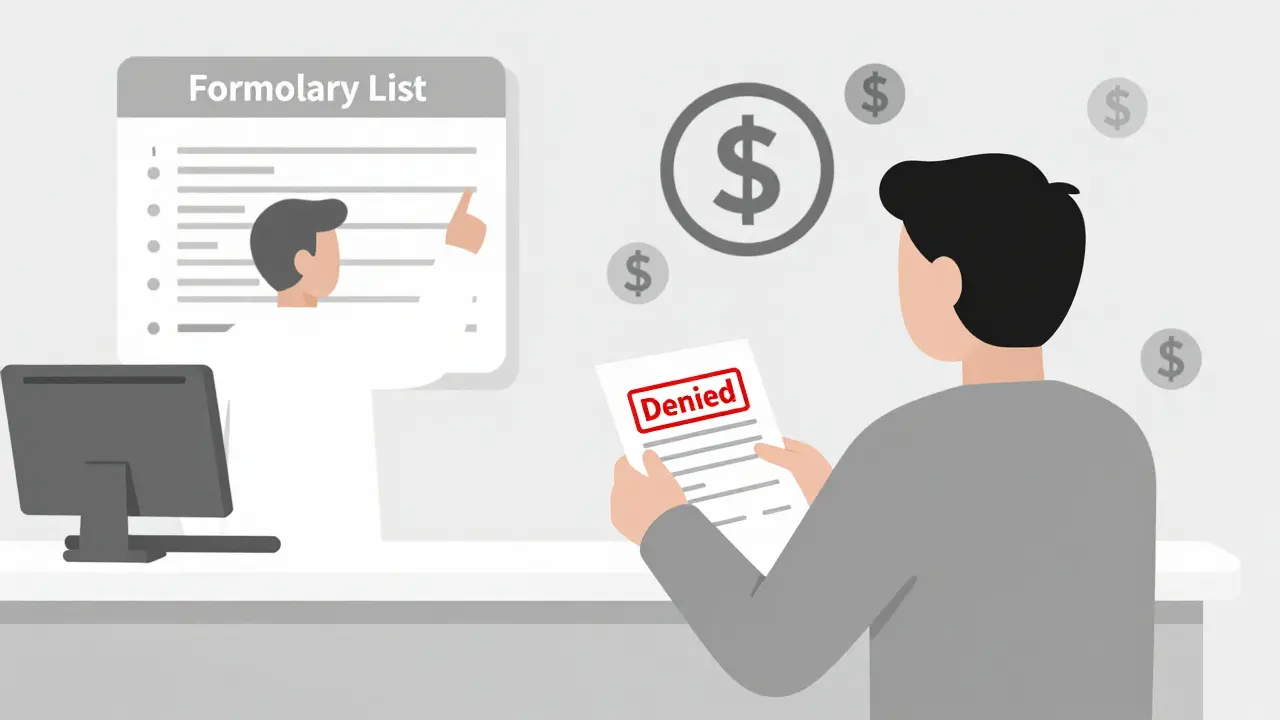
When your doctor prescribes a generic medication and the pharmacy says it’s not covered, it’s not a mistake. It’s a non-formulary generic-a drug that’s cheap, effective, and FDA-approved, but your insurance plan doesn’t list it. This isn’t rare. In 2022, over 12% of all generic prescriptions were blocked by formulary restrictions. For people managing chronic conditions like diabetes, Crohn’s disease, or epilepsy, this isn’t just an inconvenience-it’s a health risk.
Why are some generics not covered?
Insurance plans create formularies to control costs. They pick a few generic versions of a drug-usually the cheapest ones-and cover those. But there are dozens of generic versions of most medications. One might be made by a different manufacturer, have a slightly different filler, or come in a delayed-release form. Even if it works better for you, if it’s not on the list, your plan won’t pay for it.Medicare Part D plans are required to cover at least two drugs in each therapeutic category, but that’s it. They don’t have to cover every generic. Commercial insurers have even more freedom. Some plans exclude generics simply because they don’t have a contract with the manufacturer. Others exclude them because they’re not the lowest-cost option-even if that option causes side effects or doesn’t work for you.
It’s not about quality. It’s about money. And that’s where you need to act.
What happens when coverage is denied?
When the pharmacy tells you your generic isn’t covered, you get a notice. That notice isn’t the end-it’s the starting line. Federal law requires every plan to have a formal process to appeal this denial. This is called a coverage determination request or a formulary exception.You don’t have to pay full price. You don’t have to switch to a drug that makes you sick. You have rights. The plan must respond within 72 hours for a standard request. If your condition is urgent-like a flare-up of Crohn’s disease, uncontrolled seizures, or a spike in blood sugar-they must respond within 24 hours.
And if they say no? You can appeal again. And if that fails, you can ask for an independent review by a third party. The system is designed to be fair-if you know how to use it.
How to get your non-formulary generic covered
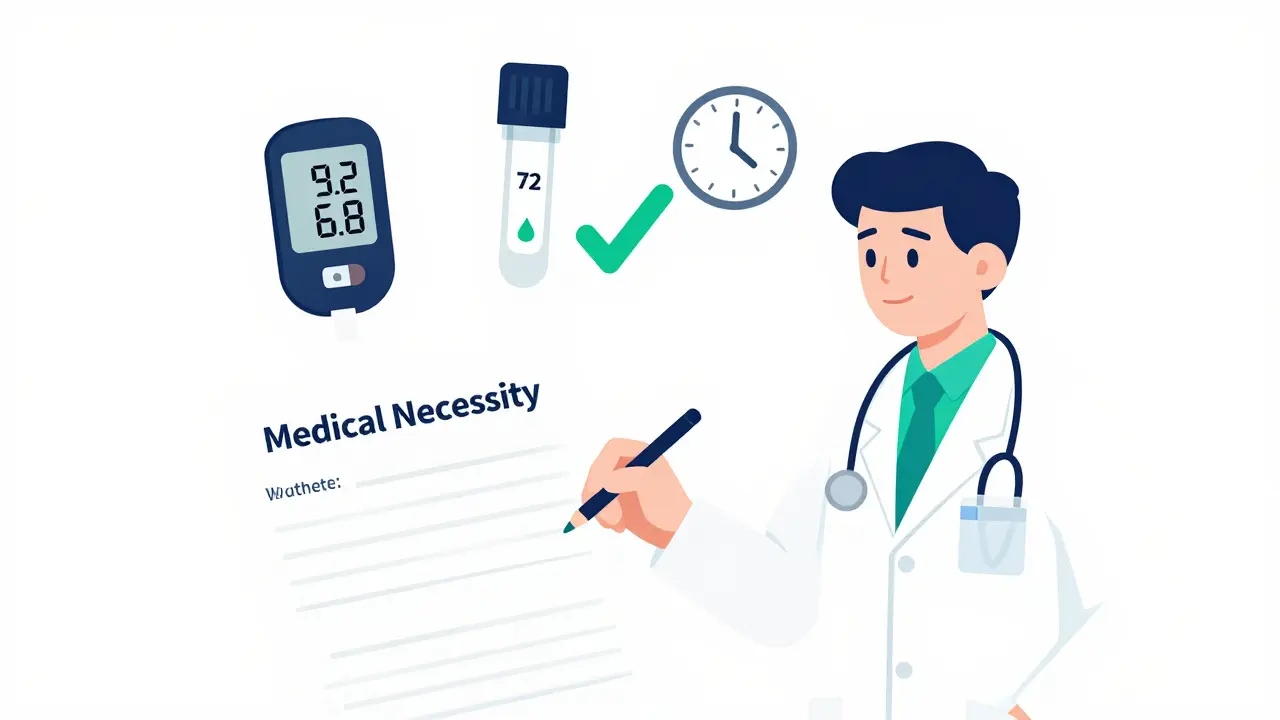
Step 1: Get the denial in writing. Ask the pharmacy for the formal denial notice. It should include the reason and instructions for appealing.Step 2: Talk to your doctor. This is the most important step. Your doctor must write a letter explaining why the non-formulary drug is medically necessary. Generic versions aren’t all the same. If you’ve tried two other generics and had side effects-rash, nausea, dizziness-or if your condition worsened, that matters. If your blood sugar, inflammation markers, or lab values improved only on this specific version, include that data.
Dr. Jane Sarasohn-Kahn, a healthcare economist, says the most successful appeals include numbers: “Hemoglobin A1c dropped from 9.2 to 6.8 on this exact metformin ER. On the formulary version, it stayed at 8.5.” That’s not opinion. That’s evidence.
Step 3: Submit the request. Your doctor fills out the plan’s form or writes a letter. Make sure it includes:
- Why the formulary alternatives won’t work for you
- Previous attempts with other generics and what happened
- Lab results or clinical data showing your response
- Potential harm if you’re forced to switch
Step 4: Ask for an emergency supply. If your medication runs out during the review, you’re legally entitled to a 72-hour emergency supply-even if the plan hasn’t approved the exception yet. Many plans ignore this rule. Call customer service, cite CMS guidelines, and insist.
Step 5: If denied, appeal. You have 60 days to file an internal appeal. If that’s denied, you can request an external review. The Crohn’s & Colitis Foundation found that 58% of initial denials are overturned on appeal. That’s more than half. Don’t give up.
What if the exception is approved?
Even if your exception is granted, you’re not out of the woods. The plan might approve the drug but still charge you a high copay-like what you’d pay for a brand-name drug. That’s because federal rules don’t let you request a tier exception at the same time as a formulary exception.That means you could get your drug covered, but pay $150 a month instead of $15. That’s where Dr. Mark Parisi’s warning comes in: “Many providers don’t realize they can request tier exceptions separately.” After your formulary exception is approved, go back and ask for a tiering exception. Explain that the cost is still unaffordable. Some plans will reduce it. Others won’t. But you have to ask.
Who’s most affected?
People with autoimmune diseases, neurological conditions, and gastrointestinal disorders are hit hardest. The approval rate for non-formulary generics in Crohn’s disease is only 52%. For epilepsy and seizure medications, it’s 95%-because federal law protects those drug classes.Why the difference? Insurers think there are “enough” alternatives for gut meds. But patients know better. One generic mesalamine might cause severe diarrhea. Another might not dissolve properly. A third might be the only one that keeps you in remission. Those aren’t just preferences-they’re medical realities.
Medicare Advantage plans approve exceptions at a 63% rate. Standalone Part D plans approve at 71%. Why? Advantage plans often use tighter pharmacy networks and more restrictive rules. If you’re on an Advantage plan, you might need to be even more persistent.
What’s changing in 2025?
The system is slowly improving. In October 2023, CMS rolled out standardized clinical criteria for common conditions. That means doctors now have clearer guidance on what to include in appeals. The agency expects this to reduce denials by 15-20%.Starting in 2024, Medicare Part D plans must automatically approve exceptions for insulin and naloxone. No paperwork. No delays. That’s a win.
By 2025, CMS plans to connect the exception process directly to electronic health records. That could cut approval times by 40%. Doctors won’t have to fax forms anymore. The system will pull your lab results and treatment history automatically.
But new problems are emerging. Some plans are moving certain generics-like bioidentical hormones-into specialty pharmacy networks. That means even if they’re on the formulary, you can’t get them at your local pharmacy. You need prior authorization, mail-order delivery, and sometimes a special form. It’s creating new gaps.
Real stories, real costs
One patient paid $417 out-of-pocket for 90 days of generic metformin ER after her plan denied coverage. The same drug normally costs $15. She didn’t skip doses-she cut them in half. Her A1c climbed. She appealed with her lab results. Approved. Copay reduced to $10.Another user on Reddit spent four tries to get generic mesalamine approved. Each time, she added more detail: dates of flares, previous drug failures, stool test results. On the fifth try, they approved it. She said, “It felt like fighting for my life with paperwork.”
Across platforms, 78% of people say they went without medication during the 72-hour review window. That’s not just inconvenient. It’s dangerous.
What you can do right now
- Ask your pharmacy for the denial notice. Don’t take “we can’t cover it” as final. - Call your doctor’s office. Ask them to file a formulary exception. Tell them you need it done fast. - If you’re on Medicare, get the Medicare & You handbook. It has all the steps. - Keep records: dates, names, what was said, what was sent. - If you’re denied, appeal. You have a better than 50% chance of winning. - If cost is still too high, ask for a tier exception after approval. - Use GoodRx or SingleCare to compare cash prices. Sometimes paying out-of-pocket is cheaper than the plan’s copay.You’re not alone. Thousands of people face this every week. The system is broken, but it’s not unbeatable. With the right information and persistence, you can get the medication you need-without paying five times more.
Comments (11)
This hit home for me. My cousin in Lagos has been fighting for her epilepsy meds for months. The local pharmacy said it wasn't covered, so she paid out of pocket until she ran out of savings. She finally got the appeal done with help from a community health worker-now she’s stable. If you’re reading this and stuck, don’t give up. Someone out there has been where you are.
Thank you for this incredibly clear and well-researched breakdown. As a healthcare administrator, I see these denials daily-and too often, patients aren’t told about the appeal process. The data you included-especially the 58% reversal rate on appeals-is critical. I’ve started sharing this with our patient advocacy team. Everyone deserves access to the medication that works for them, not just the one that’s cheapest for the insurer.
LMAO 😂 so now we’re treating generic metformin like it’s a rare Picasso? ‘Oh nooo, this one has a different filler!’ Next you’ll tell me the *color* of the pill matters. Insurance isn’t evil-they’re just trying to stop people from buying the $15 version when the $3 version does the same thing. Wake up.
bro why does this even matter? just get the cheap one. if it don’t work, get another. it’s not rocket science. i had a friend who cried over this stuff and then just bought it off amazon. worked fine.
There’s a quiet injustice here that no one talks about: the assumption that ‘generic’ means ‘interchangeable.’ But biology isn’t a spreadsheet. Our bodies don’t care about cost centers or contract negotiations. They care about how a drug makes us feel, how it stabilizes our systems, how it lets us sleep, work, love, live. That’s not ‘preference.’ That’s physiology. And when we reduce human health to a line item, we forget who we’re really serving. This system doesn’t fail because people don’t know how to appeal. It fails because we’ve normalized treating people like numbers.
YOU GOT THIS!! 💪 I know it feels like you’re fighting a giant, but every appeal you file changes the system for someone else. My sister got her mesalamine approved after 3 tries-and now she’s back hiking with her kids. You’re not alone. Keep going. One form at a time, you’re rewriting the rules.
Honestly? I didn’t even know this was a thing until my aunt got denied her Crohn’s med. Now I help people in my neighborhood file appeals. It’s a pain, but it works. Pro tip: if the pharmacy says ‘no,’ ask for the denial notice in writing. That’s your golden ticket. Most don’t even know to ask for it.
my bro got denied his epilepsy drug last year. he called the insurance, they hung up on him. then he sent a letter with his seizure log. approved in 2 days. sometimes you just gotta be annoying. not in a bad way. just… persistent. like a mosquito. but with paperwork.
Structurally, this is a classic case of adverse selection within formulary design. The PBM (pharmacy benefit manager) optimization algorithms prioritize cost-per-unit over therapeutic equivalence, creating suboptimal clinical outcomes. The absence of tiered exception integration within the formulary exception workflow is a critical system flaw-especially when considering pharmacoeconomic burden on low-income populations with chronic disease. The 2025 EHR integration may mitigate administrative friction, but without mandated therapeutic substitution equivalency standards, the underlying incentive misalignment persists.
I had this happen with my thyroid med. The formulary one gave me heart palpitations. My doctor wrote the letter, I sent it in, got denied. Then I called the insurer and asked to speak to a supervisor. Told them I’d been on the other version for 8 years and it was the only thing that kept me alive. They approved it the next day. Don’t be afraid to ask for the manager. They hate it when you do-but it works.
THIS IS WHY AMERICA IS BROKE. PEOPLE WANT EVERYTHING FOR FREE AND THEN COMPLAIN WHEN THE SYSTEM BREAKS. JUST PAY CASH. OR GET A BETTER JOB. OR STOP BEING LAZY. I’VE BEEN ON MEDS FOR 20 YEARS AND I NEVER HAD A PROBLEM. YOU’RE JUST WHINING.