
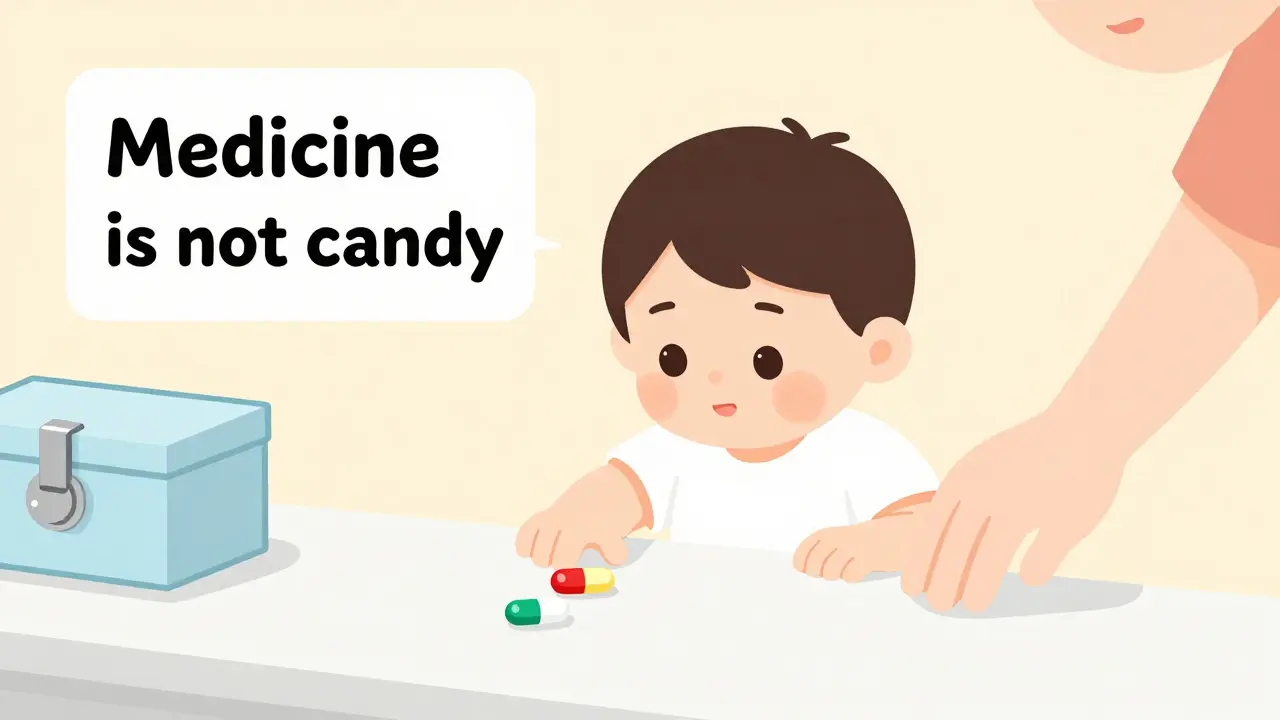
Every year, 50,000 children under five end up in emergency rooms because they accidentally swallowed medicine they shouldn’t have. Many of these cases happen at home-on a nightstand, in a purse, or even on the kitchen counter. Some kids think pills look like candy. Others see their parents taking medicine and copy them without understanding the danger. This isn’t just a scary statistic-it’s a preventable problem. Teaching children about medication safety isn’t about scaring them. It’s about giving them clear, simple rules they can live by-both at home and at school.
Why Kids Mistake Medicine for Candy
It’s easy to assume kids know the difference between medicine and candy. But think about how many medicines are brightly colored, sweet-tasting, or shaped like animals or stars. Liquid antibiotics come in cherry or grape flavors. Chewable vitamins look like gummies. Even some prescription pills are designed to be easy for adults to swallow, not to warn children away. A 2021 FDA study found that 78% of children aged two to three copied an adult taking medicine within just 60 seconds. That’s not curiosity-it’s imitation. And when adults say things like, “This will taste better than candy,” or “It’s like a treat,” they’re creating dangerous associations. The American Academy of Pediatrics warns: never call medicine candy. That phrase alone increases the risk of accidental ingestion by 220%, according to data from the Rocky Mountain Poison and Drug Center. The fix isn’t complicated. Say it plainly: “Medicine is not candy.” Repeat it every time you give a pill. Use the same words at home, in the car, at the doctor’s office. Consistency builds understanding.What Kids Should Know by Age
Children learn differently at every stage. There’s no one-size-fits-all lesson. Instead, match the message to their development.- Ages 3-4: Teach them to give any found pill to a grown-up-no tasting, no playing. Use role-play: “What if you find a red pill on the floor?” Practice saying, “I’ll give this to Mommy or Daddy.”
- Age 5: Help them personalize their medicine bottles with stickers or labels. Show them how to read their own name on the bottle. Explain that all medicines must be kept out of reach-even if they’re “just vitamins.”
- Age 6: Let them help read the label with you. Ask, “What’s this medicine for?” and “When do we take it?” Start using a calendar or chart to track doses. Let them ask the doctor simple questions like, “Will this make me sleepy?”
- Age 7: They can now understand school rules. Teach them to never take medicine from another child, even if it’s “just a headache pill.” Show them how to check the label against what the teacher or parent told them.
- Age 8: They should know their own weight. Dosing is based on pounds or kilograms. Using a household spoon can lead to 40-98% dosing error. Show them the correct tool: an oral syringe with clear markings.
Home Safety: Storage Is Everything
You can teach your child all the right things, but if the medicine is within reach, it doesn’t matter. The CDC says 67% of poisonings in children aged one to four could be prevented with proper storage. Forget “child-resistant” caps. They’re not foolproof. A 2023 CDC report found that only 29% of parents who rely on those caps store medicine safely. But when they use a locked box? That number jumps to 86%. Here’s what works:- Keep all medicines-prescription, over-the-counter, vitamins-in a locked box or cabinet, out of sight and reach.
- Never leave pills on a nightstand, bathroom counter, or in a purse.
- Use a lockbox that meets ASTM F2057-22 safety standards. Many pharmacies give them out for free.
- Store medicines separately from food and snacks. Don’t put them in the same drawer as cereal bars or gummies.
- Always put medicine away immediately after use. Don’t leave it on the table while you answer the door.
Schools and Medication: Rules Matter
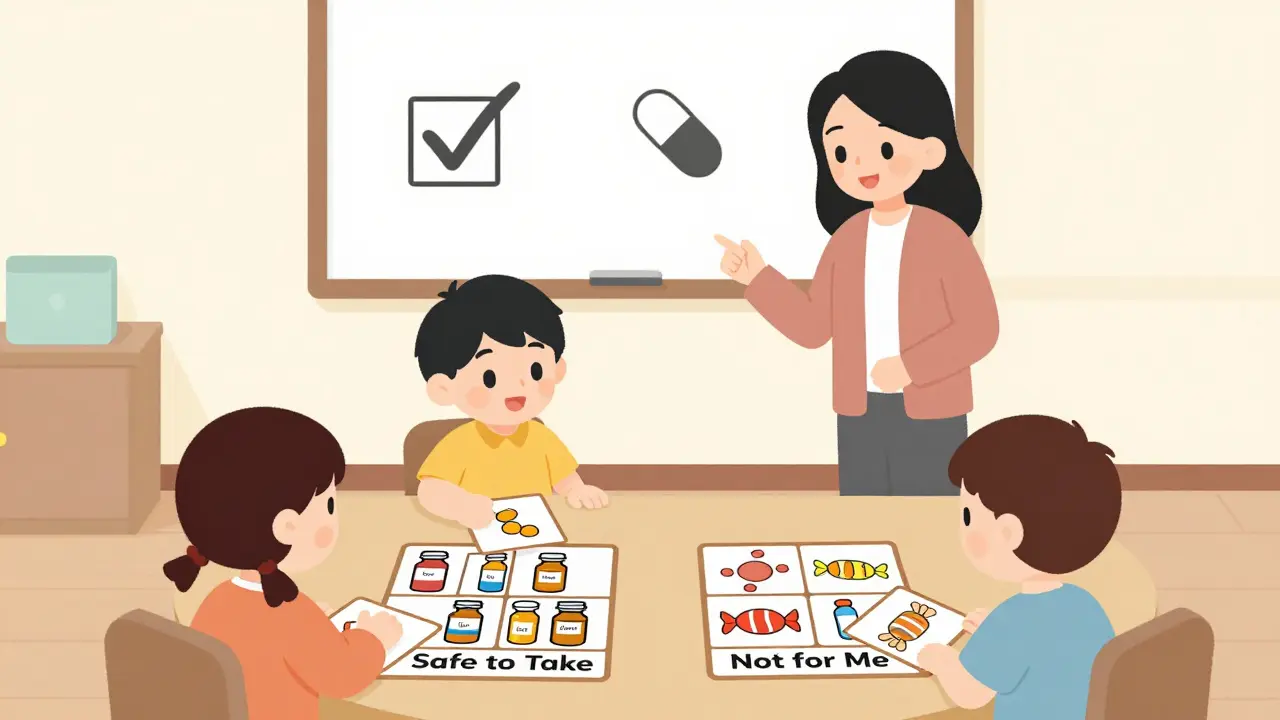
Schools are where kids spend most of their day-and where mistakes happen. In Head Start programs, 32% of medication errors occur during transitions between classrooms or caregivers. Federal rules require all Head Start centers to train staff in 12 specific competencies, including:- Getting written permission from parents before giving any medicine
- Labeling every bottle with the child’s full name and birthdate
- Logging every dose given-time, amount, who gave it
- Recognizing signs of allergic reactions or side effects
- Identify medicine versus candy using real (non-toxic) examples
- Role-play what to do if they see someone else taking medicine
- Understand that medicine is only for the person it’s labeled for
Tools That Make a Difference
You don’t need fancy gear. But a few simple tools can stop a tragedy.- Oral syringes: Never use a teaspoon or tablespoon. These vary too much. Syringes with clear markings are accurate and easy to use. Get them free from your pharmacy.
- Medication lock boxes: Look for the ASTM F2057-22 stamp. They cost under $20 and can be mounted on a wall or hidden in a closet.
- Poison Help number: Save 800-222-1222 in every phone in your house. Program it into your landline, your cell, your tablet. Post it on the fridge. This number connects you to poison control in under 10 seconds. 91% of calls about child poisonings happen within an hour of ingestion. Speed saves lives.
What’s Missing: The Gap Between 10 and 16
Most programs stop at age 10. But the real danger doesn’t end there. Prescription misuse peaks at age 16. Teens are taking leftover painkillers, ADHD meds, or anxiety pills they find at home-sometimes to cope with stress, sometimes to fit in. Experts like Dr. Stephen Wallace point out: we’re teaching kids to avoid pills, but not how to handle them responsibly as they grow older. That’s a gap. Schools need to add age-appropriate lessons for middle schoolers: how to ask questions about prescriptions, how to safely store medicine at home, how to say no to peers. The CDC is starting to address this. In 2024, they’re expanding the PROTECT Initiative to include teen-focused school programs. But parents can’t wait. Talk to your 12- to 16-year-old. Ask: “Do you know where the painkillers are kept?” “What would you do if a friend asked you for one?”What Works: Real Stories, Real Results
One mother in Melbourne told her 4-year-old that medicine was “like a special key that only opens your body’s sick lock.” Every time she gave medicine, she said it out loud. Within weeks, the child started handing her pills they found on the floor. No questions. No hesitation. A kindergarten teacher in a rural district used free printable cards from Generation Rx to make a “Medicine Detective” game. Kids sorted pictures into “Safe to Take” and “Not for Me” piles. At the end of the year, 92% of her students could name three safe storage rules. These aren’t magic tricks. They’re simple, repeated, consistent messages. Kids remember what they hear often. They follow what they understand.Next Steps: What to Do Today
You don’t need a perfect plan. Start small. Pick one thing to change today.- Find all medicines in your house. Put them in a locked box.
- Throw out expired or unused pills at a pharmacy drop-off (don’t flush them).
- Practice the phrase: “Medicine is not candy.” Say it out loud with your child.
- Call your child’s school. Ask: “Do you have a medication safety program? Can I see the materials?”
- Save 800-222-1222 on your phone. Tell your child what it is.
At what age should I start teaching my child about medicine safety?
Start as early as age 3. Even toddlers can learn to give found pills to an adult and understand that medicine is not candy. Use simple phrases, role-play, and repetition. The key isn’t complex explanations-it’s consistent, clear messages.
Is it safe to store medicine in a child-resistant cap?
No. Child-resistant caps are designed to slow down curious toddlers, not stop them. Studies show that 71% of children under 5 can open them within minutes. Always store medicine in a locked box, even if the bottle has a child-resistant cap. The cap is a backup-not the main safety measure.
What should I do if my child swallows medicine by accident?
Call Poison Help immediately at 800-222-1222. Don’t wait for symptoms. Don’t try to make them vomit. Don’t give them milk or food unless instructed. Have the medicine bottle ready when you call-this helps poison control give you the right advice fast. Most poisonings are treatable if help is called quickly.
Can my child’s school give them medicine without my permission?
No. Federal rules require written permission from a parent or guardian for any medicine given at school-even over-the-counter pills like ibuprofen. Schools must also log the time, dose, and who gave it. If your child’s school says they can give medicine without paperwork, ask to see their policy. This is a legal requirement, not a suggestion.
Why can’t I use a teaspoon to measure my child’s medicine?
Household spoons vary too much. A teaspoon from your kitchen might hold 3-6 milliliters. The correct dose could be 5. That 1-3 mL difference can be dangerous, especially for young children. Always use the oral syringe that comes with the medicine or get one free from your pharmacy. It has clear markings and ensures accuracy.
Are flavored liquid medicines more dangerous for kids?
Yes. Bright colors and sweet flavors make liquid medicines look and taste like juice or candy. Since 2020, liquid medication exposures in children under 5 have increased by 45%. Experts are now pushing manufacturers to add bitterants to make these medicines taste unpleasant. In the meantime, always store liquids in locked cabinets and never leave them out on counters.
What if my child’s grandparents don’t follow safety rules?
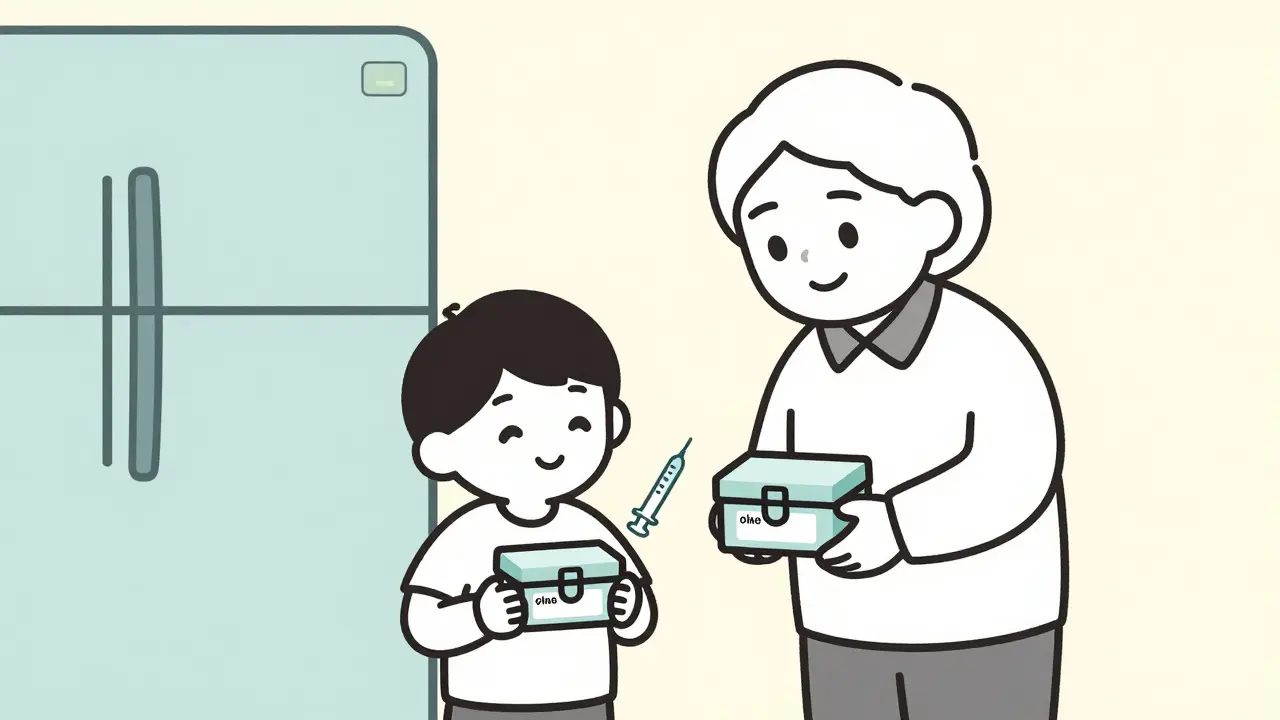
Give them a small, portable lockbox. Explain that it’s not about distrust-it’s about safety. Many grandparents don’t realize how easy it is for kids to find medicine in purses or suitcases. A $15 lockbox is a gift that protects your child every time they visit. You can even buy one with their name on it to make it personal.
How can I help my child’s school improve medication safety?
Ask if they use Generation Rx’s curriculum or similar programs. Offer to help bring in free materials from their website. Suggest a short parent workshop on safe storage. Many schools want to do more but lack resources. Your involvement can make a real difference.
Comments (14)
Medicine is not candy. Such a simple phrase, but it’s so rarely said with consistency. I’ve seen grandparents hand out liquid antibiotics like juice boxes at family gatherings. No wonder kids reach for them. The FDA data on imitation is terrifying-78% of toddlers copy adults within a minute. That’s not curiosity, that’s programming. We need to treat this like fire safety: teach it early, repeat it often, and never assume they ‘just know.’
Also, the part about flavored liquids increasing exposures by 45% since 2020? That’s not an accident. That’s a design flaw we’ve ignored for too long. Why not mandate bitterants universally? It’s not about taste-it’s about survival.
So we’re teaching kids medicine isn’t candy but we still let Big Pharma make it taste like grape soda and package it like Skittles. Classic capitalist hypocrisy. The real problem isn’t the kids it’s the industry that profits off preventable ER visits. Why aren’t we suing them? Why aren’t we banning flavoring entirely? Because regulations are written by lobbyists who have kids on their insurance plans. We’re all just pawns in a game where safety is a cost center.
Also child resistant caps are a joke. I opened one with my teeth. I’m not even a toddler.
Statistically significant data presented. But no mention of cultural differences. In India we don’t lock medicine. We keep it on the shelf. Kids learn by watching. If you’re worried about ingestion maybe stop giving medicine at all. Or at least stop making it sweet. Problem solved.
There’s something deeply human about this issue. We’re not just talking about storage or labeling-we’re talking about how we teach trust. Kids don’t learn from warnings. They learn from rhythm. The same phrase, said the same way, every single time. That’s how neural pathways form.
And the fact that 79% of grandparents don’t follow safety rules? That’s not negligence. That’s cultural dissonance. They grew up in a world where medicine was scarce. Now it’s everywhere. They don’t see the danger because they never had to fear it before.
Give them a lockbox with their name on it. Make it feel like a gift, not a lecture. That’s how change happens-not through data, but through dignity.
Just put everything in a locked box. Done. No drama. No lectures. Just lock it. My kid’s never touched a pill because he’s never seen one out in the open. Simple beats smart every time.
Think about it-the entire framework of modern parenting is built on the assumption that children are passive recipients of rules. But what if they’re not? What if they’re natural detectives? The ‘Medicine Detective’ game in that kindergarten classroom? That’s genius. It flips the script. Instead of saying ‘don’t touch,’ you say ‘figure it out.’ Kids don’t rebel against rules they helped decode. They become the guardians of them.
And the fact that 89% of those kids could tell medicine from candy? That’s not education. That’s empowerment. We’ve been treating kids like liabilities. What if we treated them like allies? The real tragedy isn’t the ER visits-it’s that we keep underestimating their capacity to understand.
This is the kind of post that makes you pause and reevaluate everything. I had no idea that using a teaspoon could cause a 98% dosing error. I’ve been doing it wrong for years. Just ordered an oral syringe from my pharmacy-free, by the way. Also saved 800-222-1222 on my phone and told my 5-year-old what it is. She said, ‘So if I find a purple pill, I call that number?’ Yep. That’s the plan.
Also, the part about grandparents? I’m sending my mom a lockbox tomorrow. No guilt. No shame. Just love. She’s going to thank me later.
Okay but what if the lockbox is hacked? 😳 What if the government is secretly using medicine to track kids? I read on a forum that the FDA added microchips to pills in 2022 for ‘safety monitoring.’ That’s why they’re making them taste like candy-to get kids used to it. And don’t even get me started on the school programs. Who’s training the teachers? Are they vetted? What if one of them is a sleeper agent for Big Pharma? 🤔 I’m not paranoid. I’m PREPARED. #MedicineIsASurveillanceTool
I’m from India and we don’t lock medicine. But I’ve started saying ‘medicine is not candy’ every time I take a pill in front of my niece. She’s 4. She now hands me any pill she finds. No questions. Just gives it. I cried. It’s not about fear. It’s about rhythm. Same words. Same tone. Same moment. That’s the magic. 💛
Westerners overcomplicate everything. In my village, we never had medicine locked. Kids learned fast: if you eat something not given by parent, you get slapped. Simple. Effective. No lockboxes. No charts. No apps. Just discipline. Maybe America needs less talk and more discipline.
There’s a quiet power in the phrase ‘medicine is not candy.’ It’s not a command. It’s a boundary. And boundaries, when spoken with calm consistency, become internalized. I work with kids in foster care. Many have never had a stable routine. But when we say that phrase every time we hand out a pill-no matter how rushed-we’re giving them something deeper than safety. We’re giving them predictability. And for kids who’ve known chaos? That’s everything.
Wait so the FDA says 78% of toddlers copy adults? That can’t be right. I think they meant 7.8%. Typo. Also my kid took a vitamin and I didn’t panic because it was just a vitamin. Why are we acting like every pill is cyanide? Overreacting much?
What’s interesting is how this mirrors other areas of child development. We teach kids not to touch fire, not because we explain combustion, but because we say ‘hot’ and remove them from it. We teach ‘don’t run into the street’ with tone and repetition, not lectures. Why is medicine different? Maybe we over-intellectualize it. Maybe the answer isn’t more data-it’s more presence.
Every time you give a pill, be there. Say the words. Put it away. Make it a ritual. That’s the real safety net.
...I just found a bottle of my husband’s blood pressure pills under the couch... I’ve been leaving them out... I’m so sorry... I’m going to buy a lockbox right now... I’m crying... I didn’t know... I’m so sorry...