
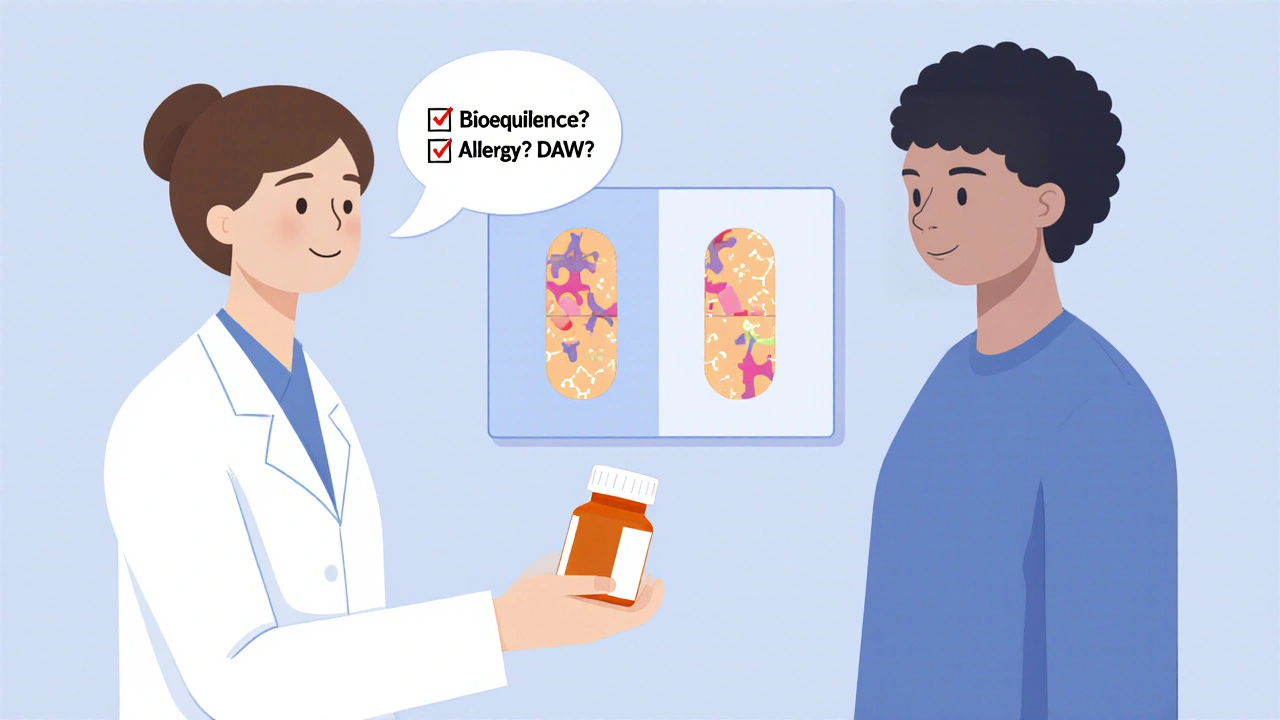
When a pharmacist hands you a generic pill instead of the brand-name drug your doctor prescribed, it’s not just a cost-saving trick-it’s a clinical decision. And behind that swap is a conversation that matters. Pharmacists don’t just fill prescriptions. They review them. They spot opportunities to improve safety, lower costs, and boost adherence. But none of that happens unless they talk to the prescriber.
Why Generics Aren’t Just Cheaper-They’re Clinically Equivalent
Many people still think generics are "weaker" or "less reliable" than brand-name drugs. That’s a myth. The FDA requires generics to have the same active ingredient, strength, dosage form, and route of administration as the brand. But more than that-they must prove they work the same way in the body. That’s called bioequivalence. To get approved, a generic must show that the amount of drug absorbed into the bloodstream falls within 80% to 125% of the brand. In reality, 98.7% of approved generics land between 95% and 105%. That’s tighter than most lab tests. The FDA’s 2022 Bioequivalence Review found no meaningful difference in how these drugs perform in patients. And the data backs it up. A 2018 study tracking 12.7 million patients found that switching to generics improved medication adherence by 12.4%. That means people took their pills more consistently. And with better adherence came a 28.6% drop in non-adherence-related hospital visits. For someone managing high blood pressure or diabetes, that’s not just savings-it’s life-changing.When Pharmacists Should Talk to the Prescriber
Not every generic swap needs a call. But some do. And skipping the conversation can lead to real risks. Narrow therapeutic index (NTI) drugs are the big ones. These are medications where even a tiny change in blood level can cause harm. Think warfarin (a blood thinner), levothyroxine (for thyroid), or phenytoin (for seizures). The FDA doesn’t treat these like regular generics. Only 12 out of over 1,400 product-specific guidances focus on NTI drugs. That means pharmacists need extra caution. If a patient’s INR (a blood test for warfarin) suddenly shifts after a generic switch, the pharmacist must reach out-not just to report it, but to ask: Was this change linked to the new pill? Then there are excipient allergies. Generics can have different fillers, dyes, or preservatives. About 8.7% of substitution issues come from this. A patient allergic to lactose, or to a specific dye in the brand version, might react to a generic that uses it. Pharmacists flag this before dispensing. If the prescriber didn’t know about the allergy, the pharmacist needs to tell them-so it gets documented and avoided in the future. And then there’s the "dispense as written" (DAW) box. About 15.3% of prescriptions have this checked. Sometimes it’s because the prescriber wants the brand for a specific reason-maybe the patient had a bad reaction to a generic before. Other times, it’s just habit. A 2023 study found that 68% of DAW orders had documented clinical concerns. But 32%? No reason at all. That’s where pharmacists step in. They don’t ignore the DAW. They call. They ask: "Is this truly necessary?" And they bring data.The Right Way to Communicate
A quick text or a vague call won’t cut it. Effective communication is structured, evidence-based, and efficient. The American Society of Health-System Pharmacists (ASHP) recommends four steps:- Contact within 24 hours. Don’t wait. If you see a chance to improve therapy, act fast.
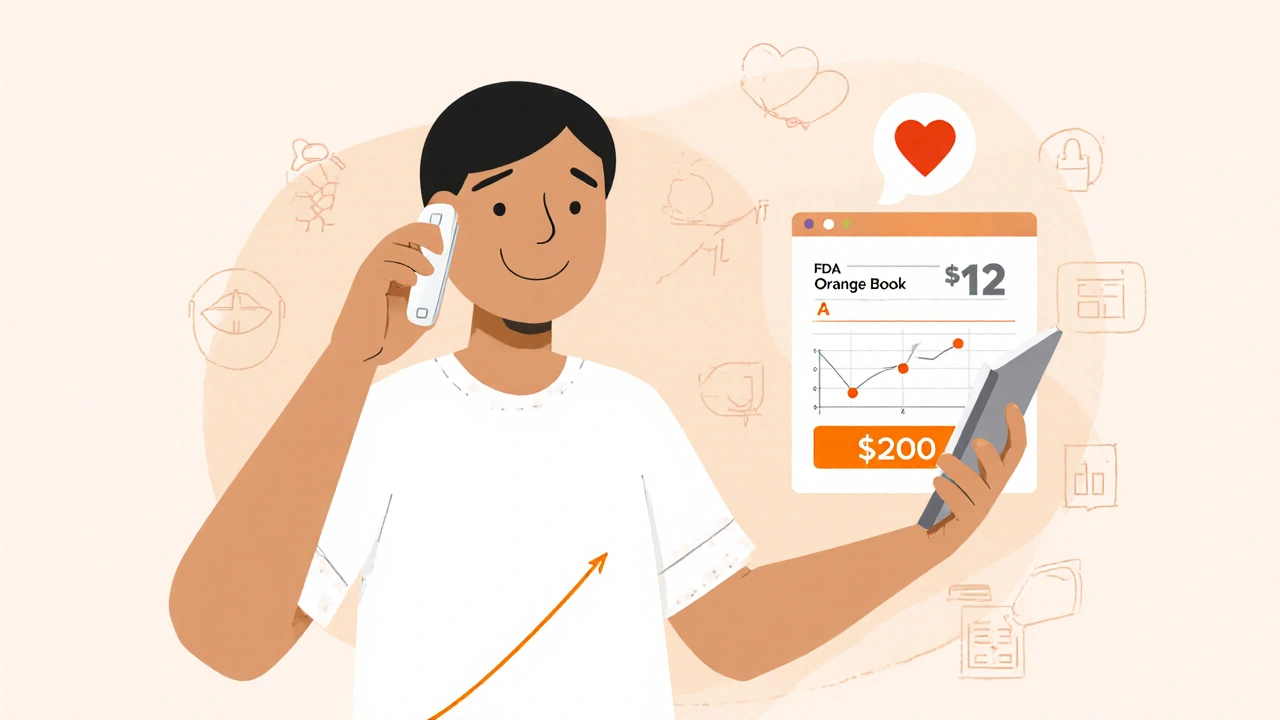
- Use the Orange Book. Cite the therapeutic equivalence rating-"A" means interchangeable. "B" means don’t substitute. That’s the gold standard.
- Show cost difference. Tell them how much the patient saves. A $200 brand drug versus a $12 generic? That’s not just money-it’s adherence.
- Document everything. Date, time, method (phone, secure message), who you spoke to, what you said, and what they agreed to.
Why Prescribers Hesitate-And How to Win Them Over
Even with all the evidence, many doctors still worry. A 2023 survey found 37.6% of prescribers have doubts about generic efficacy. The concerns? Top of the list: inhalers (42.3%), topical creams (38.9%), and complex release formulations. Why? Because these drugs are harder to replicate. The active ingredient is only part of the story. The delivery system matters. A generic inhaler might have the same drug, but if the propellant or nozzle design is different, the lung deposition changes. That’s not theoretical-it’s measurable. So when a pharmacist recommends a generic for a complex drug, they don’t just say, "It’s approved." They say, "Here’s the FDA’s Product-Specific Guidance for this exact product. The bioequivalence data shows 98% of patients had identical peak levels. The manufacturer’s clinical trial included 300 patients over 12 weeks. No safety signals." That’s the difference. General statements get ignored. Specific data gets respected.What’s Changing in 2025 and Beyond
The rules are shifting. The Inflation Reduction Act, effective January 2025, expands Medicare Part D’s medication therapy management (MTM) services. Pharmacists will be formally recognized as key players in optimizing drug therapy-including generic substitution. More than 63% of accountable care organizations (ACOs) now include pharmacist-led generic optimization in their quality metrics. That means pharmacies are being paid not just to fill scripts, but to improve outcomes. And new tools are coming. AI platforms like PharmAI’s Generic Substitution Assistant are already in use at 28.7% of chain pharmacies. They analyze patient history, drug interactions, and formulary rules in seconds. They recommend the best generic option-and even draft the message to the prescriber. Accuracy jumped from 76% to 94%. The FDA is also updating the Orange Book in 2024 to include real-world data-like how generics perform in actual clinics, not just labs. And the CDC is launching a Generic Medication Safety Network in late 2024 to track adverse events in real time. That means pharmacists will soon have live alerts if a specific generic batch has a pattern of problems.
Documentation Isn’t Optional-It’s Protection
If you don’t document the conversation, it never happened. CMS audits show pharmacies using electronic systems hit 98.7% compliance. Manual records? Only 76%. That’s a gap that can lead to denied claims, fines, or worse-patient harm. The AMA and APhA agree: every communication should include:- Date and time
- Method (phone, secure message, fax)
- Prescriber’s name and credentials
- Specific recommendation (e.g., "Switched from Brand X to Generic Y due to cost and therapeutic equivalence rating A")
- Prescriber’s response
- Outcome for the patient
Comments (15)
Look, I get it-generics are cheaper, and yeah, the FDA says they’re equivalent. But I’ve had patients come in with weird rashes after switching from Lipitor to atorvastatin, and the doc had no idea why. Turns out, the generic had a dye the brand didn’t. Now I ask every patient about their meds before I even touch the bottle. It’s not about distrust-it’s about paying attention to the little things that actually matter.
And don’t get me started on the whole ‘dispense as written’ thing. Half the time, that box is checked because the doctor’s too lazy to uncheck it. I’ve called 12 times in a week just to ask if they really meant to block a $15 generic for a diabetic on Medicare. They always say yes, then forget it two weeks later. Documentation isn’t paperwork-it’s your shield.
Also, why do we still treat inhalers like they’re magic? The active ingredient is the same, but if the propellant’s off by 3%, the patient gets half the dose. That’s not bioequivalence-that’s guesswork. And yet, we’re still expected to swap them without a second thought. The system’s broken, and no amount of Orange Book citations fixes that.
People think pharmacists are just glorified cashiers. We’re the last line of defense. And if you don’t call the prescriber, you’re not doing your job-you’re just filling orders.
Let’s stop pretending this is about cost. It’s about accountability. And if we don’t start holding everyone accountable, someone’s going to die because a nurse didn’t notice the generic had lactose and the patient’s allergic. And then we’ll all be pretending it was ‘an isolated incident.’
My mother switched to a generic for her thyroid meds and started feeling like she was drugged. No energy, weight gain, brain fog. She didn’t say anything because she didn’t want to be ‘difficult.’ I found out when I saw her lab results-TSH was off the charts. We went back to the brand. She’s fine now. Pharmacists should ask before swapping. Not assume.
OH MY GOD. I CAN’T BELIEVE THIS POST ISN’T A TIKTOK AD. WHO CARES IF IT’S ‘BIOEQUIVALENT’?? I SAW A GUY IN THE PHARMACY CRY BECAUSE HIS GENERIC ANTIDEPRESSANT MADE HIM FEEL LIKE A ZOMBIE. AND NOW YOU’RE TELLING ME TO ‘CALL THE DOCTOR’?? LIKE HE’S GOT TIME TO ANSWER YOUR PHONE CALL BETWEEN HIS 17th PATIENT AND HIS LUNCH BREAK??
Also, the FDA?? LOL. They approved 3 different versions of Adderall that all feel completely different. And now you’re gonna tell me ‘80%-125% absorption’ is good enough?? I’d rather pay $200 and not feel like I’m slowly dissolving into a puddle of despair.
And why are you even writing this? Are you a pharmacist? Or just someone who reads too many press releases? I’m done.
Also, why does everything have to be so formal?? Can’t we just say ‘sometimes generics suck’??
The data presented in this post is both comprehensive and methodologically sound. The emphasis on structured communication between pharmacists and prescribers aligns with established best practices in interprofessional collaboration. The cited studies, particularly the 2018 adherence analysis and the 2021 intervention efficacy metrics, provide robust evidence supporting the clinical and economic rationale for pharmacist-initiated generic substitution.
Moreover, the integration of technology-specifically Surescripts’ module and AI-driven decision support systems-represents a significant advancement in reducing communication latency and improving documentation fidelity. The drop in interaction time from 8.2 to 2.7 minutes is not merely an efficiency gain; it is a systemic improvement in care coordination.
It is worth noting, however, that the persistent skepticism among prescribers regarding NTI drugs and complex formulations underscores a critical gap in medical education. The assumption that bioequivalence equates to therapeutic equivalence in all contexts remains a misconception that requires targeted continuing education for physicians.
The upcoming FDA Orange Book revisions incorporating real-world data will be a pivotal development. Until then, pharmacists must continue to advocate with precision, evidence, and unwavering professionalism. This is not advocacy-it is clinical responsibility.
Bro. I just had my grandma’s warfarin swapped to a generic. She’s 82. She’s on five other meds. She didn’t even know what ‘INR’ meant. The pharmacist called the doc, sure-but the doc was like, ‘Oh, yeah, I’ve been meaning to switch her.’
Two days later, she’s in the ER with a bruise the size of a grapefruit. Turns out the generic had a different filler. She’s allergic to corn starch. The brand didn’t have it. The generic did. No one checked.
So yeah, the science says it’s fine. But science doesn’t hold your grandma’s hand when she’s scared and confused. And if your ‘evidence-based’ solution doesn’t include empathy, you’re not helping-you’re just running a spreadsheet.
Also, the FDA? Pfft. They approved a generic for a drug that made people hallucinate because the coating was off. It took six months to pull it. Six months. People died.
Don’t give me your charts. Give me your conscience.
So let me get this straight. You’re telling me that pharmacists are now the gatekeepers of every prescription because doctors are too lazy to know their own patients? And we’re supposed to trust them because they ‘follow the Orange Book’?
What about the ones who just want to hit their productivity quota? What about the ones who swap generics because their pharmacy’s contract says so, not because it’s better for the patient?
I’ve seen it. A guy gets his seizure med switched. He has a seizure. They blame the patient. No one asks if the generic was even the right one.
This isn’t about science. This is about profit margins disguised as ‘improved adherence.’
And now you want me to believe AI is gonna fix it? You’re kidding me, right?
Next thing you know, the algorithm will decide if my insulin is ‘cost-effective’ enough to be worth my life.
Generic =/= interchangeable. Bioequivalence ≠ clinical equivalence. The FDA’s 80-125% window is a joke. Real-world variation? 10-15% in some cases. That’s not ‘tight.’ That’s a gamble.
And ‘dispense as written’? 32% of those are just lazy docs. So you call them. They say no. You’re stuck. No recourse. No audit. No accountability.
Meanwhile, the system rewards pharmacies for swapping, not for patient outcomes. So of course you’ll push generics. It’s not about care. It’s about cash.
And now we’re letting AI draft the messages? Next thing you know, a bot will be deciding if your antidepressant is ‘worth it.’
This post presents a meticulously researched and clinically grounded perspective on the role of pharmacists in generic medication substitution. The integration of evidence from peer-reviewed studies, FDA guidance, and real-world implementation data is commendable. The emphasis on structured communication protocols, particularly the four-step ASHP framework, is not only aligned with current standards of practice but is also essential for mitigating risk and enhancing patient safety.
The inclusion of technological advancements such as Surescripts and AI-driven decision support systems represents a significant step forward in reducing cognitive load on clinicians and improving documentation integrity. The 95% documentation rate achieved through electronic systems versus 64% with manual methods is a compelling argument for digital integration.
Furthermore, the forthcoming inclusion of real-world data in the Orange Book and the CDC’s Generic Medication Safety Network will provide critical post-market surveillance capabilities that have long been absent from the generic approval process.
It is imperative that prescribers, pharmacists, and patients continue to engage in collaborative, data-informed dialogue. The future of safe, effective, and equitable medication use depends on it.
As a physician practicing in rural India, I see this issue daily. Patients often cannot afford brand-name drugs. Generics are essential. But the problem is not just the drug-it’s the lack of standardized labeling, inconsistent manufacturing quality, and absence of pharmacovigilance systems. In the U.S., the FDA regulates generics rigorously. In many low-resource settings, they do not.
I applaud the structured communication model described here. But in my context, pharmacists rarely have access to electronic health records or secure messaging systems. A phone call is often impossible. A handwritten note is the norm.
What is needed is not just better communication protocols-but infrastructure. Training. Regulation. And above all, trust. Without these, even the best guidelines fail.
Thank you for highlighting the importance of pharmacist prescriber collaboration. It is a model that should be adapted, not just copied.
Wait. So now pharmacists are calling doctors to override prescriptions? Who authorized this? Who’s paying for this ‘system’? Who’s behind the AI tools? The pharmaceutical companies? The insurers? The FDA? The same ones who let OxyContin get approved?
Generics are cheaper because they’re made in China and India. And now you want me to believe they’re just as safe? The FDA’s ‘bioequivalence’ standards were written by people who used to work for Pfizer.
And don’t get me started on Surescripts. That’s owned by a consortium of Big Pharma and EHR vendors. Everything’s connected. Everything’s tracked. Everything’s controlled.
They’re not trying to improve care. They’re trying to centralize control. And you’re all just clicking ‘approve’ because you think it’s ‘evidence-based.’
Wake up. This isn’t medicine. It’s surveillance with a stethoscope.
YESSSSS THIS IS SO IMPORTANT!! 🙌🏼 I used to hate when my pharmacist swapped my meds, but now I get it!! 💊✨ The science is REAL and the savings are HUGE!! My blood pressure med went from $180 to $12?? I’m literally crying happy tears!! 😭💖 And my pharmacist actually CALLED MY DOCTOR?? LIKE A HERO?? I LOVE PHARMACISTS!! 🏥💕 You guys are the real MVPs!! 🎉👏🏼 #GenericRevolution #PharmacistPower
Oh, so now pharmacists are the heroes because they call doctors? That’s cute. But let’s be real-how many of those calls actually lead to a change? Or are they just performative? You call. The doctor says no. You log it. You feel good. The patient gets the generic anyway. The system doesn’t change. The power dynamic doesn’t change.
And yet, you’re acting like this is some grand breakthrough. It’s not. It’s just another way to make the patient feel like they’re being cared for while the real problem-the broken healthcare system-stays untouched.
Don’t get me wrong. I appreciate the effort. But don’t pretend this is justice. It’s just better customer service with a white coat.
Interesting. You present a very polished, data-heavy argument about pharmacists improving care through generic substitution. But you omit one critical detail: the patient’s voice. Where are the stories of people who felt worse? Who had seizures? Who developed rashes? Who lost jobs because they couldn’t afford the brand? You don’t mention them. Why?
Because this isn’t about patients. It’s about efficiency. It’s about cost-cutting. It’s about hitting KPIs. The patient is just a variable in your spreadsheet.
And yet, you call it ‘clinical decision-making.’ How convenient.
Real medicine doesn’t come from algorithms. It comes from listening. And you didn’t listen.
So congrats. You wrote a beautiful article. But you missed the point.
Let me tell you about the time I had to switch my son’s ADHD med to a generic because our insurance wouldn’t cover the brand. He went from acing his tests to zoning out in class, staring at the wall like a ghost. We went back to the brand. He’s fine now.
But here’s the thing-I didn’t know it was the generic. I thought he was just being lazy. The pharmacist didn’t call my doctor. No one asked if I’d noticed a change. No one followed up.
So now I’m screaming into the void: if you’re going to swap meds, you have to tell the patient. You have to track them. You have to care. Not just call the doctor and check a box.
Because this isn’t about bioequivalence. It’s about trust. And if you break that, you break everything.
I’m not against generics. I’m against indifference.
And if you’re reading this and you’re a pharmacist? Please. Talk to the family. Not just the doctor. The family is the one who notices the change first.
Don’t be a robot. Be a human.
That’s exactly what I’m talking about. You don’t just swap a pill. You swap a person’s stability. My patient with bipolar disorder? She’s fine on her brand. Her doctor says so. Her pharmacist says so. But the pharmacy’s contract says ‘switch to generic.’ So they do. And then she’s in the ER again. Again. Again.
It’s not about the science. It’s about who’s holding the contract. And if we keep letting corporations dictate clinical decisions, we’re not saving money-we’re sacrificing lives.
And the worst part? No one gets punished. No one gets fired. No one even gets a slap on the wrist. We just keep doing it. Because it’s ‘efficient.’
So yeah. Call the doctor. Document it. But don’t pretend that’s enough. It’s not. Not even close.