
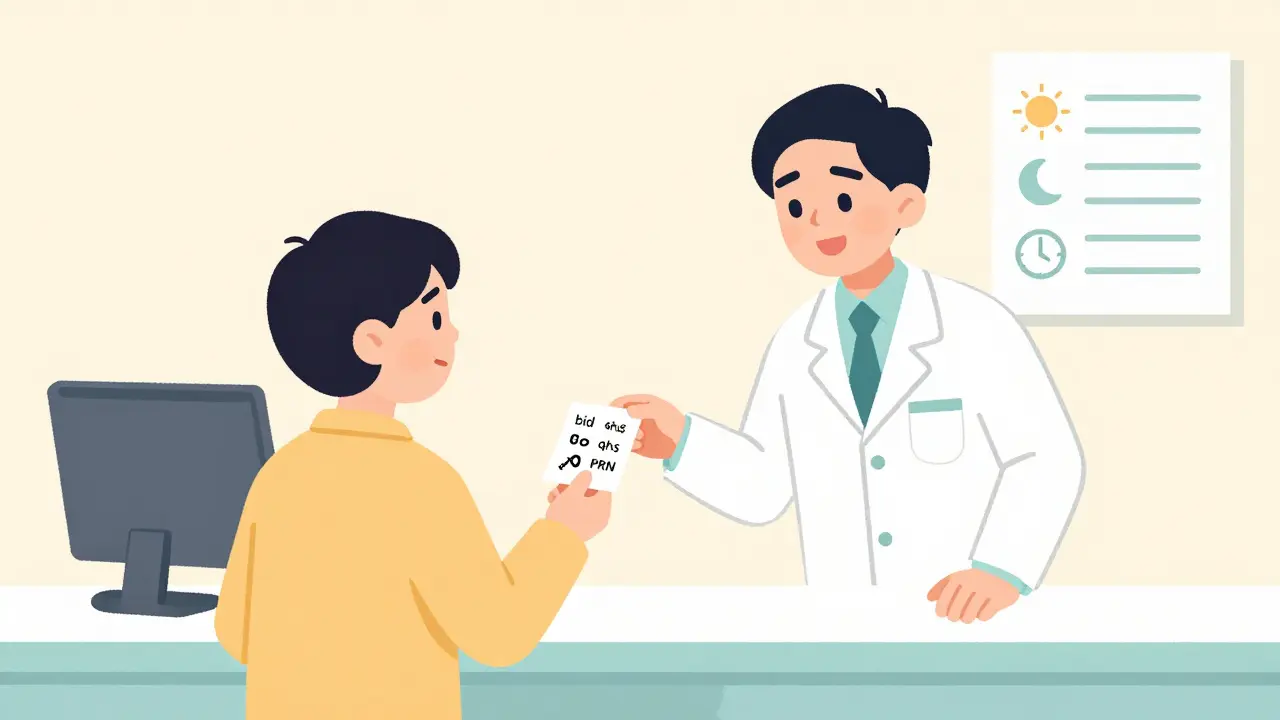
Getting a prescription filled shouldn’t feel like solving a puzzle in a language you don’t speak. Yet too many people leave the pharmacy with a small paper slip full of medical jargon-words like bid, qhs, or PRN-and no real idea what they’re supposed to do. If you’ve ever stared at your medication label and thought, “I have no clue what this means,” you’re not alone. And you’re not wrong to ask for better.
The truth is, you have a right to understand your meds. Not just vaguely, not just when it’s convenient for the pharmacy-but clearly, in writing, and in a way that makes sense to you. This isn’t a favor. It’s part of your basic healthcare rights.
You Have the Right to Understand Your Medications
It’s not just common sense-it’s backed by law and ethics. The American Medical Association says patients have the right to receive information about their treatment in a way they can understand. The same goes for pharmacies. AmerisourceBergen, Tennessee Oncology, Vivo Health Pharmacy, and even the federal Office of Personnel Management all list this as a core patient right: you are entitled to receive medication instructions in a language and format you can actually use.
And it matters. A 2022 report from the Institute for Safe Medication Practices found that 63% of medication errors happen because patients didn’t understand their instructions. That’s not a small number. That’s millions of people taking the wrong dose, skipping doses, or mixing drugs dangerously-all because the instructions were unclear.
Compare that to countries like Canada and the UK, where pharmacy laws require instructions to be written at a 6th-grade reading level. In the U.S., there’s no national standard. That means your experience depends on where you live, which pharmacy you use, and how loudly you ask.
Why Most Written Instructions Don’t Work
Many pharmacies do give you something in writing-but it’s often useless. You might get a two-page sheet full of terms like “titrate,” “adverse reaction,” or “hepatic metabolism.” These aren’t helpful. They’re intimidating.
A University of Florida study in 2022 analyzed medication guides from major chains like CVS and Walgreens. The reading level? Between 6th and 11th grade. That sounds okay-until you realize that nearly half of U.S. adults read at or below a 6th-grade level. If your instructions are written at 10th grade, they’re still too hard for millions of people.
And it’s not just the words. Many labels don’t say when to take the pill. Is it before food? After? With water? On an empty stomach? They might say “take daily,” but not what time. Or they list side effects but don’t tell you which ones are normal and which mean you need to call your doctor.
Pharmacies often use generic templates. They’re cheap. They’re fast. But they’re not designed for you. They’re designed for liability. And that’s why you have to ask for better.
How to Ask-And How to Get What You Need
Asking for clearer instructions isn’t rude. It’s smart. And there’s a right way to do it.
Here’s a simple five-step method that works:
- Ask to speak with the pharmacist, not the technician. Technicians fill prescriptions. Pharmacists explain them. A 2022 survey found that 73% of chain pharmacies require technicians to pass complex questions up to a pharmacist.
- Use the exact words from your rights. Don’t say, “Can you make this easier?” Say: “I’m exercising my right under the AmerisourceBergen Patient Rights document to receive education in a language I understand.” Research shows patients who quote specific rights are 3.7 times more likely to get better instructions.
- Request a visual schedule. Ask for a chart with boxes for morning, noon, night, and as needed. Add pictures if you can-like a sun for daytime pills or a moon for bedtime ones. A 2023 study in Annals of Internal Medicine found visual schedules improve adherence by 42%.
- Do a read-back. After they explain it, say: “Let me repeat it back to make sure I got it right.” Then say it out loud. If you stumble, they’ll fix it. Johns Hopkins found this simple step reduces errors by 63%.
- Say you’re documenting it. Tell them: “I’m writing this down for my medical records.” A 2023 survey found pharmacies are 58% more likely to give you a written copy if you mention documentation.
Timing matters too. Ask when you pick up a new prescription-not during a refill. Pharmacists have more time then. One 2022 study showed 87% of pharmacists say they can spend more time explaining new meds.
What If They Say No?
Some pharmacists will hesitate. They’re busy. They don’t have templates. They think you’ll “figure it out.” But you don’t have to accept that.
If they refuse, say: “I understand this isn’t standard, but I have a legal right to understandable instructions. Can you please check with your manager or contact the prescribing doctor for help?”
If you’re still stuck, ask for a printed copy of the FDA-approved patient information leaflet for the drug. It’s usually more detailed and better written than the pharmacy label. Or ask if they can email or text you a simplified version.
And if you speak a language other than English? You have federal rights under Title VI of the Civil Rights Act. Say: “I need medication instructions in [your language] per federal law.” A 2023 CMS report found 92% of pharmacies provide translations when asked this way.
What’s Changing-and What’s Coming
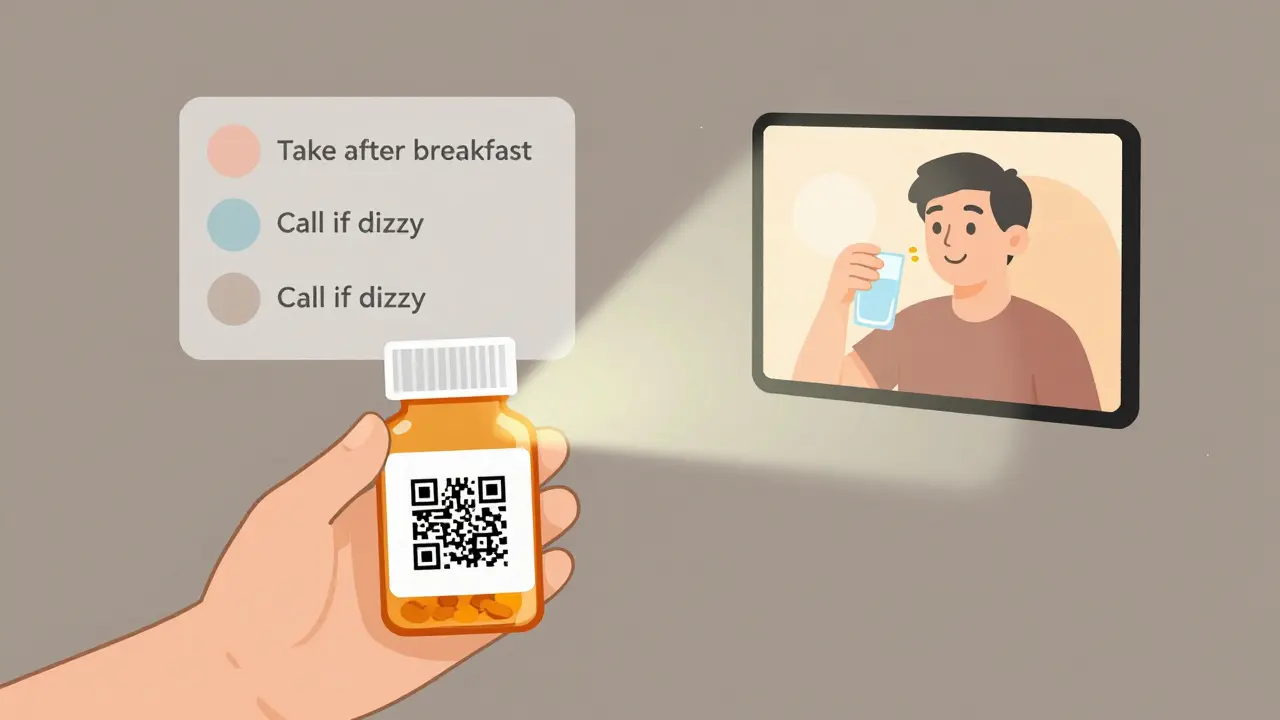
Things are slowly getting better. In March 2024, Walgreens announced all prescriptions will include QR codes linking to video instructions in 20 languages by the end of the year. CVS is rolling out a system called “Medi-Simplify” that creates pictogram-based guides. The FDA is pushing for standardized icons on labels-like a red X for “don’t drink alcohol” or a clock for “take at bedtime.”
And there’s a bill in Congress-H.R. 1173, the Patients’ Right to Know Their Medication Act-that would require every prescription in the U.S. to come with a one-page, plain-language instruction sheet approved by the FDA. It has 147 bipartisan co-sponsors. It’s not law yet-but it’s coming.
Meanwhile, some pharmacies already use digital tools that generate custom, easy-to-read guides. Ask if your pharmacy uses one. If not, ask them to consider it.
What You Can Do Today
You don’t need to wait for new laws or fancy apps. Right now, you can take control:
- Always ask for written instructions when you get a new prescription.
- Don’t accept vague answers. Ask: “What happens if I miss a dose?” “Can I take this with my other meds?” “What side effects mean I should call you?”
- Take a photo of your instructions. Share them with a family member or caregiver.
- If you’re on multiple meds, ask for a pill organizer with labels you can read.
- Keep a simple list: Drug name, dose, time, purpose, and one thing to watch for.
Remember: You’re not asking for special treatment. You’re asking for the basic information you need to stay safe. That’s not too much to ask.
Medication errors don’t happen because people are careless. They happen because the system isn’t designed for people. You can change that-starting with your next pharmacy visit.
Can I ask for medication instructions in my native language?
Yes. Under Title VI of the Civil Rights Act of 1964, pharmacies that receive federal funding must provide language assistance services at no cost. You can say: "I need medication instructions in [your language] per federal law." Studies show 92% of pharmacies comply when asked this way.
What if the pharmacist gives me the same confusing paper again?
Politely say: "I appreciate this, but I still can’t understand it. Can you help me make a simpler version? I’m exercising my right to receive information I can understand." If they still refuse, ask to speak with the pharmacy manager or contact the prescribing doctor. You can also file a complaint with your state pharmacy board.
Are there apps or tools that can help me understand my meds?
Yes. Apps like Medisafe, MyTherapy, and PillPack let you input your prescriptions and send you simple reminders with plain-language instructions. Some pharmacies now offer QR codes on labels that link to video instructions in multiple languages. Ask your pharmacist if they use these tools.
Why don’t all pharmacies give clear instructions?
Many use generic, low-cost templates designed for legal protection, not patient understanding. Independent pharmacies often lack resources to create custom materials. Chain pharmacies are improving, but change is slow. Until laws require better standards, patients must ask-and keep asking.
Can I get written instructions for refills too?
You can ask anytime, but refills are harder. Pharmacists assume you already know the instructions. Still, if your regimen changed, if you’re confused, or if you’re helping someone else take their meds, you have the right to updated, clear instructions-even for refills. Say: "My situation changed. Can I get a new, simple version?"
Comments (11)
Been there. Got the paper with 'qhs' and just stared at it like it was ancient hieroglyphs. Finally called my mom-she’s a nurse-and she said, 'It means bedtime.' I cried a little. Then I yelled at the pharmacy. It’s 2024. We can do better.
Thank you for writing this. I’ve worked in community health for 18 years, and this is the #1 gap in care. Patients aren’t dumb-they’re just handed jargon like it’s common sense. Simple visual schedules? Yes. QR codes to video instructions? Absolutely. These aren’t luxuries. They’re lifelines.
As a patient advocate, I formally affirm the rights outlined herein. The legal and ethical obligations of healthcare providers to deliver comprehensible medication instructions are unequivocal under both the AMA Code of Medical Ethics and Title VI of the Civil Rights Act. Noncompliance constitutes a breach of fiduciary duty and may constitute actionable negligence. I encourage all individuals to document all interactions and escalate to state pharmacy boards when necessary.
Wow. Finally, someone who gets it. 🙄 Most people are too lazy to read a 6th-grade instruction sheet. Honestly, if you can’t understand 'take once daily,' maybe you shouldn’t be managing your own meds. Also, QR codes? Cute. But I’m still waiting for the FDA to mandate emojis. 🌞💊🌙
My grandma took 14 meds. I made her a color-coded chart with stick figures holding pills. She started taking them right. No more hospital trips. You don’t need fancy apps-just a pen, some crayons, and a heart. If you’re reading this and you’re scared to ask? Do it. They’re paid to help you.
Why do people think the system owes them anything? If you can’t read, go to adult education. If you don’t understand 'bid,' learn it. This isn’t a customer service complaint-it’s personal responsibility. Pharmacies aren’t here to babysit. Stop demanding hand-holding.
My cousin’s dad died because he mixed his blood thinner with grapefruit juice. The label didn’t say not to. No one explained it. I’ve been asking pharmacists for simple sheets ever since. It’s not hard. It’s not extra work. It’s just human. And if they say no? Tell them I said hi.
QR codes in 20 languages? That’s progress. But don’t forget rural areas with no cell service. Paper still matters. Keep the old-school stuff alive.
Let’s deconstruct the epistemological framework of pharmaceutical literacy. The current paradigm, predicated on linguistic assimilation within a capitalist healthcare-industrial complex, inherently alienates the embodied subject from their own pharmacological agency. The proposed 'visual schedules' are merely symptom management-a palliative gesture within a system that commodifies cognition itself. We must transcend the binary of 'simple vs. complex' and reimagine medication as a dialogic, not transactional, practice.
I’ve used Medisafe for two years. It’s free. It texts me when to take pills. It tells me in plain English what each one does. I wish my doctor had told me about it sooner. If you’re confused, download it. No one’s coming to save you. But your phone might.
It’s funny how we blame the system when the real issue is we’ve stopped asking. My dad used to say, 'If you don’t speak up, they assume you’re fine.' He was right. That one sentence-'Can you explain this like I’m 10?'-changed everything for us. No drama. No yelling. Just clarity. We all deserve that.