
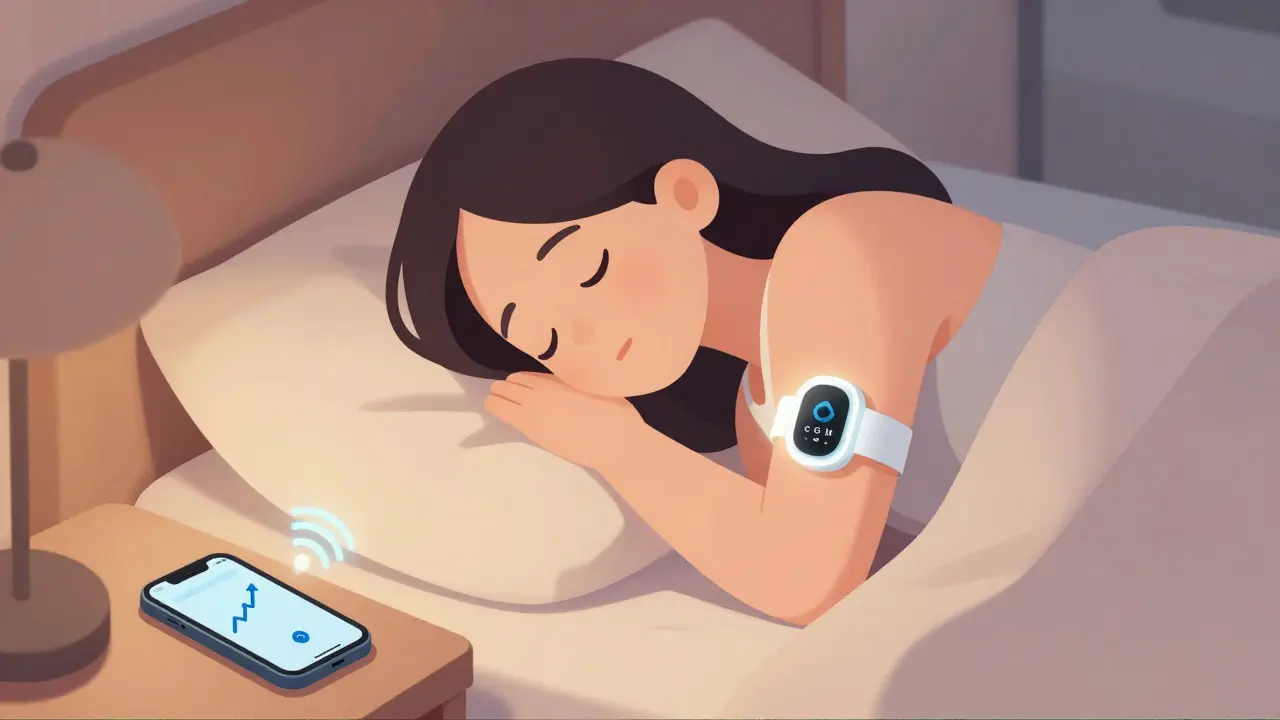
For people managing diabetes, checking blood sugar with a fingerstick test can feel like a daily chore - and it’s only giving you a single snapshot. What if you could see your glucose levels changing in real time, day and night? That’s the power of a continuous glucose monitor (CGM). Unlike traditional meters that show you a number at one moment, CGMs track your glucose trends around the clock, giving you warnings before highs or lows hit. They’re not just for people with type 1 diabetes anymore. More and more people with type 2 diabetes, prediabetes, and even those tracking metabolic health are using them. But how do they actually work? And who gets the most out of them?
How CGMs Measure Glucose Without a Needle
A CGM doesn’t measure blood sugar directly. Instead, it measures glucose in the fluid between your cells - the interstitial fluid. A tiny sensor, about the size of a pencil eraser, is inserted just under your skin, usually on your belly or upper arm. Inside that sensor is a thin filament coated with glucose oxidase, an enzyme that reacts with glucose in the fluid. When glucose interacts with this enzyme, it creates a small electric current. The strength of that current matches how much glucose is present.
This signal gets sent wirelessly to a small transmitter attached to the sensor. From there, data flows to your smartphone or a handheld receiver. Most modern CGMs update every 1 to 5 minutes. That means you’re getting over 280 readings a day, not just 4 or 5 like with fingersticks. You don’t need to prick your finger to see your number - the device shows it automatically. Some systems, like the Abbott FreeStyle Libre 3, even update every minute.
But here’s the catch: interstitial fluid glucose doesn’t change as fast as blood glucose. There’s a lag of 5 to 20 minutes. So if your blood sugar drops quickly during a workout or after eating, the CGM might show a delay. That’s why experts always say: if you feel symptoms of low blood sugar but your CGM says you’re fine, trust your body and check with a fingerstick.
The Three Main Types of CGMs on the Market
Not all CGMs are the same. There are three main types, each with different features, costs, and use cases.
- Real-time CGMs - These include the Dexcom G7 and Eversense E3. They send automatic updates and can alert you if your glucose is going too high or too low. Some can even pause insulin delivery from a connected pump before a low happens. Dexcom G7 requires two daily calibrations with fingersticks, but it’s one of the most accurate with a MARD score of 9.1%.
- Flash CGMs - The Abbott FreeStyle Libre 3 falls into this category. You don’t get automatic alerts unless you scan the sensor with your phone. But you also don’t need fingersticks for calibration. It’s factory-calibrated and costs less than real-time systems. Many users love the simplicity - just wave your phone over the sensor to see your number and trend.
- Implantable CGMs - The Eversense E3 is the only one of its kind. A small sensor is surgically placed under the skin and lasts up to 180 days. It vibrates to alert you of highs and lows, and doesn’t need daily replacement. But it requires a minor procedure to insert and remove, which isn’t for everyone.
Here’s how they compare:
| Device | Update Frequency | Sensor Life | Calibration Needed | Monthly Cost (Without Insurance) | Alerts |
|---|---|---|---|---|---|
| Dexcom G7 | Every 5 minutes | 10 days | Twice daily | $399 | Yes - customizable highs/lows |
| FreeStyle Libre 3 | Every 1 minute | 14 days | No | $110 | Only if scanned |
| Eversense E3 | Every 5 minutes | 180 days | No | $1,200 upfront | Vibration + app alerts |
The FreeStyle Libre 3 has become the most popular in the U.S. and Europe because it’s affordable, accurate (MARD of 7.9%), and requires no fingersticks. Dexcom G7 is preferred by those who want alarms without scanning. Eversense suits people who hate changing sensors every two weeks.
Who Benefits Most From a CGM?
CGMs aren’t just for people with type 1 diabetes - though they’ve been a game-changer for them. The American Diabetes Association now recommends CGMs for all people with type 1 diabetes and for those with type 2 diabetes who take insulin. But the benefits go beyond that.
- Type 1 diabetes - CGMs reduce severe low blood sugar episodes by 31%, according to a 2022 JAMA study. They help avoid nighttime lows, which are especially dangerous. Many users say their CGM saved their life during sleep.
- Type 2 diabetes on insulin - If you’re taking multiple daily insulin shots, a CGM helps you fine-tune doses. It shows patterns you’d never see with fingersticks - like why your sugar spikes after lunch or drops after evening walks.
- Pregnant people with diabetes - Tight glucose control during pregnancy reduces risks for both mother and baby. CGMs provide the constant data needed to keep levels stable.
- People with hypoglycemia unawareness - Some people don’t feel when their blood sugar drops. A CGM’s alarm is literally lifesaving for them.
- Non-diabetic wellness users - A growing number of people without diabetes use CGMs to see how food, sleep, and stress affect their glucose. While not medically necessary, it’s helped many optimize their diet and avoid energy crashes.
Dr. Anne Peters, a leading diabetes expert, says: “The trend arrow - showing if glucose is rising or falling and how fast - is more important than the number itself.” That’s because it tells you what’s coming next. If your glucose is dropping fast, you can eat before you feel dizzy. If it’s climbing slowly, you can adjust your insulin early.
What You’ll Notice First - and What Might Frustrate You
Most users report three big wins in the first week:
- Seeing nighttime lows - No more waking up exhausted from an undetected low.
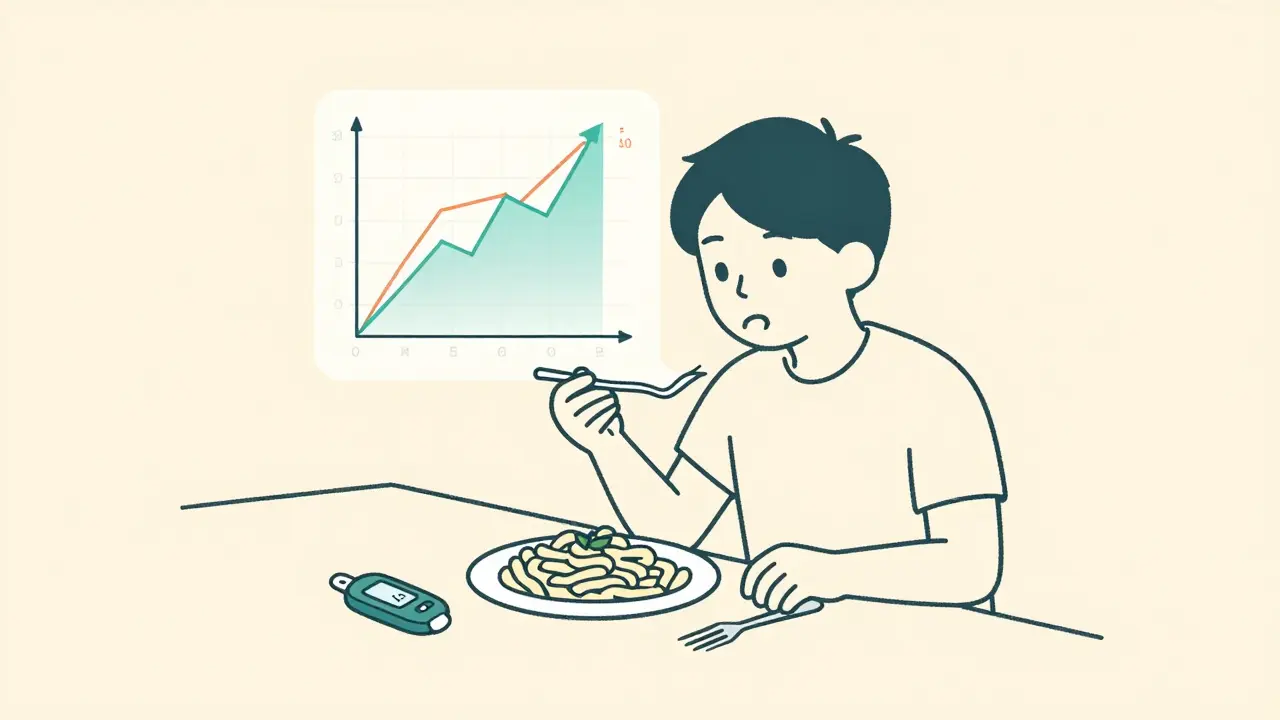
- Understanding food reactions - Why does pasta spike you but rice doesn’t? The CGM shows you.
- Feeling more in control - You stop guessing. You start responding.
But there are downsides too.
- Cost - Without insurance, CGMs can cost $100-$400 a month. In the UK, the NHS provides FreeStyle Libre 2 for free to eligible patients. In the U.S., Medicare covers CGMs for insulin users, but private insurers vary. Some people pay out of pocket because the value outweighs the cost.
- False alarms - A Dexcom user on Reddit reported a false low during cycling that made them eat 40 grams of carbs unnecessarily. Sensors can misread during intense exercise or if the adhesive fails.
- Adhesion issues - The sensor can fall off, especially if you sweat a lot, shower often, or have oily skin. Many users swear by Skin Tac wipes or medical tape like Opsite Flexifix to keep it in place.
- Information overload - For older adults or those managing multiple health conditions, constant data can be overwhelming. Dr. John Buse warns that some people get anxious from too many alerts.
One user on Reddit wrote: “My Libre 3 alarm saved me from a 32 mg/dL hypo at 3 AM last week - I’d have been dead without it.” That’s the kind of story that makes the cost and hassle worth it.
What’s Next for CGMs?
CGMs are getting smarter - and more accessible.
The Dexcom G7, launched in 2022, cut its warm-up time from two hours to just 30 minutes. The FreeStyle Libre 3 Plus, released in 2023, now tracks insulin doses automatically. Hybrid closed-loop systems - like Tandem’s Control-IQ - are already using CGM data to adjust insulin delivery without user input. Experts call these “80% of an artificial pancreas.”
Looking ahead, companies are testing non-invasive sensors. Glucowise, a device that uses infrared light to read glucose through the skin, completed Phase 2 trials in 2023. Apple is rumored to be developing a glucose-sensing smartwatch. If it works, it could bring CGM tech to millions who never thought they’d need it.
Long-term data is promising too. A 2023 study in the New England Journal of Medicine found that CGM users had 24% fewer hospital visits for diabetes complications. That’s not just better health - it’s lower healthcare costs.
Getting Started With a CGM
If you’re considering one:
- Talk to your doctor first. They can help you choose based on your needs and insurance.
- Check if your insurance covers it - many plans do for insulin users.
- Watch the tutorials. Dexcom Clarity and LibreView have interactive guides that explain trend arrows and alerts.
- Expect a learning curve. It takes 3-5 days to understand what the data means.
- Always verify with a fingerstick if you feel symptoms but the CGM doesn’t match.
CGMs don’t replace good habits - they enhance them. You still need to eat well, move regularly, and take meds as prescribed. But now, you have a real-time map of your body’s response. That’s not just convenience. It’s control.
Do CGMs replace fingerstick tests completely?
No - not yet. While systems like the FreeStyle Libre 3 are approved for non-adjunctive use (meaning you don’t need fingersticks for routine decisions), you should still use a fingerstick if you feel symptoms of low or high blood sugar that don’t match your CGM. CGMs measure interstitial fluid, not blood, and there’s a lag. During rapid changes - like after eating, exercising, or taking insulin - fingersticks are still the gold standard for accuracy.
Can I use a CGM if I don’t have diabetes?
Yes - and many people do. While CGMs aren’t medically necessary for non-diabetics, they’re increasingly used by those tracking metabolic health, managing prediabetes, or optimizing diet and exercise. Some users notice how sugar, caffeine, or sleep affects their glucose levels. However, insurance won’t cover it unless you have diabetes. You’ll pay out of pocket, typically $100-$150 per month for sensors.
Are CGMs accurate enough to trust?
Yes - modern CGMs are highly accurate. The most precise, like the FreeStyle Libre 3, have a MARD score of 7.9%, meaning their readings are within 7.9% of lab blood tests on average. That’s better than many fingerstick meters. But accuracy doesn’t mean perfection. Lag, sensor errors, and interference from medications like acetaminophen can cause temporary mismatches. Always use your symptoms as a guide, and verify with a fingerstick when in doubt.
How long does a CGM sensor last?
It depends on the device. Dexcom G7 lasts 10 days, FreeStyle Libre 3 lasts 14 days, and Eversense E3 lasts 180 days. Sensor life is determined by material durability and how long the enzyme coating stays active. Most users replace sensors on schedule even if they seem fine - because accuracy drops over time. Never try to extend sensor life beyond manufacturer guidelines.
Can I swim or shower with a CGM?
Yes - all major CGMs are waterproof. Dexcom G7 and FreeStyle Libre 3 can be worn while swimming, showering, or sweating. You don’t need to remove them. However, prolonged exposure to hot tubs or saunas (above 104°F/40°C) may affect sensor performance. Always check your device’s manual for temperature limits.
What should I do if my CGM stops working?
First, check your phone’s Bluetooth connection and ensure the transmitter is properly attached. If the sensor still doesn’t transmit, try restarting your phone. If that doesn’t work, the sensor may have failed. Most manufacturers offer free replacements if the sensor stops working before its expiration date. Contact customer support - they’ll usually send a new one within 24-48 hours. In the meantime, go back to fingerstick testing until your replacement arrives.
Comments (14)
Just got my FreeStyle Libre 3 last month. No more finger pricks? Game changer. I used to hate checking before dinner, now I just wave my phone and see if I need to adjust. Also, seeing how coffee spikes me at 8 AM was eye-opening. Not even sugar-just the brew. Weird.
I tried one for two weeks, gave up. Too much data. My brain couldn’t handle the constant alerts. I’d look at my phone and just sigh. Like, ‘Oh great, another number. What am I supposed to DO with it?’ Ended up going back to fingersticks. Simpler.
As someone who manages type 2 with insulin, this changed everything. I used to wake up at 3 a.m. panicked, not knowing if I was crashing or just tired. Now I see the trend arrow dropping-slowly-and I eat a tiny snack before it becomes a crisis. I’ve had zero nighttime lows since I started. This isn’t convenience. It’s safety.
People act like CGMs are magic, but let’s be real-you’re still eating carbs and taking insulin. All this data just makes you obsess over numbers you can’t control. I’ve seen people cry over a 145 reading. It’s not diabetes, it’s anorexia with glucose. You’re not a machine. Your body doesn’t need 280 readings a day to function.
Did you know the FDA has approved zero CGMs for non-diabetic use? Yet corporations are pushing them like fitness trackers. The data is being sold. Your glucose trends are being aggregated. This isn’t health tech-it’s surveillance capitalism with a bandage on your arm.
MY SENSOR FELL OFF DURING A HIIT WORKOUT. I WAS SO UPSET I CRIED. I’VE NEVER BEEN THIS EMOTIONAL ABOUT A MEDICAL DEVICE. I SPENT $150 ON A STICKY TAPE THAT WAS SUPPOSED TO KEEP IT ON, AND STILL-IT SLIPPED. I FELT LIKE MY BODY WAS BETRAYING ME. THEN I GOT A NEW ONE, AND IT WORKED. I’M NOT SURE IF I’M MORE HOOKED ON THE DATA OR THE EMOTIONAL ROLLERCOASTER.
Let me tell you something about CGMs. They’re not for the masses. They’re for people who’ve been conditioned to believe that perfect metabolic control equals moral superiority. I’ve seen people on Instagram bragging about their ‘optimal glucose curve’ after eating kale and quinoa. Meanwhile, their cortisol is through the roof. You can’t optimize stress with a sensor. You need therapy, not a transmitter.
If you’re even thinking about trying one, just do it. Don’t overthink it. I was skeptical too-until I saw my glucose spike after a ‘healthy’ smoothie. I thought I was eating clean. Turns out, ‘organic fruit juice’ is just sugar with a fancy label. That one insight changed my whole diet. You don’t need to be diabetic to benefit. You just need to be curious.
As a clinical researcher in metabolic health, I’ve reviewed over 300 CGM studies. The data is compelling, but context is everything. A single glucose reading means nothing without sleep quality, stress levels, circadian rhythm, and gut microbiome data. Most users treat CGMs like a crystal ball. They’re not. They’re one tool in a much larger diagnostic puzzle. If you’re not tracking other variables, you’re just collecting noise.
My 72-year-old dad started using a Libre 3 last year. He hated tech. Now? He’s the one reminding me to check my levels. He says it gave him back his independence. No more guessing if he’s dizzy from low sugar or just old. I cried when he told me that. This isn’t just a device. It’s dignity.
There’s a profound ethical dimension here. CGMs are increasingly being mandated in workplace wellness programs. Employers are offering discounts on sensors-but only if you share your data. This blurs the line between personal health and corporate surveillance. We need regulation before this becomes a norm. Not everyone wants to be monitored-even if it’s for their own good.
My CGM went off at 2 a.m. I panicked. Ate a banana. Turned out I was fine. Then it went off again 20 minutes later. I ate two more bananas. I gained five pounds. Now I don’t trust it. It’s like having a screaming alarm clock that’s always wrong. I’m going back to fingersticks. At least I know when I’m being an idiot.
Did you know that the FDA approved the Dexcom G7 using data from a trial where 40% of participants were under 18? That’s not a coincidence. Big Pharma wants kids on CGMs. Why? Because they’ll use them for life. And every sensor replacement? That’s revenue. They’re not selling health. They’re selling dependency. You think you’re in control? You’re a customer.
I’ve been using a CGM for three years. I’ve had highs, lows, false alarms, sensor failures. I’ve cried, laughed, and stared at graphs for hours. But here’s the truth: I’m not more in control. I’m more aware. And awareness? That’s the first step to change. You don’t need to fix everything. Just notice it. That’s enough.