
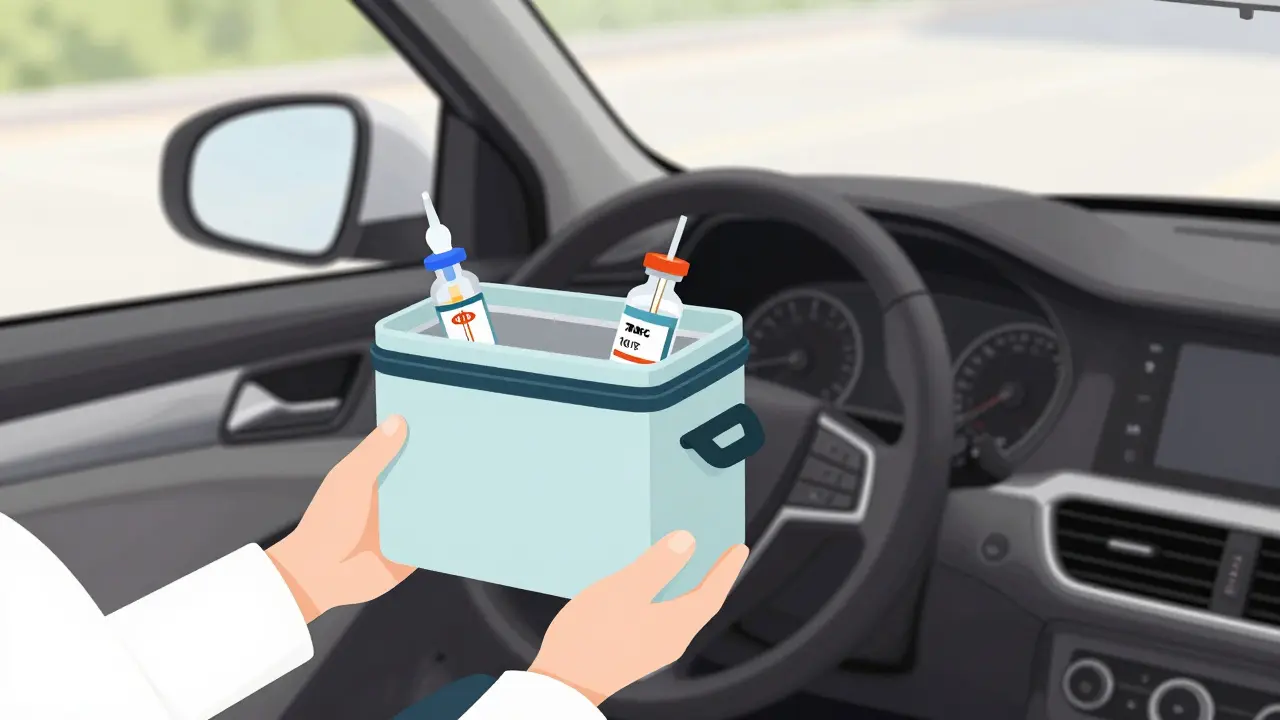
Getting your medications to their destination-whether across town or across the world-can be a matter of life or death if the temperature gets too hot or too cold. Many people assume that as long as the pill bottle is sealed, it’s fine. But that’s not true. Insulin can turn cloudy. Vaccines can lose potency. Antibiotics can become useless. And none of it shows up on the label. If you’re traveling, shipping, or just storing meds in extreme weather, you need to know how to protect them.
What Happens When Medications Get Too Hot or Too Cold?
Not all drugs handle temperature the same way. The effect of heat or cold depends on the type of medication. For example:- Insulin starts breaking down at temperatures above 25°C (77°F). After just one hour in a hot car, it can lose up to 1.2% of its potency. Over time, that adds up-cloudy or clumpy insulin won’t work at all.
- Vaccines like MMR or flu shots degrade rapidly above 8°C (46°F). Some lose 10% of their effectiveness per hour outside the cold range.
- Antibiotics such as amoxicillin can become completely ineffective after 30 minutes above 40°C (104°F).
- Biologics and newer drugs for autoimmune diseases often need to stay between 2°C and 8°C (36°F-46°F). Even a short exposure to freezing can ruin them.
- Tablets and capsules are more stable, but they can still get sticky, crack, or lose their coating in extreme heat or humidity.
The problem isn’t just long trips. It’s the little moments: leaving your meds in the car while you run into the pharmacy. Putting your insulin bag on the dashboard during a road trip. Forgetting to bring a cooler on a winter hike. These are the moments when most damage happens.
Three Temperature Zones You Need to Know
Pharmaceuticals are grouped into three main temperature categories. Knowing which one your meds fall into is the first step to safe transport.- Ambient (15°C-25°C / 59°F-77°F): Most pills, capsules, and some liquid medicines. These are the least sensitive. But even here, avoid leaving them in direct sunlight or in a hot car.
- Refrigerated (2°C-8°C / 36°F-46°F): Insulin, many vaccines, biologics, and some eye drops. This is the most common range for critical medications. If your drug needs refrigeration, it will say so on the label.
- Cryogenic (below -150°C): Only used for a few specialized treatments like certain mRNA vaccines (e.g., original Pfizer-BioNTech COVID-19 vaccine) or blood products. These require special dry shippers with liquid nitrogen and are not something most individuals handle.
If you’re unsure, check the package insert or ask your pharmacist. Never guess.
How to Transport Medications in Hot Weather
Summer heat is brutal on meds. A car dashboard can hit 70°C (160°F) on a sunny day. Here’s how to protect your drugs:- Keep them with you. Never leave medication in the glove compartment or trunk. Even if it’s shaded, the temperature inside a parked car can rise dangerously fast.
- Use an insulated bag. A standard lunch cooler with two frozen gel packs can keep insulin or vaccines cool for up to 8 hours in 32°C (90°F) weather. Look for bags with thick walls and a tight seal.
- Use ice packs, not ice cubes. Ice cubes melt into water and can leak, ruin packaging, or even freeze the medication. Gel packs stay solid longer and don’t leak.
- Don’t overpack. Too many gel packs can make the bag too cold, which risks freezing. For refrigerated drugs, aim for a stable 5°C (41°F), not a freezer.
- Plan ahead. If you’re flying, carry meds in your personal item, not checked luggage. Airplane cargo holds can get extremely hot or cold.
Pro tip: If you’re driving long distances, stop every few hours to check your meds. If the gel packs are melted, replace them. A small cooler with fresh packs every 6 hours is better than one overloaded pack that gives out.
How to Transport Medications in Cold Weather
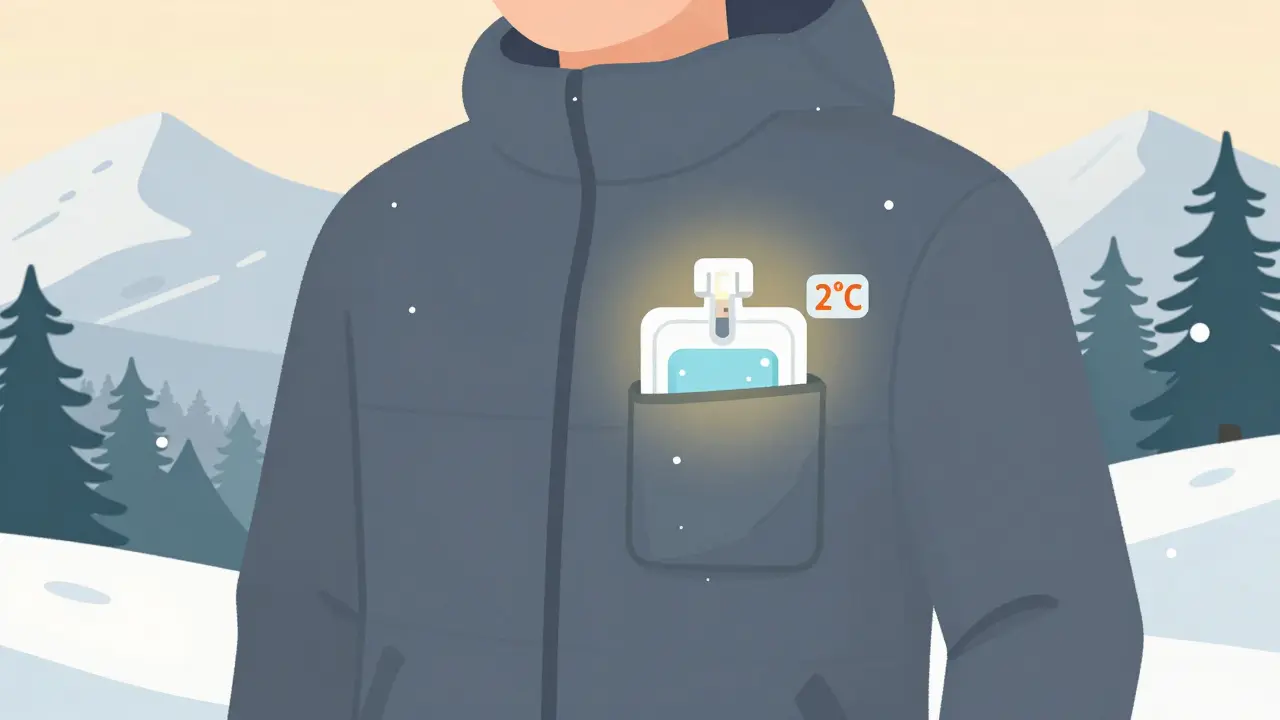
Cold is just as dangerous as heat-maybe more so. Freezing can damage liquid medications, break ampoules, or ruin the structure of biologics.- Keep meds close to your body. Store insulin or vaccines in an inside jacket pocket or a bag worn against your torso. Body heat can prevent freezing.
- Avoid direct contact with ice or snow. If you’re skiing or hiking, don’t put your meds in an outer pocket where they might freeze solid.
- Use insulation, not warmth. Don’t use hand warmers or heating pads directly on medication. They can overheat and damage the product. Instead, wrap the insulated bag in a fleece or towel to buffer against extreme cold.
- Pre-warm your transport container. If you’re using a refrigerated box for shipping, make sure it’s been brought to room temperature before adding the meds. Sudden cold can cause condensation, which leads to mold or label damage.
- Watch for frozen gel packs. If your gel packs are hard as ice, they’re too cold. Let them warm slightly before use. A frozen pack can drop the internal temperature below freezing, even if the meds are meant to be refrigerated.
Real story: A patient in Scotland left her insulin in a car overnight during a -5°C (-23°F) freeze. The liquid froze, forming crystals. When she tried to use it the next day, the insulin didn’t work. She ended up in the ER. That’s why insulation matters-even in winter.
What to Use: Passive vs. Active Cooling
There are two main types of temperature-controlled transport systems:| Type | How It Works | Duration | Cost | Best For |
|---|---|---|---|---|
| Passive Containers | Insulated boxes with gel packs or phase-change materials | 24-72 hours | $10-$50 | Travel, short shipments |
| Active Containers | Electrically powered coolers or refrigerated trucks | Indefinitely | $500-$2,000+ | Hospitals, pharmacies, long-distance shipping |
| Hybrid Systems | Insulated with a small battery-powered cooler | 12-48 hours | $100-$300 | Long trips, air travel |
For most people, passive containers are enough. The TempAid 2.0 is a popular choice among travelers. It holds two vials of insulin, maintains 2°C-8°C for 48 hours, and has 4.7 stars on Amazon from over 1,200 reviews. But it weighs 3.2 pounds. If you’re flying, check airline rules-some limit the number of gel packs you can carry.
Monitoring: Don’t Just Guess
You can’t tell if your meds are still good just by looking at them. That’s why temperature monitoring matters.- Use a simple digital thermometer with a probe. Place it next to your meds, not on the outside of the bag.
- For critical meds, get a data logger. These small devices record temperature every 15 minutes and store the full history. You can download the data later to prove the meds were safe.
- Some devices even send alerts to your phone if the temperature goes out of range. These are worth it if you’re shipping expensive biologics.
The FDA says it’s not enough to check the average temperature. What matters is the highest temperature your meds reached-even for a minute. That’s why continuous monitoring beats occasional checks.
Last-Mile Problems: The Hidden Danger
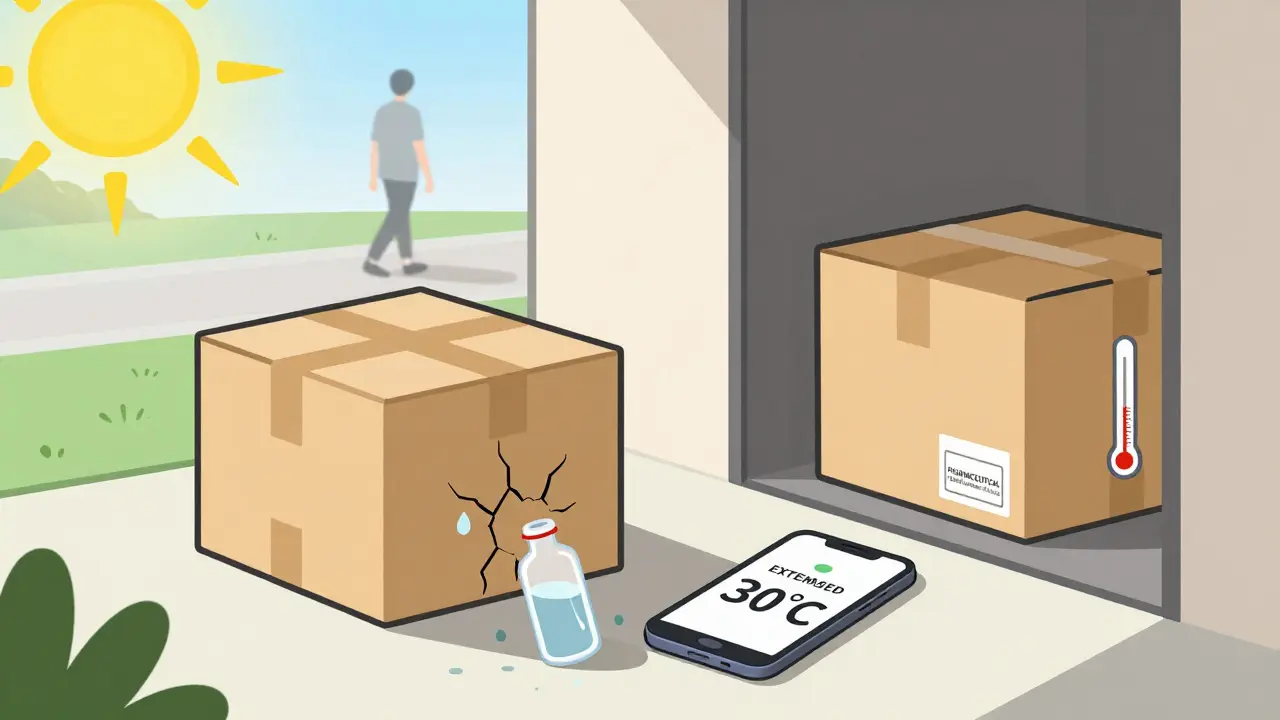
Most temperature failures don’t happen during transit. They happen at the end.- Pharmacists report that 43% of temperature excursions occur during final delivery-when packages are left on porches, in mailboxes, or in unattended lockers.
- A 2023 survey found that 68% of pharmacists had at least one incident of degraded medication due to a package being left outside in the heat.
So if you’re expecting a shipment:
- Ask for a signature or hold at the pharmacy.
- Don’t let it sit in a hot or cold mailbox.
- If it’s a high-value drug, arrange for delivery when you’ll be home.
Travel Tips for Flying and Road Trips
If you’re traveling:- Carry meds in your hand luggage. Checked bags go through extreme temperatures and pressure changes.
- Bring a doctor’s note. Some airlines require proof that your meds are necessary, especially if you’re carrying needles or large quantities.
- Use a TSA-approved cooler. Look for one that holds up to 4 oz of gel packs (most are allowed in carry-ons).
- Don’t rely on airport refrigerators. They’re not always available, and they’re not calibrated for medication storage.
- For long flights, bring extra gel packs. Change them halfway through if possible.
For road trips:
- Keep your cooler in the passenger seat, not the trunk.
- Use a car thermometer to check the cabin temperature. If it’s above 30°C (86°F), your meds are at risk.
- Plan rest stops every 2-3 hours to check your pack.
What to Avoid
Here are common mistakes people make:- Putting meds in the glove compartment
- Leaving them in a car overnight
- Using regular plastic bags instead of insulated ones
- Assuming "room temperature" means you can leave them anywhere
- Ignoring expiration dates after a temperature event
- Using microwaveable heat packs to warm up cold meds
If your medication looks different-cloudy, discolored, or has particles in it-don’t use it. Call your pharmacist. It’s better to be safe than sorry.
Documentation Is Non-Negotiable
If you’re shipping meds professionally, you need records. Even if you’re just traveling:- Keep the original packaging-it has storage info.
- Take a photo of the temperature log if you’re using one.
- Write down the date and time if you had to replace a gel pack.
Why? Because if something goes wrong, you need proof. Insurance claims, pharmacy replacements, or legal liability all depend on documentation. The IATA and FDA both say: No record? No validity.
Final Checklist
Before you leave:- Confirm your medication’s required temperature range.
- Use the right container: insulated bag for most, hybrid for long trips.
- Bring extra gel packs-frozen, not icy.
- Use a thermometer or data logger.
- Carry meds with you, never in checked luggage.
- Plan for delays-add 6-12 hours of buffer time.
- Document everything: photos, logs, receipts.
Temperature control isn’t optional. It’s science. And when your health depends on it, cutting corners isn’t an option.
Can I leave my insulin in the car if it’s cloudy?
No. Even on cloudy days, the inside of a parked car can reach 40°C (104°F) or higher. Insulin degrades quickly at that temperature. Always carry it with you in a cooler or insulated bag. Never rely on weather conditions to protect your medication.
Do I need a prescription to buy a medication cooler?
No. Insulated travel coolers for medications are sold over the counter at pharmacies, medical supply stores, and online. You don’t need a prescription. Look for ones labeled for pharmaceutical use and check reviews for reliability.
What if my medication freezes accidentally?
If a liquid medication freezes, don’t try to thaw it in warm water or a microwave. Let it thaw slowly at room temperature. Then check the appearance. If it’s cloudy, clumpy, or has particles, discard it. Even if it looks fine, call your pharmacist. Some drugs, like insulin, lose potency after freezing even if they appear normal.
How long do gel packs last in extreme heat?
In 32°C (90°F) weather, a standard insulated bag with two frozen gel packs can keep meds cool for 6-8 hours. After that, the packs melt and lose effectiveness. For longer trips, bring replacement packs or plan to recharge them every few hours. High-quality bags with thicker insulation can extend this to 12 hours.
Is it safe to use a regular fridge to store meds during travel?
Not reliably. Household fridges vary in temperature and can dip below 2°C (36°F), which risks freezing sensitive drugs. Also, the door opens frequently, causing spikes. Use a dedicated pharmaceutical cooler instead. If you must use a fridge, monitor the temperature with a thermometer and keep meds in a sealed insulated container inside.
What should I do if I suspect my medication was damaged by temperature?
Stop using it immediately. Contact your pharmacist or prescribing doctor. They can assess whether the medication is still safe based on the type of drug, how long it was exposed, and the temperature range. Never guess. A damaged drug can be ineffective-or even dangerous.
Temperature control for medications isn’t about convenience-it’s about safety. Whether you’re a patient, caregiver, or shipper, knowing how to protect your meds in extreme weather could mean the difference between treatment and crisis.
Comments (8)
Just got back from a road trip with my insulin and let me tell you - I used one of those $15 Amazon coolers and it held perfect temp for 10 hours in 35°C heat. No gel packs melted. I’m sold. Seriously, if you’re on a budget, this thing is a lifesaver. Just make sure the seal is tight - I learned that the hard way after leaving mine open for five minutes. 😅
It’s astonishing how many people treat life-saving medication like a snack left on the counter. The fact that you need a 1,200-word guide to explain that insulin shouldn’t be in a car on a sunny day speaks volumes about societal negligence. If you can’t be bothered to read the label or invest in a $20 insulated bag, you shouldn’t be entrusted with prescription drugs. This isn’t rocket science - it’s basic biology. And yet, here we are.
Temperature excursions are not merely inconvenient - they are biohazards. The FDA’s guidance on stability testing is clear: even one minute above threshold can trigger irreversible molecular degradation. Yet, we treat this like a suggestion. The real tragedy isn’t the cost of a cooler - it’s the thousands of patients who unknowingly administer degraded biologics. We need mandatory temperature logs on all prescriptions. Not optional. Not "recommended." Mandatory. And if you’re flying, you should be required to carry a certified data logger. This isn’t paranoia - it’s pharmacokinetics.
Y’all need to stop sleeping on this! I’m from Nigeria and we don’t have AC everywhere, but my cousin who’s on insulin? She uses a cloth bag wrapped around her waist under her dress - body heat keeps it safe. No fancy gear. Just creativity and discipline. If she can do it with no fridge and 40°C heat, you can too. Stop overcomplicating it. Your meds need love, not a NASA mission. Stay sharp, stay safe!
It is imperative to emphasize that the integrity of pharmaceutical compounds is governed by strictly defined thermal stability profiles, as delineated in the United States Pharmacopeia (USP) Chapter <1079>. The assertion that "tablets are more stable" is misleading; excipient degradation and hygroscopic absorption may occur even within ambient ranges under prolonged humidity exposure. Furthermore, the recommendation to utilize gel packs without temperature monitoring is scientifically unsound. A calibrated digital thermometer, placed in direct proximity to the medication, is an indispensable adjunct. Failure to adhere to these protocols constitutes a breach of pharmaceutical safety standards.
Who the hell leaves medicine in a car? Are we raising dumbasses now? I’ve seen people put their inhalers in the cup holder like it’s a soda. This isn’t a "guide" - it’s a public service announcement for people who can’t read a label. If you can’t figure out that heat kills drugs, maybe you shouldn’t be in charge of your own health. Just buy the cooler. It’s not that hard. Stop being lazy and start being responsible.
Wait - did you know that the FDA and WHO are secretly using temperature degradation data to track who’s not following the rules? I read a leak on a forum once. They’re building a database of people who leave meds in cars. Next thing you know, they’ll revoke your prescription if you "accidentally" expose your insulin to 28°C. They’re already testing microchips in pill bottles. I saw a guy in Dublin with a chip implanted in his wrist. He said it "syncs with his meds." I’m not joking. This isn’t science - it’s control.
It’s funny how we treat temperature like it’s some abstract concept, when really, it’s just physics. A molecule doesn’t care if you’re "in a hurry" or "it’s just for a minute." It doesn’t know your life is busy. It just reacts. And when it does - when that insulin molecule unfolds or that vaccine protein denatures - you don’t get a warning. No flashing light. No beep. Just silence. And then, weeks later, your blood sugar spikes. Or your fever won’t break. Or your immune system doesn’t respond. And you wonder why. That’s the scariest part. Not the heat. Not the cold. The silence after the damage is done. So yeah - keep your meds cool. Not because it’s a rule. But because your body deserves better than a gamble.