
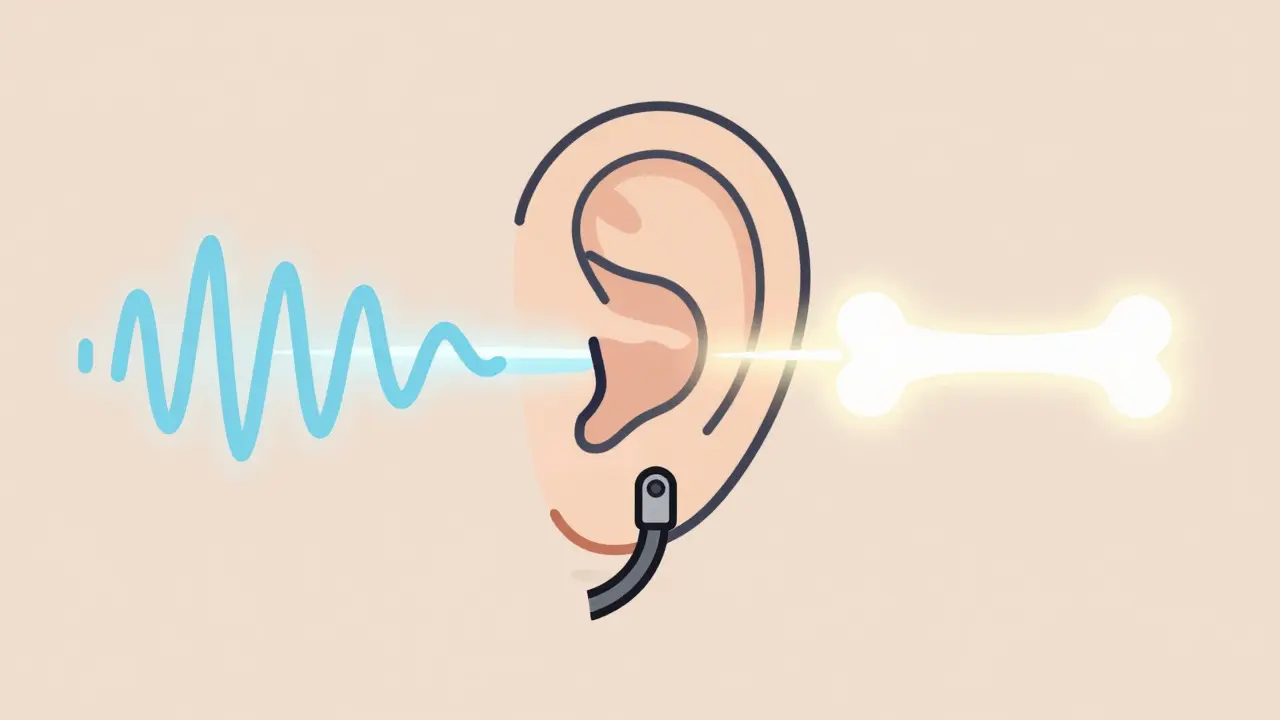
When sound doesn’t reach your inner ear properly, you don’t just hear less-you hear differently. Things muffle. Voices sound distant. You turn up the TV, but still miss parts of the conversation. This isn’t just being hard of hearing-it’s conductive hearing loss. Unlike sensorineural hearing loss, which comes from nerve damage, conductive hearing loss is a mechanical blockage. Something in the outer or middle ear is stopping sound from getting through. And the good news? Many of these blockages can be fixed-with surgery.
What Exactly Is Conductive Hearing Loss?
Conductive hearing loss happens when sound waves can’t move efficiently from the outer ear to the inner ear. Think of it like a kinked garden hose. The water (sound) is there, but it can’t flow freely. The problem isn’t in the cochlea, the part of the inner ear that turns sound into signals for the brain. It’s in the path leading up to it: the ear canal, eardrum, or the tiny bones in the middle ear. People with this condition often struggle to hear quiet sounds. Loud sounds might be clearer, but they still sound dull or muffled. It’s not just about volume-it’s about clarity. You might notice it more in noisy rooms, on the phone, or when someone speaks from another room. This isn’t rare. About 3 in 1,000 newborns have some form of congenital conductive hearing loss. And by age 3, up to 80% of kids have had at least one episode of fluid behind the eardrum. Adults aren’t immune either. Trauma, infections, or even just earwax buildup can trigger it.Common Middle Ear Problems That Cause It
Not all causes are the same. The middle ear is a complex little space, and different problems affect it in different ways.- Otitis media with effusion (glue ear): Fluid builds up behind the eardrum, often after a cold or infection. It’s the most common cause of hearing loss in children. The fluid doesn’t always hurt-it just blocks sound. Many cases clear up on their own, but if it lasts longer than 3 months, surgery may be needed.
- Perforated eardrum: A hole in the eardrum can come from trauma, a loud explosion, or chronic ear infections. It affects 15-20% of adult cases. Small holes often heal themselves. Larger ones don’t.
- Otosclerosis: This is an inherited condition where the stapes bone (one of the three tiny bones in the middle ear) fuses to the surrounding bone. It can’t vibrate anymore. This causes progressive hearing loss, usually starting in young adulthood. It’s more common in women and often runs in families.
- Cholesteatoma: This isn’t a tumor, but it acts like one. Skin cells get trapped in the middle ear and grow abnormally. Over time, they erode bone, damage hearing structures, and can even lead to infection or brain complications. It’s serious and always requires surgery.
- Aural atresia: A baby is born without a properly formed ear canal. It’s rare-about 1 in 10,000 births-but it’s a major cause of congenital conductive hearing loss. Without intervention, the child hears very little on that side.
How Is It Diagnosed?
You can’t diagnose this with a hearing test from a pharmacy. Basic screenings miss the point. A proper diagnosis needs an audiologist and specialized tests. The gold standard is the air-bone gap test. It measures how well sound travels through the air (via headphones) versus through bone (via a vibrator on the skull). If sound travels better through bone than air, you have conductive hearing loss. The gap is usually between 15 and 60 decibels. Tympanometry checks how the eardrum moves. A flat line (Type B tympanogram) means fluid is trapped behind it-common in glue ear. An otoscope lets the doctor see inside the ear canal: wax, a hole, or signs of infection. For complex cases, a high-resolution CT scan of the temporal bone is needed. It shows the exact position and condition of the ossicles and whether cholesteatoma has eroded bone. These scans cost $800-$1,200 out-of-pocket in the U.S.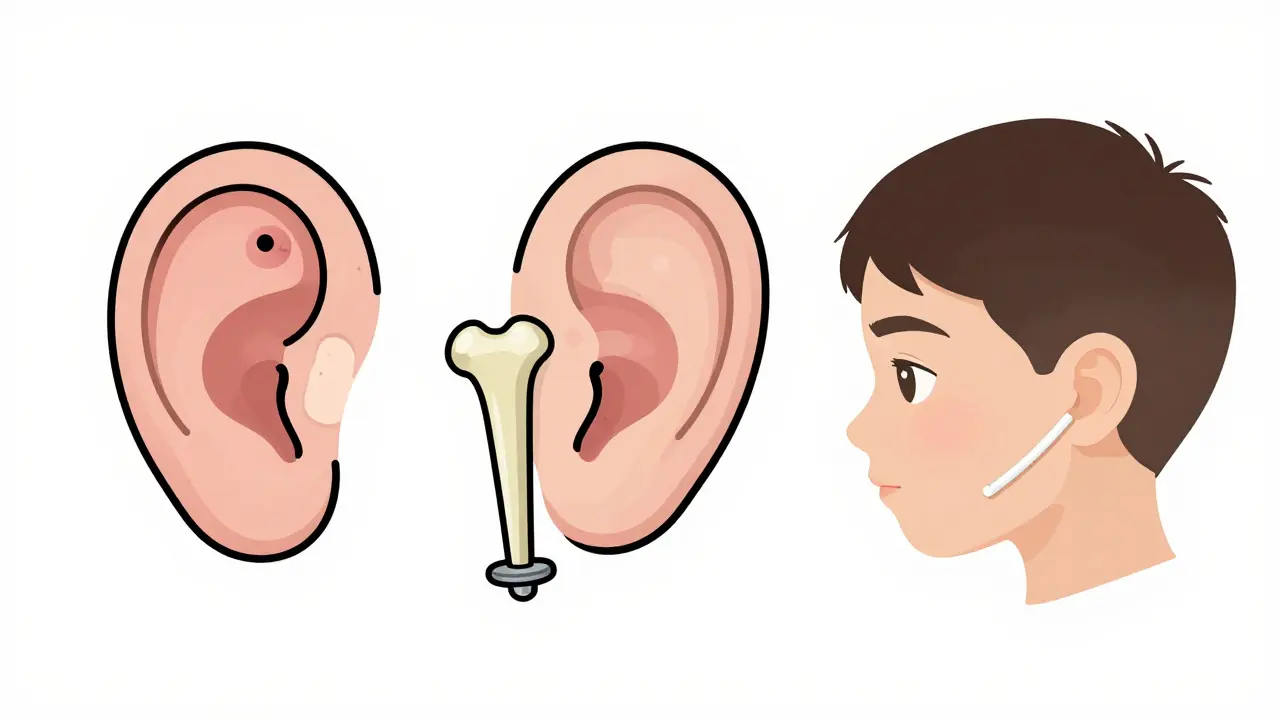
Surgical Repair Options
Surgery isn’t always the first step. For kids with fluid in the ear, doctors often wait 3-4 months. For adults, if the hearing loss is under 25-30 dB and not getting worse, they may try hearing aids first. But if the problem is structural, surgery is the only way to fix it.Tympanoplasty: Repairing the Eardrum
If the eardrum is torn, a tympanoplasty rebuilds it. The surgeon takes a graft-usually from the patient’s own tissue, like the temporalis fascia or cartilage-and patches the hole. Success rates? 85-95% for small perforations. For larger ones, it’s still 70-85%. Recovery takes 6-8 weeks. No swimming, no flying, no heavy lifting. Water exposure is a big no-no. One study found that patients who followed these rules had 90% graft survival rates.Stapedectomy or Stapedotomy: Fixing Otosclerosis
For otosclerosis, the stapes bone is replaced. In a stapedotomy, the surgeon drills a tiny hole in the stapes and inserts a prosthetic piston. In a stapedectomy, the whole bone is removed and replaced. Modern techniques use lasers, cutting complication rates from 15% in the 1980s to under 2% today. About 80-90% of patients close their air-bone gap to within 10 dB. Many report hearing whispers again, no longer needing to turn up the TV. Side effects? Temporary dizziness in 7% of cases. A change in taste in 4%. Tinnitus can flare up in 3%. Most of these fade within weeks.Myringotomy with Tympanostomy Tubes
This is the most common pediatric middle ear surgery in the U.S. - 667,000 procedures every year. A tiny tube is placed in the eardrum to drain fluid and let air in. It falls out on its own after 6-12 months. About 75% of kids see improvement in hearing within 3 months. Parents report fewer ear infections and better speech development. But 18% still have occasional drainage, needing antibiotics.Canalplasty and Cholesteatoma Removal
For aural atresia, canalplasty reconstructs the ear canal. Success? 60-70% functional hearing improvement. Multiple surgeries are often needed. Cholesteatoma surgery is more complex. The goal isn’t just hearing-it’s safety. The surgeon removes all abnormal tissue to prevent infection and bone erosion. Hearing restoration comes second. Recovery takes 4-6 weeks. Some patients report changes in sound quality after reconstruction, even if hearing improves.What to Expect After Surgery
Recovery isn’t instant. You can’t rush it. - Avoid water in the ear for 6 weeks (no showers without ear protection, no swimming).- No flying or scuba diving for 8 weeks (pressure changes can damage healing tissue).
- No heavy lifting or straining for 4-6 weeks.
- Follow-up appointments are critical. Some grafts fail silently. Most patients see improvement within 4-8 weeks. But full healing can take up to 6 months. Patience matters.
Real Patient Experiences
On patient portals, 87% of adults who had stapedectomy say they can hear daily sounds better-conversations, birds, even their own footsteps. One wrote: “I didn’t realize how much I’d been missing until I heard my daughter laugh without shouting.” Parents of kids with ear tubes report 92% satisfaction. But some say: “The tubes helped with infections, but we still had to use antibiotics three times.” Reddit users with cholesteatoma surgery often mention: “I thought I’d bounce back in two weeks. Took six.” And: “My hearing is better, but sounds feel… off. Like everything’s too sharp.” These aren’t side effects to ignore. They’re normal trade-offs.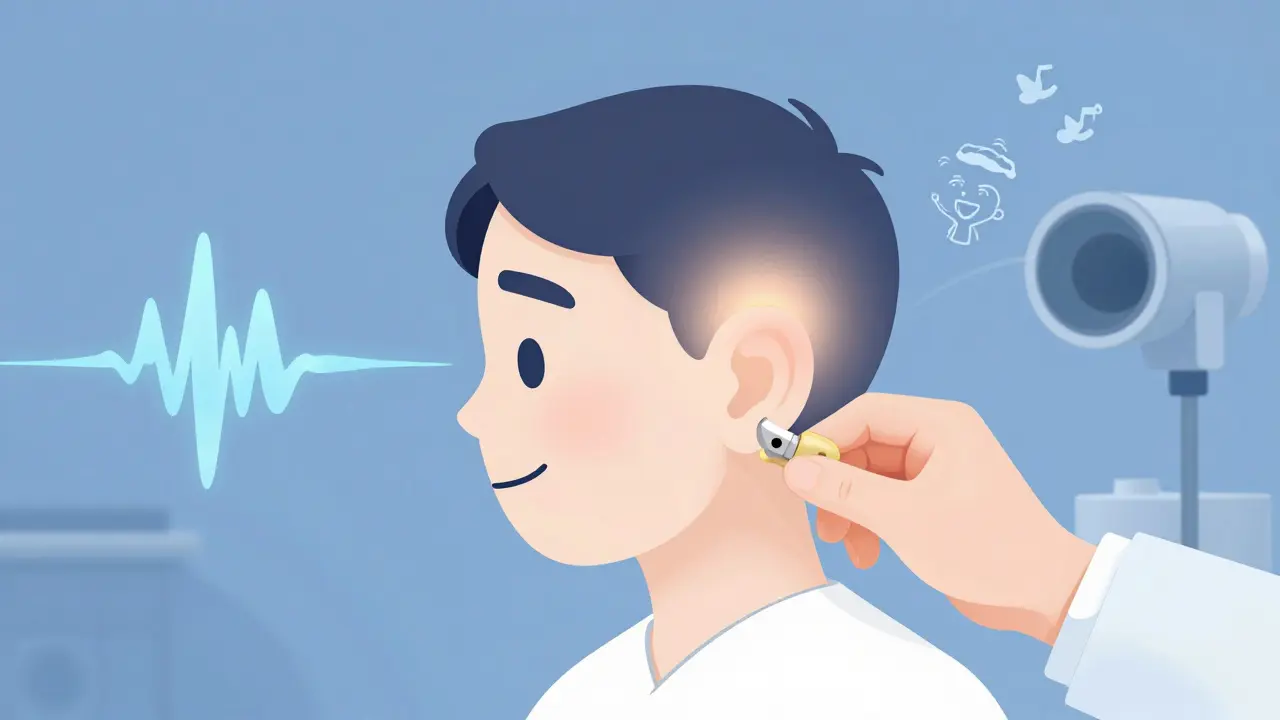
Comments (12)
okay but like… i had glue ear as a kid and my mom just let it go for 8 months bc she ‘didn’t wanna rush into surgery’? turns out i missed like… half of first grade? like, i thought everyone else was just talking in slow motion. now i’m 32 and still can’t hear birds chirping. why is this not a national emergency??
You claim conductive hearing loss is 'mechanical' and 'fixable'-yet you omit that 18% of tympanostomy tube patients still require antibiotics. That’s not a fix; it’s a Band-Aid with a side of recurrent infection. Also, stapedotomy success rates are inflated. A 2021 JAMA Otolaryngology meta-analysis showed 32% of patients developed sensorineural loss post-op. You’re selling a cure. It’s a gamble with your cochlea.
they say surgery fixes hearing but what if the government put something in the ear during surgery? like microchips to track you? i heard they already do this in hospitals. no one talks about it. they say it's 'normal recovery' but i think its mind control. you think you hear better but really you're just listening to the system.
If you're reading this and you've been struggling with muffled hearing for months-you're not alone. And you don't have to live with it. I've seen patients go from barely hearing their grandchildren to laughing at jokes they'd missed for years. It's not magic. It's medicine. Get the air-bone gap test. Find a good ENT. Don't wait until it's too late. Your ears are worth fighting for.
While the clinical efficacy of surgical interventions for conductive hearing loss is well-documented, I would respectfully submit that the socioeconomic disparities in access to otologic care remain profoundly unaddressed. In rural communities, particularly in the Global South, the cost of high-resolution CT scans and specialized surgical procedures is often prohibitive. This raises critical ethical questions regarding equity in auditory healthcare.
Look, I've had two ear infections in three years. I went to the doc. They said 'wait three months.' I waited. Then I went back. They said 'maybe a tube.' I said 'fine.' Now I'm out $1200 and still get water in my ear when I shower. This whole system is a scam. You pay, you wait, you get half a fix. I'm just tired.
Y’all. I had stapedotomy last year. I was skeptical. I thought I’d be the one who got dizzy forever. But? I heard my cat purr for the first time. Like… actually purr. Not like ‘oh I think I heard that.’ I heard it. And my mom’s voice? She doesn’t have to yell anymore. I cried. I didn’t even know I was missing that. You think it’s just about hearing louder-but it’s about feeling connected again. Don’t ignore it. Do the thing.
Wait-you say ‘cholsteatoma’ but spell it ‘cholesteatoma’ in the next paragraph? And ‘tympanoplasty’ is misspelled as ‘tympanoplsty’ in the second section? And you claim 87% satisfaction? Source? Citation? Link? No? Then it’s anecdotal. And you’re not a doctor. This article is dangerously misleading. I’m reporting this.
They tell you surgery is safe. But have you seen the lawsuits? The patients who lost hearing entirely? The ones who got facial paralysis? They bury it under ‘rare side effects.’ But rare doesn’t mean ‘never happens to me.’ And what about the ones who get tinnitus after? They say ‘it fades.’ But what if it doesn’t? What if you’re stuck with ringing for life? They’re not fixing your ear-they’re gambling with your sanity.
Bro. I had glue ear as a kid. Got tubes. Felt like a superhero. Now I’m 28, and my left ear still sounds like I’m underwater. But guess what? I stopped caring. I got a hearing aid. It’s tiny. It’s wireless. It connects to my phone. I hear podcasts better than most people. Sometimes you don’t need surgery-you just need to stop pretending your ears are broken. They’re just… different. And that’s okay.
Let me be blunt: this entire narrative is a corporate propaganda piece. Who funds these studies? Who profits from 667,000 ear tube surgeries a year? Who owns the patents on 3D-printed ossicular prostheses? It’s not medicine-it’s a revenue stream disguised as hope. They’re selling you a miracle so you’ll pay for it. And when it fails? They’ll tell you it’s ‘your body’s fault.’
my grandpa had conductive hearing loss and he just sat there for 10 years until he died. no surgery. no hearing aid. just quiet. and you know what? he was happy. maybe we dont need to fix everything. maybe the problem is we think every sound has to be heard. maybe silence is better. america needs to chill.