

When a patient picks up a generic pill, they don’t just see a cheaper version of their branded medicine. They see a color, a shape, a size - and sometimes, a hidden ingredient that goes against their beliefs. For many people from diverse cultural and religious backgrounds, the difference between a branded drug and its generic copy isn’t just about price. It’s about trust, identity, and safety.
Why Generic Pills Feel Different - And Why It Matters
Generic medications contain the same active ingredient as their brand-name counterparts. That’s the law. But the rest? The color, the shape, the coating, the capsule shell - those are up to the manufacturer. And those details matter more than you think. In Australia, where over 80% of prescriptions are filled with generics, pharmacists often assume patients don’t care about these differences. But for many, they do. A Muslim patient might refuse a capsule because it contains gelatin derived from pork. A Jewish patient may avoid a medication without kosher certification. An older patient from Southeast Asia might believe a red pill is stronger than a white one - and refuse to take it if it looks different from what they remember. A 2023 study in the U.S. found that 28% of African American patients doubted the effectiveness of generics, compared to just 15% of non-Hispanic White patients. Why? Many had seen their grandparents distrust medications after bad experiences with the healthcare system. Others simply didn’t recognize their new generic pill because it looked nothing like the brand they’d used for years.Hidden Ingredients That Break Cultural Trust
The real issue isn’t the active drug. It’s the excipients - the inactive ingredients that hold the pill together, make it easier to swallow, or keep it stable on the shelf. These can include gelatin, lactose, dyes, preservatives, and even alcohol. For Muslims, gelatin from pigs is strictly forbidden. For Hindus, bovine gelatin may be unacceptable. For vegans, any animal-derived ingredient is out. And for people with severe allergies, even trace amounts of lactose or peanut oil in a coating can be dangerous. Pharmacists in Melbourne, Sydney, and Brisbane report weekly calls from patients asking: "Is this halal?", "Does this have pork?", "Is it kosher?". One pharmacist in Footscray spent two hours calling manufacturers to find a liquid version of a blood pressure medication without gelatin because the patient was Muslim and refused to swallow a capsule. Yet, only 37% of generic medication labels in the U.S. list excipients in detail. In the EU, where rules are stricter, it’s 68%. That gap leaves patients guessing - and often, not taking their medicine at all.Cultural Beliefs About Color, Shape, and Size
It’s not just about ingredients. It’s about perception. In many Asian cultures, white pills are seen as weak or ineffective. Yellow or red pills are associated with strength and healing. In parts of Latin America, large pills are trusted more than small ones. In some African communities, oval shapes are linked to traditional remedies, while round pills feel "too modern" and suspicious. When a patient has been taking a red, oval-shaped branded pill for years - and then gets a small, white, round generic - their brain doesn’t process it as the same drug. It feels like a downgrade. A substitution. A risk. A 2022 FDA survey showed that patients who switched to generics without explanation were 3x more likely to stop taking their medication within 30 days. That’s not just non-adherence. That’s a public health risk.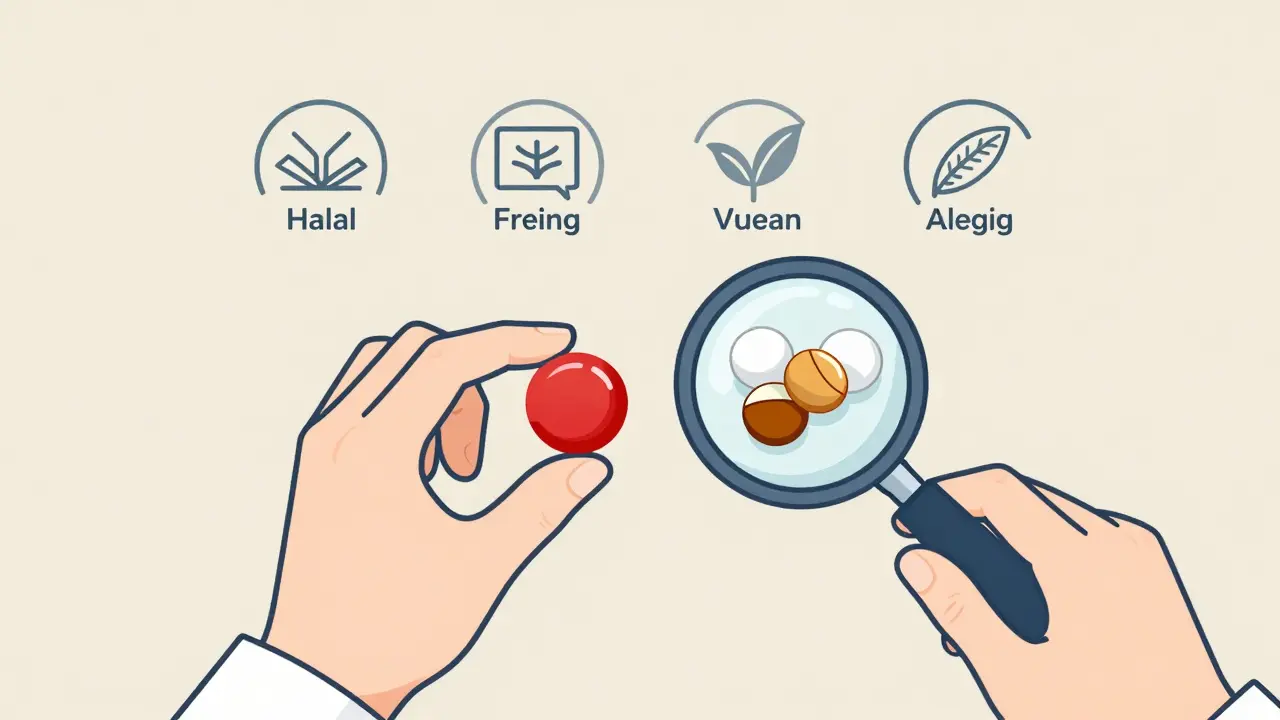
What Pharmacies Are Doing Right
Some pharmacies are stepping up - quietly, but effectively. In Melbourne, one chain started keeping a printed reference sheet behind the counter: a simple list of generic medications with halal and kosher certifications, flagged by excipient type. Staff were trained to ask: "Do you have any religious or cultural preferences about how your medicine is made?" - not as a formality, but as part of normal care. Another pharmacy partnered with a local mosque to distribute translated pamphlets explaining how generics work - with diagrams showing the difference between active ingredients and excipients. The message: "The medicine inside is the same. What’s outside can change. We can find one that fits your needs." These efforts cut refill abandonment by 40% in their multicultural patient groups.The Regulatory Gap
The Food and Drug Omnibus Reform Act (FDORA) passed in December 2022 pushed for better inclusion of diverse populations in clinical trials and better understanding of social factors in health. But it didn’t fix the labeling problem. Generic manufacturers still aren’t required to list excipients clearly. Even when they do, the information is buried in tiny print or only available online - not on the bottle. Teva and Sandoz, two of the world’s biggest generic makers, announced new initiatives in 2023 and 2024 to improve transparency. But these are voluntary. There’s no global standard. No mandatory labeling. No universal database. That means a patient in Toronto might get a halal-certified generic, while the same drug in Brisbane has no such label - even though it’s made by the same company.
What Needs to Change
We can’t wait for big pharma to fix this alone. Here’s what’s needed now:- Clear labeling: All generic packaging must list excipients in plain language - not just in technical terms.
- Training for pharmacists: At least 8 hours of cultural competence training per staff member, focused on religious restrictions, color beliefs, and communication.
- Digital tools: Apps or online databases where pharmacists can quickly check if a generic is halal, kosher, vegan, or allergen-free.
- Standardized icons: A universal symbol (like a halal or kosher mark) on packaging, so patients know at a glance.
- Community partnerships: Pharmacies working with religious leaders, cultural centers, and patient advocacy groups to build trust.
It’s Not Just About Medicines - It’s About Respect
A pill is more than chemistry. It’s a promise. A promise that it will work. That it’s safe. That it respects who you are. For too long, the generic drug system has treated cultural preferences as "special requests" - something to handle on a case-by-case basis. But when 1 in 3 patients in major cities come from non-English-speaking or minority backgrounds, that’s not a niche issue. It’s the norm. The cost of ignoring this isn’t just lost sales. It’s missed doses. Worsening diabetes. Uncontrolled blood pressure. Hospital visits that could have been avoided. The solution isn’t expensive. It’s thoughtful. It’s simple: ask. Listen. Adapt. When a patient says, "I can’t take this," don’t assume they’re being difficult. Ask: "What’s stopping you?" You might just find out they’re not refusing the medicine. They’re refusing to feel invisible.Why do some people refuse generic medications because of their color or shape?
Many cultures associate specific colors, shapes, or sizes with healing, strength, or danger. For example, in parts of Asia, red pills are seen as powerful, while white ones are viewed as weak. In Latin America, large pills are trusted more than small ones. When a generic pill looks different from the branded version a patient has used for years, they may believe it’s less effective - even if the active ingredient is identical. This perception, rooted in cultural experience, directly affects whether they take the medicine.
Are gelatin capsules always made from pork?
No. Gelatin can come from pigs, cows, or fish. But in many generic medications, the source isn’t listed on the label. For Muslims, pork-derived gelatin is forbidden. For Hindus, cow-derived gelatin may be unacceptable. Without clear labeling, patients can’t know if a capsule is safe for them. Some manufacturers now offer plant-based or fish-derived capsules, but these are rarely labeled as such unless specifically requested.
How can pharmacists find out what’s in a generic medication?
Pharmacists can check the manufacturer’s website, contact customer service directly, or use databases like the one developed by the European Medicines Agency. In Australia, some pharmacies use internal spreadsheets or apps that track excipients by brand and generic name. But there’s no centralized, publicly accessible database. Many pharmacists still spend hours calling manufacturers just to confirm if a pill contains alcohol, lactose, or gelatin.
Is there a legal requirement to label excipients on generic drugs?
In Australia and the U.S., there’s no strict legal requirement to list excipients in plain language on the packaging. The FDA and TGA require the information to be available - usually in the product information leaflet - but not prominently displayed. In the EU, regulations are stronger: excipients must be clearly listed. This inconsistency means patients in different countries get different levels of information, even for the same drug.
What can patients do if they need a culturally appropriate generic?
Patients should ask their pharmacist directly: "Does this medication contain gelatin, alcohol, or animal products? Is there a version without these?" They can also request a liquid form, which often avoids gelatin capsules. If the pharmacy doesn’t know, ask them to call the manufacturer. Many patients don’t realize they have the right to ask - and pharmacists don’t always offer the information unless prompted.
Comments (8)
Let’s be real-this isn’t about ‘cultural sensitivity,’ it’s about medical illiteracy masquerading as identity politics. You can’t have a healthcare system that accommodates every superstition disguised as tradition. If someone believes a red pill is ‘stronger,’ that’s not a cultural nuance-it’s a cognitive bias that needs to be corrected, not catered to. The FDA doesn’t certify placebo effects, and neither should pharmacies.
And don’t get me started on the gelatin debate. There are 7 billion people on this planet. If we start custom-formulating every pill based on religious dietary codes, we’ll need a new branch of pharmacology called ‘Theology & Therapeutics.’ This isn’t healthcare-it’s a cafeteria of exceptions.
Stop treating patients like toddlers who need their cereal in the right-shaped bowl. The active ingredient is what matters. The rest is aesthetic noise.
And yes, I’ve seen patients refuse insulin because the capsule was ‘too shiny.’ I’m not joking. We’re not running a spiritual retreat. We’re saving lives.
It’s not about ‘superstition,’ it’s about dignity. You’re reducing human beings to their pharmacokinetics and ignoring the fact that trust is a biological variable in treatment adherence.
When a Muslim grandmother refuses a pill because she can’t verify its halal status-she’s not rejecting medicine. She’s rejecting being erased. And yes, that’s a medical issue. Non-adherence kills. Period.
Pharmacists aren’t priests. But they’re the last human touch before a patient swallows something that could save-or kill-their life. If you think asking ‘Is this kosher?’ is ‘catering,’ then you’ve never held someone’s hand while they cry because they lost their husband to uncontrolled hypertension because they stopped taking the pills.
Labeling excipients isn’t ‘cultural appeasement.’ It’s basic harm reduction. And if your system can’t handle that, your system is broken.
Hey, I’m a pharmacist in Chicago, and I’ve been doing exactly what the article says-training staff, keeping a printed cheat sheet of excipients, and asking patients: ‘Is there anything about your meds that makes you uncomfortable?’
It takes 30 seconds. But it cuts abandonment by half. One guy came in last week because his generic blood pressure pill was white-he hadn’t taken it in three weeks because he thought it was ‘poison’ after his cousin died on a similar-looking pill in Mexico.
We found him a yellow, oval version. He cried. Said he felt ‘seen.’
That’s not ‘cultural catering.’ That’s medicine.
And yeah, I know it’s extra work. But if we’re serious about health equity, we don’t wait for regulations. We just… do it.
Oh, so now we’re entering the postmodern pharmacopeia, where the placebo effect is legislated by cultural anthropology? Fascinating. The pill is a signifier, not a substance. The color is the covenant. The shape is the sacrament.
But let’s deconstruct this: if a patient’s belief in the efficacy of a red pill is culturally constructed, then why is the belief in the efficacy of a white pill not equally valid? Is this just epistemic relativism with a pharmacy label?
And what happens when the next patient refuses a pill because it’s ‘too square’-because in their village, square objects symbolize death? Do we start designing pills as ritual objects? Do we outsource formulation to shamans?
This isn’t healthcare reform. It’s the commodification of trauma dressed in rainbow-colored capsules. And the worst part? We’re rewarding magical thinking with regulatory compliance. That’s not progress. That’s regression with better UX.
People dont realize how much trust matters. Not the science. Not the dosage. The trust. I had my grandpa stop his diabetes med because the new pill was blue. He said blue meant ‘weak medicine’ in his village. We got him the old brand. He took it. His sugar dropped. That’s not superstition. That’s psychology. And psychology is medicine too.
Also-why is it so hard to print ‘gelatin: bovine’ on the bottle? It’s not rocket science. Just… say it. Plain. Clear. No jargon. Just words. Like humans talk.
Man, in India, we’ve been doing this for decades. People know their brand names like family members. ‘I take the green one from Sun Pharma’-that’s not branding, that’s identity. When generics came in, my aunty refused them for a year because they were ‘too small’ and ‘too white.’ We had to get her the same shape, same color, even if it cost more. She’s fine now.
It’s not about religion. It’s about memory. The pill is a symbol of safety. Change the symbol, you break the ritual.
And honestly? The pharma companies are lazy. They could easily make 3-4 variants of the same drug for different markets. But they’d rather save 2 cents per pill and lose 10x in adherence.
Smart business? Nah. Just greedy.
Let me be blunt: the current system is failing marginalized populations because we treat cultural competence as an optional add-on, not a core competency. This is not a ‘niche issue’-it’s a systemic failure of public health infrastructure. The FDA, TGA, EMA-they all have the authority to mandate excipient transparency. They choose not to. Why? Because profit margins matter more than patient outcomes.
Every time a patient skips a dose because they don’t trust the pill’s appearance, we are complicit. Every delayed hospitalization, every avoidable stroke-it’s on us. We’ve turned healthcare into a transaction, not a relationship.
Training? Yes. Apps? Yes. Icons? Absolutely. But none of it matters unless we stop treating this as a ‘problem to solve’ and start treating it as a moral obligation. The law doesn’t require it? Then change the law. The manufacturers won’t do it? Then boycott them. The system is broken. We don’t fix it by whispering. We fix it by demanding.
Oh wow. So now we’re validating irrational fears as cultural rights? This is the exact kind of identity-based pseudoscience that’s destroying evidence-based medicine. Gelatin? Color? SHAPE? You’re telling me a 65-year-old woman in Brisbane refuses her antihypertensive because it’s ‘too round’? And we’re supposed to *apologize* for that?
This isn’t healthcare. This is a carnival of delusion. You’re rewarding magical thinking with regulatory compliance. The moment we start customizing pills for every cultural belief, we collapse into medical anarchy. Where do we draw the line? Next thing you know, someone’s demanding a pill shaped like their zodiac sign.
Stop infantilizing patients. Educate them. Don’t bend the science to their superstitions. The medicine works. Period. If they don’t believe it, they shouldn’t take it. But don’t make the entire system bend for their ignorance.