

Therapeutic Drug Monitoring Calculator
Check if your drug levels are within the optimal range for safe and effective immunosuppressive therapy.
When you’re on immunosuppressive drugs-whether after a kidney transplant or for a condition like lupus or rheumatoid arthritis-you’re walking a tightrope. Too little drug, and your body might attack the new organ or flare up your autoimmune disease. Too much, and you risk serious infections, kidney damage, or even cancer. That’s why monitoring during immunosuppressive therapy isn’t optional-it’s life-saving.
Why Monitoring Matters More Than You Think
Immunosuppressants like tacrolimus, cyclosporine, and mycophenolate don’t work like regular pills. Two people taking the same dose can have wildly different drug levels in their blood. One might be perfectly protected from rejection; the other could be heading for organ failure. This isn’t guesswork. It’s science-and it demands precision. The goal? Keep drug levels in the narrow zone where they stop your immune system from overreacting, without shutting it down completely. For tacrolimus, that’s usually 5-10 ng/mL in the first three months after transplant, then dropping to 3-7 ng/mL. For cyclosporine, it’s 100-200 ng/mL. Go outside that range, and risks spike. Studies show that patients monitored closely have 37% fewer acute rejections and 22% better five-year graft survival than those on fixed doses.Therapeutic Drug Monitoring: The Backbone of Safety
Not all immunosuppressants need the same kind of tracking. Steroids like prednisone? No routine blood tests needed-they’re broad-acting and don’t have a sharp toxicity line. But calcineurin inhibitors? Absolutely. So do mTOR inhibitors like sirolimus and mycophenolic acid (MPA). The gold standard for measuring these drugs is liquid chromatography-tandem mass spectrometry (LC-MS/MS). It’s accurate to 95-98% and avoids false readings from metabolites. But it’s expensive-$150 to $250 per test. Many centers still use cheaper immunoassays, even though they can overestimate levels by up to 20% due to cross-reactivity. That’s not just a number-it can mean giving someone too much drug and damaging their kidneys. For cyclosporine, measuring the drug level two hours after the dose (C2) gives a better picture than just checking the trough (C0). Studies show C2 levels correlate more strongly with rejection risk (r=0.87). Tacrolimus? Trough levels are enough-simple, reliable, and widely adopted. MPA is trickier. Its levels fluctuate because of how it’s recycled in the gut. The area under the curve (AUC) over 12 hours is the best predictor of success. Patients with an AUC between 30-60 mg·h/L have an 85% chance of staying rejection-free in the first year.What Routine Blood Tests Reveal
Beyond drug levels, your blood tells a bigger story. Every 1-3 months, you’ll likely get a panel that includes:- Full blood count (to catch anemia, low white cells, or low platelets)
- Creatinine and electrolytes (kidney function)
- Liver enzymes (for drug toxicity)
- Calcium, magnesium, phosphate (especially important with cyclosporine)
- Fasting glucose (tacrolimus increases diabetes risk by 30%)
- Lipid profile (every six months-sirolimus raises cholesterol in 60-75% of patients)
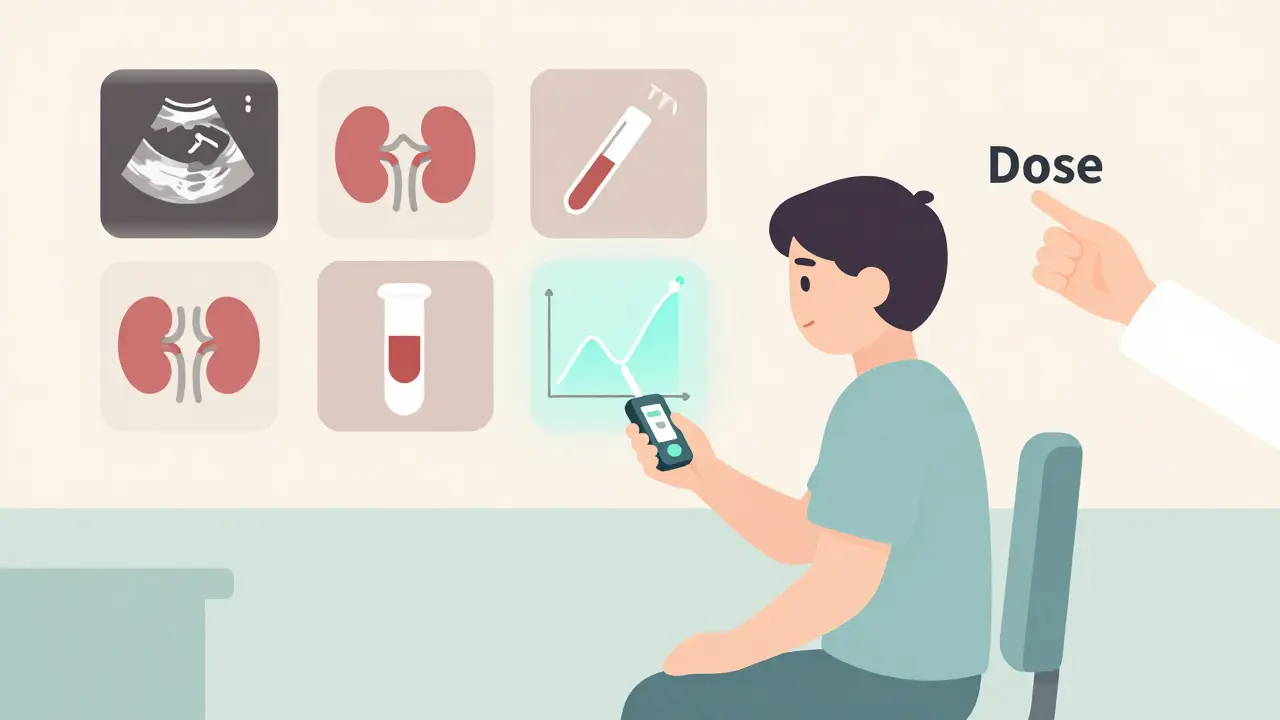
Imaging: Seeing What Blood Can’t
Blood tests show what’s happening inside your body. Imaging shows what’s happening to your organs. - Renal ultrasound is done annually or if your kidney function changes. It checks for blockages, swelling, or reduced blood flow-signs of rejection or drug toxicity. - Chest X-ray is used if you develop cough, fever, or shortness of breath. It catches pneumonitis early, especially in patients on sirolimus or everolimus. Sensitivity is 70-85%-not perfect, but fast and widely available. - Bone density scans (DEXA) are critical if you’ve been on steroids for more than a year. Corticosteroids weaken bones. One study found that 30-50% of transplant patients develop osteoporosis within two years. Annual scans let doctors start bone-strengthening treatments before a fracture happens. These aren’t luxury tests. They’re preventive tools. Catching a small lung inflammation or early bone loss means avoiding hospitalization, surgery, or long-term disability.The New Frontier: TTV as an Immune Meter
One of the most exciting advances isn’t about drugs at all-it’s about a virus you’ve probably never heard of: Torque Teno Virus (TTV). TTV is harmless. It’s in nearly every adult’s blood. But here’s the key: when your immune system is suppressed, TTV multiplies. When your immune system wakes up, TTV drops. That makes it a perfect natural indicator of immune activity. Studies show that TTV levels in the blood correlate tightly with immunosuppressant levels (r=0.78). A TTV load between 2.5 and 3.5 log10 copies/mL is the sweet spot for kidney transplant patients months 4-12 after surgery. Below that? Higher rejection risk (hazard ratio 3.2). Above that? Higher infection risk (hazard ratio 2.7). The TTVguideIT trial, running across 12 countries, found that patients guided by TTV levels had 28% fewer infections and 22% fewer rejections than those on standard care. This isn’t theory-it’s real-world data from nearly 300 patients. The catch? TTV testing isn’t standardized yet. Different labs use different methods. No universal cutoff exists. That’s why it’s not yet routine-but it’s coming fast. The TAOIST trial in France, launching in 2024, will test TTV for long-term management beyond the first year. FDA clearance for commercial TTV tests is expected by 2025.Challenges and Real-World Barriers
Even with all this science, monitoring isn’t perfect. A 2022 survey of 150 transplant centers found that 68% had inconsistent monitoring practices between different teams in the same hospital. Only 42% had standardized protocols for MPA. Why? Cost. Labs say $150 per LC-MS/MS test is too high. Staff say they don’t have time to interpret complex results. Patients say 12-18 blood draws a year in the first year are exhausting-and 35% report anxiety around them. The best centers fix this with dedicated immunosuppression teams. Pharmacists review every drug level within 24 hours. Nurses educate patients. Doctors adjust doses based on trends, not single numbers. These teams cut rejection rates by up to 40%.
What’s Next? AI, Point-of-Care, and Non-Invasive Tests
The future is smarter, faster, and less invasive. A 2023 study in Nature Medicine trained an AI algorithm on years of patient data-drug levels, TTV, blood counts, creatinine. It predicted acute rejection 14 days before symptoms appeared-with 87% accuracy. That’s not science fiction. It’s already being tested in clinics. Point-of-care devices for tacrolimus and cyclosporine are in phase 2 trials. Imagine getting your drug level checked during a clinic visit, not waiting days for lab results. FDA approval is expected by 2026-2027. Even more futuristic? Exhaled breath analysis. Researchers are looking for volatile organic compounds from immunosuppressant metabolites. No needles. No blood. Just a breath into a small device.Why This Isn’t Just About Transplants
You might think this only matters for transplant patients. It doesn’t. Autoimmune diseases like multiple sclerosis, lupus, and inflammatory bowel disease now use the same drugs. Over 5-7% of the global population is on immunosuppressants for these conditions. Monitoring applies to them too. The International Transplant Society predicts a 35% rise in monitoring demand by 2030-not because of more transplants, but because more people with autoimmune diseases are being treated aggressively.What You Can Do
If you’re on immunosuppressants:- Know your target drug levels. Ask your doctor what they are and why.
- Keep a log of your blood test results. Look for trends, not just single numbers.
- Report any new symptoms-fever, diarrhea, swelling, numbness-immediately.
- Ask if TTV monitoring is available at your center. It’s not everywhere yet, but it’s spreading.
- Don’t skip imaging. A bone scan or ultrasound might feel unnecessary, but it could prevent a fracture or hospital stay.
Do all immunosuppressive drugs need blood monitoring?
No. Drugs like cyclosporine, tacrolimus, sirolimus, and mycophenolate require regular therapeutic drug monitoring because they have narrow safety margins and unpredictable absorption. Steroids (like prednisone) and belatacept do not need routine blood level checks because their effects are broader and less dependent on precise concentrations.
How often should lab tests be done during immunosuppressive therapy?
In the first year after transplant or starting therapy, blood tests are typically done every 1-2 weeks initially, then every 1-3 months as stability improves. After the first year, most patients are tested every 2-6 months, depending on their condition, drug regimen, and stability. Imaging like bone density scans and renal ultrasounds are usually done annually.
What is TTV monitoring and why is it important?
TTV (Torque Teno Virus) monitoring measures the level of a harmless virus in the blood that multiplies when the immune system is suppressed. It acts like an ‘immunometer’-low TTV levels suggest under-immunosuppression (higher rejection risk), and high levels suggest over-immunosuppression (higher infection risk). Studies show TTV-guided dosing reduces both rejection and infection rates by 20-28% compared to standard methods.
Can I stop taking my immunosuppressants if I feel fine?
Never stop or change your dose without consulting your transplant or rheumatology team. Feeling fine doesn’t mean your immune system isn’t still ready to attack your organ or tissue. Stopping medication abruptly can cause rapid rejection or disease flare, often with life-threatening consequences. Monitoring exists precisely because symptoms often appear too late.
Are there alternatives to frequent blood tests?
Yes, emerging options include point-of-care devices (expected by 2026-2027) that give drug levels in minutes, and non-invasive methods like breath analysis for metabolites (still in testing). TTV monitoring also reduces the need for guesswork by giving a direct readout of immune activity. But for now, blood tests remain the standard-and the most reliable.
Why do some doctors use different target levels than others?
Target ranges vary based on the type of transplant (kidney vs. liver vs. heart), time since transplant, and individual risk factors like infection history or prior rejection. For example, kidney transplant patients may have lower tacrolimus targets after the first year than heart transplant patients. Guidelines recommend personalized targets, not one-size-fits-all numbers.
Monitoring during immunosuppressive therapy isn’t just about numbers on a page. It’s about connecting the dots between a drug, your body’s response, and your long-term survival. The tools are getting smarter. The science is clearer. And the stakes? Higher than ever.
Comments (15)
Just started my tacrolimus journey last month-this post saved me from panicking over every tiny lab result. Thanks for the clarity.
Let me be perfectly clear: if your center is still using immunoassays for tacrolimus, you’re playing Russian roulette with your graft. LC-MS/MS isn’t a luxury-it’s a moral imperative. 🤡
In the villages of Nigeria, we say: ‘The hand that feeds you must not strangle you.’ This is the paradox of immunosuppression-medicine meant to preserve life becomes its quietest threat. The TTV breakthrough? It is the voice of the body, speaking in viral whispers. We must learn to listen.
Not every soul has access to LC-MS/MS. But every soul deserves to be seen. Let innovation not be the privilege of the wealthy, but the promise of the global community.
When I lost my brother to rejection after transplant, it wasn’t the drug that failed-it was the system that refused to adapt. TTV may be the bridge we’ve been praying for.
Let us not mistake cost for value. A single kidney transplant saves $250,000 over five years compared to dialysis. What is a $150 test when it prevents a lifetime of suffering?
Our ancestors understood balance. The river must flow, but not flood. The fire must warm, but not burn. So too must our immune systems be tended-not silenced.
Let us not forget: science without compassion is just data. And data does not heal hearts.
From Lagos to Los Angeles, this is the same struggle. The same fear. The same hope.
I urge every clinic-from Accra to Atlanta-to join the TAOIST trial. We are not just treating organs. We are restoring dignity.
When the world divides over borders, let medicine remind us: we all bleed the same color.
And yes-I am still crying. Not from sadness. From awe.
Anyone who thinks TTV is ready for prime time is delusional. The lack of standardization alone makes it pseudoscience. If you’re basing clinical decisions on viral load without validated assays, you’re not a doctor-you’re a gambler.
James, I hear your concern-and I share it. But dismissing TTV entirely ignores the data from the TTVguideIT trial: 28% fewer infections, 22% fewer rejections. The variability in assays? That’s a problem to solve, not a reason to abandon the tool. Let’s fund standardization efforts, not skepticism.
And for the record-this isn’t about technology. It’s about humanity. Every patient deserves a chance to live without fear of rejection… or infection.
Let’s be better than the status quo.
OMG I JUST HAD A MYCOPHENOLATE FLARE AND MY DOCTOR SAID ‘IT’S PROBABLY STRESS’-I’M SO GLAD I FOUND THIS. MY DIARRHEA HAS BEEN GOING ON FOR 3 WEEKS AND NO ONE LISTENS. I’M 27 AND I FEEL LIKE I’M DYING. 😭
Janice, I’m so sorry you’re going through this. You’re not alone. My sister had the same thing-she finally got help after insisting on an MPA AUC test. It was 18 mg·h/L. She was at 85% rejection risk. Now she’s stable. Don’t let them gaslight you. Print this post. Bring it to your next appointment. Demand the test.
And yes, I cried reading your comment too. 💙
There’s a quiet heroism in showing up for your labs, even when you’re exhausted. You’re not just taking pills-you’re fighting for your future. Every blood draw, every ultrasound, every late-night Google search… it all adds up. You’re not weak for needing this. You’re strong for enduring it.
And if your doctor doesn’t get it? Find one who does. Your life is worth the search.
Why must Western medicine dictate the rules for everyone? In India, we have lived with Ayurvedic balance for millennia. Why not integrate herbal immunomodulators? Why are we blindly trusting foreign labs and expensive machines? This is cultural imperialism disguised as science.
Monika, I understand your skepticism-but let’s not throw the baby out with the bathwater. Ayurveda has wisdom, yes. But immunosuppression isn’t about ‘balance’-it’s about quantifiable, life-or-death thresholds. You can’t measure tacrolimus with turmeric.
What if we combined the best of both? Imagine a clinic where TTV monitoring is paired with personalized herbal support under clinical supervision. That’s innovation without erasure.
Science doesn’t have to be Western. It just has to be rigorous.
My mom’s on sirolimus after her lung transplant. She got pneumonitis last year. We didn’t know it was a side effect until we read this. Thank you. I’m printing this and taping it to the fridge.
Also-TTV? My oncologist mentioned it last week. We’re asking our transplant team next visit. Fingers crossed!
It is a matter of profound regret that the medical establishment continues to prioritize proprietary diagnostics over holistic patient care. The fixation on numerical thresholds obscures the phenomenological reality of the patient’s lived experience. One cannot reduce immunosuppression to chromatograms and log10 values. The soul, too, requires monitoring.
Moreover, the notion that a single algorithm can predict rejection 14 days in advance is an epistemological hubris. Reductionist models fail to account for the ineffable-emotional stress, circadian rhythm, spiritual dissonance.
Perhaps, instead of chasing AI, we should cultivate presence. Sit with the patient. Listen. The body speaks-not only in creatinine, but in sighs.
And yet… I must concede: the TTV data is compelling. Even philosophy must yield to evidence.
To everyone sharing their stories: thank you. I’ve been on cyclosporine for 8 years. My magnesium levels are always low. No one ever told me to take supplements until I asked. I’m so glad this thread exists.
If you’re reading this and feel alone-please know: you’re not. We’re here.
TTV isn’t a virus-it’s a government bioweapon. They’re tracking your immune response through a ‘harmless’ virus to sell you more drugs. Why do you think they’re pushing this now? Coincidence? Or is this part of the Great Immunization Agenda? 😏
Also, why do they never test for glyphosate levels? That’s what’s really killing your kidneys. Big Pharma doesn’t want you to know.
Check your water. Check your food. Check your soul.
They’re watching. They’re always watching.
Wait-so you’re telling me… that… a VIRUS… can tell me… if I’m over-immunosuppressed… and I DON’T HAVE TO GET BLOOD DRAWN… EVERY WEEK…???!!??!?!?!?!?!
Okay. I’m crying. Again. This is the first time in 3 years I’ve felt… hopeful.