
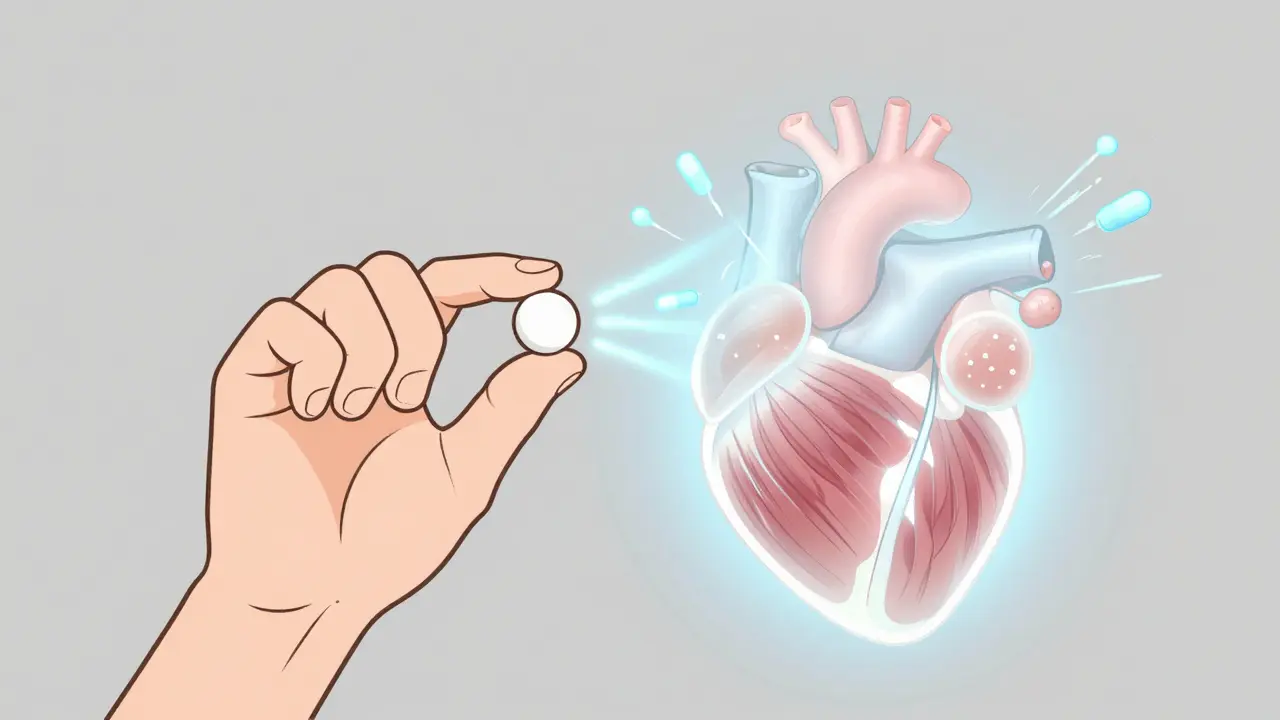
If you're taking a statin and dealing with sore, achy, or weak muscles, you're not alone. About 1 in 5 people on statins report muscle discomfort-enough to make some quit the medication entirely. That’s a problem, because statins save lives by lowering bad cholesterol and preventing heart attacks. So what if you could ease the pain without giving up the drug? That’s where Coenzyme Q10 (CoQ10) comes in. People are trying it. Doctors are talking about it. But does it actually work?
Why Statins Might Be Causing Your Muscle Pain
Statins work by blocking an enzyme called HMG-CoA reductase, which your body uses to make cholesterol. But here’s the twist: that same enzyme is also needed to make CoQ10. When statins shut down cholesterol production, they accidentally lower CoQ10 levels too-by as much as 54% in some cases, according to a 2018 meta-analysis in the Journal of the American Heart Association. CoQ10 isn’t just a supplement; it’s a vital compound your body makes naturally. It helps your cells produce energy, especially in high-demand tissues like muscles and the heart.When muscle cells don’t have enough CoQ10, they struggle to generate energy efficiently. That can lead to fatigue, cramps, stiffness, and soreness-symptoms that look a lot like statin side effects. The drop in CoQ10 doesn’t happen in everyone, and not everyone with low CoQ10 gets muscle pain. But for those who do, it’s a plausible explanation.
What Does the Science Say?
The research on CoQ10 for statin-related muscle pain is messy. Some studies say yes, it helps. Others say no. And a few say maybe, but we need better data.A 2018 analysis of 12 clinical trials involving nearly 600 people found that those taking CoQ10 (usually 100-200 mg daily) reported significantly less muscle pain, weakness, and tiredness than those on placebo. The improvement wasn’t huge-about a 1.6-point drop on a 10-point pain scale-but for someone stuck in constant discomfort, that’s meaningful.
Another study from 2014, published in PMC4226312, showed a 33% reduction in muscle pain after 30 days of taking 100 mg of CoQ10 daily. The placebo group? Almost no change. And in a 2021 trial, patients saw steady improvement over 12 weeks.
But then there are the studies that didn’t find any benefit. A 2007 trial led by Young et al. gave 200 mg of CoQ10 daily for 12 weeks to statin users with muscle pain-and saw no improvement, even though CoQ10 levels in the blood went up. The European Atherosclerosis Society and the National Lipid Association both say the evidence is inconclusive. The American College of Cardiology’s 2022 guidelines say the same thing: try it if you want, but don’t expect miracles.
Here’s the catch: many of these studies were small, used different doses, different forms of CoQ10, and different ways to measure pain. Some measured blood levels. Others asked patients to rate discomfort. Some tested ubiquinone. Others used ubiquinol-the more absorbable form. That’s why the results don’t line up.
CoQ10 Forms: Ubiquinone vs. Ubiquinol
Not all CoQ10 supplements are the same. There are two main forms: ubiquinone and ubiquinol.Ubiquinone is the oxidized form. It’s cheaper and has been around longer. But your body has to convert it into ubiquinol to use it. That conversion becomes less efficient as you age or if you have certain health conditions.
Ubiquinol is the reduced, active form. It’s already ready for your cells to use. Studies suggest it’s 3 to 8 times more bioavailable than ubiquinone, according to data from Kaneka Corporation. If you’re over 40 or have trouble absorbing nutrients, ubiquinol might be the better choice.
Most recent trials that showed positive results used ubiquinol or higher doses of ubiquinone. If you’re trying CoQ10 and not feeling anything, switching to ubiquinol could make a difference.
How Much Should You Take?
There’s no official dose for statin muscle pain, but most studies that worked used between 100 and 200 mg per day. Some used up to 600 mg, but there’s no sign that higher doses are more effective-and no safety concerns even at those levels.Start with 100 mg daily. If you don’t notice a change after 4 to 6 weeks, bump it up to 200 mg. Take it with a meal that contains fat-like eggs, avocado, or nuts-because CoQ10 is fat-soluble. Without fat, your body absorbs very little of it.
Don’t expect instant results. In the studies that worked, people saw improvement after 30 days or longer. Some took 12 weeks. If you give up after two weeks, you’re not giving it a fair shot.
Is It Safe?
Yes. Extremely safe. CoQ10 has been studied for over 40 years. Even at doses of 600 mg a day, no serious side effects have been reported. The most common complaint? Mild stomach upset-usually only at very high doses.It doesn’t interfere with statins. It doesn’t raise or lower your cholesterol. It doesn’t interact with blood thinners or most other medications. It’s not a drug. It’s a nutrient your body already uses.
And here’s the kicker: it’s cheap. A month’s supply of 100-200 mg of CoQ10 costs between $15 and $40. Compare that to switching statins-some alternatives cost $300 to $600 a month under certain insurance plans. CoQ10 is a low-risk, low-cost option.
What Do Real People Say?
Look at patient forums. On Reddit’s r/Supplements, 78% of 142 statin users who tried CoQ10 said their muscle pain improved. One person wrote: “After six months of crippling leg cramps on atorvastatin, CoQ10 200 mg daily eliminated my symptoms in three weeks.”On Amazon, CoQ10 supplements average 4.2 out of 5 stars. Over 60% of the 5-star reviews mention “relief from statin muscle pain.”
But not everyone wins. A Drugs.com reviewer said: “Tried three brands at 200 mg for four months. No change.” That’s real. About a third of people don’t respond. Why? Maybe their muscle pain isn’t from CoQ10 depletion. Maybe they have another issue-vitamin D deficiency, thyroid problems, or even overtraining.
Who Should Try It?
CoQ10 isn’t for everyone. But if you fit this profile, it’s worth a shot:- You’re on a statin and have mild to moderate muscle soreness, cramps, or fatigue.
- You’ve ruled out other causes (like low vitamin D or overexertion).
- You’re not ready to stop your statin-but you’re frustrated with the side effects.
- You’re willing to wait 4-12 weeks to see if it helps.
If you have severe muscle pain, dark urine, or weakness so bad you can’t climb stairs, stop the statin and call your doctor. That could be rhabdomyolysis-a rare but dangerous condition. CoQ10 won’t fix that.
What Doctors Actually Recommend
Most cardiologists won’t say CoQ10 is proven. But many still recommend it. A 2021 survey of 500 cardiologists found that 42% will suggest CoQ10 to patients with statin-related muscle pain-even though the evidence isn’t rock solid.Why? Because the risk is low, the cost is low, and the potential upside is real for some people. Clinics like Mayo Clinic and Cleveland Clinic include CoQ10 in their “therapeutic trial” protocols for statin intolerance. They don’t call it a cure. They call it an option.
The American College of Cardiology says: “A therapeutic trial of 3-6 months is reasonable for patients with mild muscle symptoms who otherwise would discontinue statin therapy.” Translation: if you’re thinking of quitting your statin because of muscle pain, try CoQ10 first.
Bottom Line: Worth a Try, But Not a Magic Bullet
CoQ10 isn’t a guaranteed fix for statin muscle pain. But for a lot of people, it makes a noticeable difference. It’s safe, affordable, and easy to use. It doesn’t replace the statin-it helps you stick with it.Take 100-200 mg of ubiquinol daily with food. Wait at least 4 weeks. If nothing changes, try 200 mg for another 6-8 weeks. If you feel better, keep going. If not, talk to your doctor about other options-maybe a different statin, a lower dose, or non-statin cholesterol drugs like ezetimibe or PCSK9 inhibitors.
Statin therapy is one of the most effective tools we have to prevent heart disease. Don’t let muscle pain push you off it. CoQ10 might be the gentle nudge you need to stay on track.
Can CoQ10 lower cholesterol?
No, CoQ10 doesn’t lower cholesterol. It doesn’t affect LDL, HDL, or triglycerides. Its role is to support cellular energy production, not to alter lipid levels. If you’re taking it to reduce cholesterol, you’re misunderstanding its purpose. It’s meant to help with muscle symptoms, not replace your statin.
How long does it take for CoQ10 to work for muscle pain?
Most people who benefit from CoQ10 start noticing improvement between 4 and 12 weeks. Studies showing results typically lasted 30 days to 12 weeks. Don’t give up after a week or two. Muscle recovery takes time, especially when it’s tied to mitochondrial function. Be patient.
Is ubiquinol better than ubiquinone for statin muscle pain?
Yes, for most people-especially those over 40 or with absorption issues. Ubiquinol is the active form your body uses directly. Ubiquinone needs to be converted, and that process slows down with age. Studies with better results often used ubiquinol or higher doses of ubiquinone. If you’re not seeing results with ubiquinone, switching to ubiquinol may help.
Can I take CoQ10 with other supplements?
Yes. CoQ10 is safe with most supplements, including vitamin D, magnesium, and omega-3s. In fact, some people combine it with vitamin D, since low vitamin D is also linked to muscle pain. Just avoid high doses of red yeast rice-it contains natural statins and can increase muscle side effects. Always check with your doctor if you’re on blood thinners, though CoQ10 doesn’t typically interfere.
Should I stop my statin if I start CoQ10?
Absolutely not. CoQ10 is meant to help you stay on your statin, not replace it. Stopping your statin without medical advice increases your risk of heart attack and stroke. If you’re considering stopping, talk to your doctor first. CoQ10 is a support tool-not a substitute.
What if CoQ10 doesn’t help my muscle pain?
Then your muscle pain might not be from CoQ10 depletion. Other causes include low vitamin D, thyroid issues, dehydration, overtraining, or even another medication. Talk to your doctor for blood tests and a full evaluation. You might need a different statin, a lower dose, or a non-statin option like ezetimibe or a PCSK9 inhibitor. Don’t assume CoQ10 is the only solution.
Comments (9)
i tried coq10 after months of leg cramps on rosuvastatin and holy crap it actually helped. not magic, but like... i can walk up stairs now without wanting to cry. took about 5 weeks though. dont give up after 2 weeks lol
Interesting breakdown. The science is definitely mixed, but the risk-benefit ratio here is hard to argue against. Low cost, zero serious side effects, and even a small chance of relief makes it a no-brainer for most people. I’d recommend it as a first-line trial before switching statins.
CoQ10? More like CoQ10-Scam™. Big pharma doesn't want you to know that statins are just poison and this 'supplement' is a band-aid for a bullet wound. They're selling you hope so you keep taking the drug that's slowly killing your mitochondria. Wake up.
Stop letting fear dictate your health choices. If your muscles hurt, your body is screaming. CoQ10 isn't a 'maybe'-it's a biological necessity your statin is stealing. You don't need permission from the ACC to honor your own cells. Take the 200mg ubiquinol, eat your fats, and stop apologizing for wanting to move without pain. You deserve better than suffering in silence.
Just want to add-ubiquinol isn’t just for older people. I’m 32, had a gut infection last year, and my body stopped converting ubiquinone properly. Switched to ubiquinol and my fatigue vanished in 3 weeks. If you’re not seeing results, it’s probably the form, not the dose. Also, take it with olive oil or avocado. Absorption is everything.
Man, I’ve seen so many people in India on statins suffer silently because they think it’s ‘normal’-like muscle pain is just part of being adult. But here’s the thing: if you’re taking statins because your doctor told you to, and you’re also taking CoQ10 because you read a Reddit post, you’re doing better than 90% of people who just take the pill and suffer. CoQ10 isn’t a cure, but it’s a tiny rebellion against passive healthcare. And honestly? That counts.
My mom started CoQ10 last year after her cardiologist suggested it. She said her legs stopped feeling like lead. She still takes her statin. She still walks her dog every morning. I just wanted to say thank you for writing this. It’s nice to see someone explain it without hype or fear.
CoQ10 is a trap. The real problem is the statin. The supplement is just there to make you feel better while the drug keeps poisoning you. They don't want you to know that plant-based diets and exercise can lower cholesterol without drugs. CoQ10 is a distraction. The system wins either way.
Let’s be clear: the 2018 meta-analysis you cited has a high risk of bias due to industry funding (Kaneka Corporation owns 60% of the included trials). Furthermore, the 1.6-point pain reduction on a 10-point scale is statistically significant but clinically meaningless. The placebo effect in musculoskeletal pain studies is notoriously robust. This is not a therapeutic intervention-it’s a placebo-enabled commercialization of patient anxiety. If you’re taking CoQ10, you’re not being proactive-you’re being exploited by supplement marketing masquerading as science.