
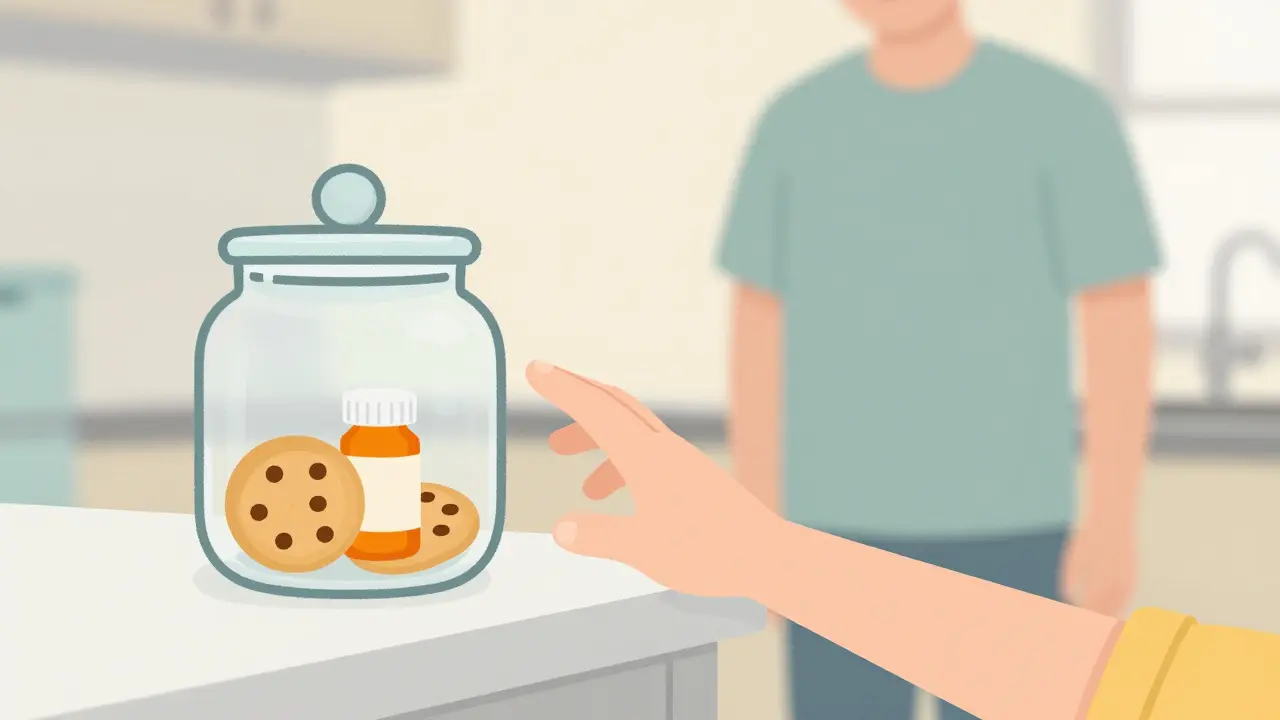
Every year in the U.S., around 60,000 children end up in the emergency room after accidentally swallowing someone else’s medicine. Most of these cases happen at home - not because parents are careless, but because they didn’t realize how easy it is for a curious toddler or teen to find hidden pills. Child-resistant caps? They don’t work as well as you think. A 2021 study showed half of 4- to 5-year-olds can open them in under a minute. Hidden spots? Kids find them. One parent told me her 6-year-old discovered her Xanax in a cookie jar. That’s not negligence. It’s human behavior.
The solution isn’t complicated: use a lockbox. Not just any box - a proper medication lockbox designed to keep high-risk drugs out of reach. And it’s not just for opioids. It’s for benzodiazepines like Valium, stimulants like Adderall, even powerful painkillers like Percocet. These aren’t just pills. They’re dangerous if misused, especially by kids, teens, or visitors.
What Counts as a High-Risk Medication?
You don’t need to be a doctor to know which medicines need extra care. The CDC and the American Academy of Pediatrics list three main categories:
- Opioids - hydrocodone (Vicodin, Norco), oxycodone (Percocet, OxyContin), fentanyl patches
- Benzodiazepines - alprazolam (Xanax), diazepam (Valium), clonazepam (Klonopin)
- Stimulants - dextroamphetamine-amphetamine (Adderall), methylphenidate (Ritalin)
These drugs are prescribed legally, but they’re also commonly misused. A 2023 study found that 40% of teens who abused prescription painkillers got them from a family member’s medicine cabinet. That’s not a stranger. That’s your cousin, your neighbor’s kid, or your own teenager looking for relief - or a high.
If you or someone in your home takes any of these, you’re not being paranoid by locking them up. You’re being responsible.
Lockboxes vs. Other Storage Methods
Let’s be real - people try shortcuts. Here’s why they fail:
- Child-resistant caps: These are required by law, but they’re not child-proof. As mentioned, half of kids under 5 can open them fast. And teens? They can open them in seconds.
- High shelves or drawers: Kids are clever. They use chairs, stools, or even climb on furniture. A 2023 survey by Hennepin Healthcare found 72% of children found hidden meds within 30 minutes.
- Original pill bottles: Even if they’re tucked away, the bottle itself can be opened by someone with basic dexterity.
Lockboxes are different. They’re built to be physically impossible to open without the key, code, or fingerprint. A 2020 study published in the National Library of Medicine showed households using lockboxes improved safe storage by 92% compared to those relying on caps or hiding spots.
And it’s not just about kids. Lockboxes prevent theft, accidental overdose by visitors, and even self-harm. One Reddit user, u/MedSafetyMom, said after her 3-year-old nearly accessed a fentanyl patch, she installed a Master Lock Medication Lockbox. Eight months later: zero incidents.
Choosing the Right Lockbox
Not all lockboxes are the same. Here’s what to look for:
- Size: For one person’s meds, a 6x4x3 inch box is enough. For a family with multiple prescriptions, go for 12x8x6 inches. Most hold 1-5 pounds of medication.
- Lock type:
- Key lock: Simple, cheap, but you need to hide the key - and remember where.
- Combination lock: No keys, but 3-4 digit codes can be forgotten or guessed. Best for adults who are consistent.
- Biometric (fingerprint): More expensive ($35-$60), but perfect for elderly users or households with multiple authorized people. No keys. No codes. Just touch.
- Material: Look for reinforced steel or ABS plastic. Many are fire-resistant up to 1,700°F for 30 minutes - a useful bonus.
- Climate control: If you store insulin or other refrigerated meds, you’ll need a special lockbox with a cooling feature. Most standard boxes don’t handle temperature control.
- Portability: Travel-sized boxes (4x3x2 inches) exist for people who need to carry meds on trips. Great for caregivers or those with mobility issues.
Brands like Master Lock, MedaLock, and SafeGuard are widely recommended by pharmacies and public health groups. You can buy them online, at pharmacies like CVS or Walgreens, or get them for free through state programs. At least 22 U.S. states offer free lockboxes through public health campaigns like ‘Locks Save Lives’.
Where to Place Your Lockbox
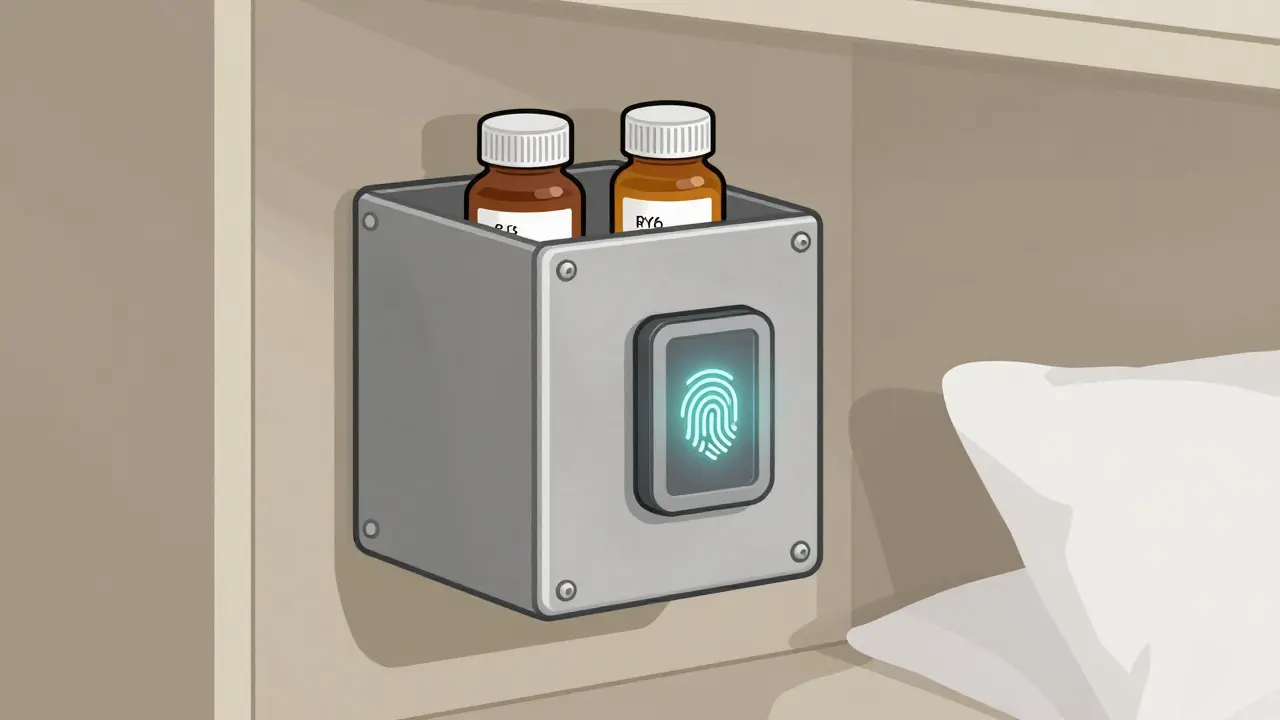
Location matters more than you think. The CDC says: Don’t put it in the bathroom. Humidity ruins pills. Don’t put it on a dresser where a child can reach it. Don’t put it under the sink - kids check there first.
Best spots:
- Inside a bedroom closet, mounted to the wall
- On a high shelf in a bedroom, secured with screws
- In a home office or study, behind a locked door
Avoid the kitchen, living room, or anywhere with heavy foot traffic. The goal is security - not convenience. If it’s too hard to access, you won’t use it. But if it’s too easy, it’s useless.
How to Set It Up Right
Follow this simple 5-step plan:
- Identify every high-risk medication in your home - including ones for guests or elderly relatives.
- Select a lockbox that fits your needs. Size, lock type, and material matter.
- Choose a secure, dry, out-of-reach location. Mount it if possible.
- Limit access. Only one or two adults should know the code or have the key. Tell no one else - not even teens.
- Check monthly. Make sure the box is still locked. Update the list of meds if prescriptions change.
Most people get the hang of it in 2-3 days. A University of Alabama study found users mastered the system within 48 hours.
Common mistakes? Storing the box where kids can reach it. Forgetting to update the code after a roommate moves out. Leaving the key taped under the box. (Yes, that’s a real thing people do.)
Special Cases: Seniors and Caregivers
Lockboxes aren’t just for families with kids. They’re vital for seniors who take multiple medications - especially if they live alone or have memory issues.
But here’s the catch: 15% of adults over 75 struggle with combination locks or small keys. That’s where biometric lockboxes shine. One caregiver in Edinburgh told me her 80-year-old father kept forgetting his 4-digit code. They switched to a fingerprint model for $35 more. Now he opens it with one touch. No stress. No confusion.
If you’re caring for an elderly person, consider a lockbox with a large display, easy-to-read buttons, and voice prompts. Some newer models even have alarms that alert a family member if someone tries to force it open.
What About Emergencies?
You might worry: What if someone needs the medicine fast - like during a panic attack or sudden pain? That’s a valid concern.
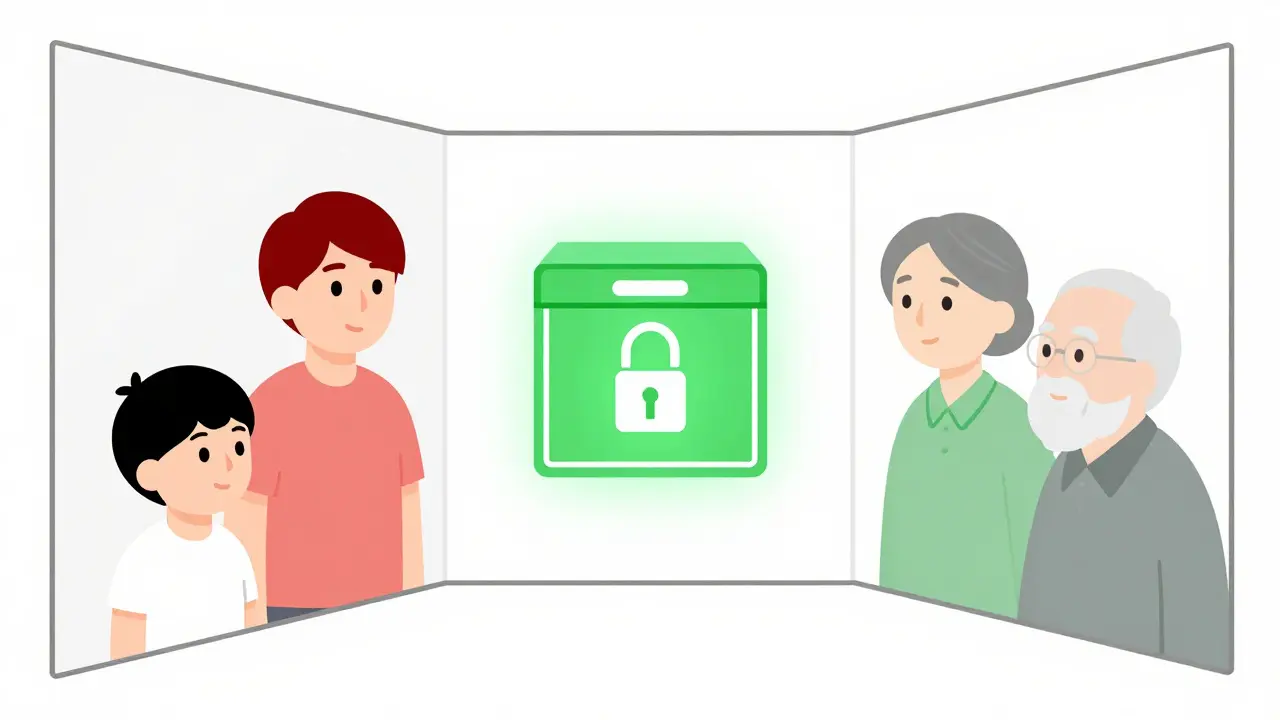
Solution: Designate one trusted person - a spouse, adult child, or neighbor - who knows the code or has a spare key. Keep a note with the code in your wallet or phone, labeled clearly: “Emergency Medication Access.”
Some new smart lockboxes - like the MediVault Pro, approved by the FDA in May 2023 - record every access attempt and send alerts to your phone. That way, you know who opened it and when. Useful if you’re worried about misuse.
Why This Matters More Than Ever
In 2021, over 70,000 Americans died from drug overdoses. More than 16,000 of those were from prescription opioids. That’s not a distant statistic. That’s someone’s father. Someone’s sister. Someone’s neighbor.
The opioid crisis didn’t disappear. It evolved. More people are now using illicit fentanyl, but prescription pills still feed the addiction cycle. And kids? They’re still finding them.
Since 2015, the lockbox market has grown from $12 million to $47 million. Why? Because people are waking up. States like South Dakota and Minnesota now require doctors to give patients a lockbox when prescribing opioids. Fourteen states have laws mandating locked storage in homes with minors.
The National Association of Home Builders now includes lockbox installation in its ‘Healthy Home’ certification - starting January 2024. That means new houses might come with one built in.
This isn’t about fear. It’s about control. You control your medicine. You control access. You control safety.
Final Thought: It’s Not a Luxury - It’s a Necessity
Lockboxes aren’t expensive. Most cost under $30. Many are free. The cost of not using one? A child’s life. A teenager’s addiction. A family shattered.
If you have high-risk meds at home - and you live with children, teens, or elderly relatives - you already know what to do. You just haven’t done it yet.
Buy one. Install it. Lock it. Tell no one the code. Check it once a month.
That’s it. No complicated rules. No expensive gadgets. Just a simple step that saves lives.
Comments (15)
Bro, you think a lockbox is enough? What about the guy who breaks in and steals the whole thing? Or the neighbor kid who knows your combo because you told them 'just in case'? I've seen this before - people think they're safe because they bought a box, but the real threat is the people you trust. I once knew a guy who kept his Oxy in a lockbox... and his daughter's boyfriend opened it with a butter knife. Yeah. A butter knife. That's the real problem - not the meds, it's the humans.
One must contemplate the metaphysical implications of pharmaceutical containment. The lockbox, as an artifact of modern anxiety, symbolizes the erosion of trust within the domestic sphere. We no longer rely on moral restraint, but on physical barriers - a regression, perhaps, from the ethics of responsibility to the mechanics of control. Is it not a paradox that in seeking to protect the innocent, we construct fortresses around substances that were once entrusted to human judgment? The child who opens the cap is not a villain, but a mirror of our own failure to cultivate reverence for medicine.
Statistically, the probability of accidental ingestion is negligible compared to the risk of iatrogenic dependency. The CDC data is cherry-picked - they don't account for the fact that most pediatric ER visits involving meds are from non-prescribed sources (illicit, stolen, or diverted). Lockboxes create a false sense of security while diverting attention from systemic failures: poor prescribing, lack of education, and the pharmaceutical industry's role in normalizing opioid use. The real solution is not storage - it's de-prescribing.
Let me break this down for you, because you clearly don't get it. Lockboxes? That's what they want you to think is the answer. Meanwhile, the government is quietly pushing biometric locks so they can track every time you take your meds. Fentanyl patches? Adderall? They're not dangerous - they're controlled. And who controls the controller? The same people who told you to lock your doors, then installed cameras in your locks. You think this is about safety? It's about surveillance. They want to know when you're on painkillers. When you're awake. When you're vulnerable. This isn't prevention - it's data harvesting disguised as parenting.
Oh, sweet summer child. You think a $30 plastic box is going to stop a teenager with a screwdriver and a YouTube tutorial? Darling, the real issue is that we’ve turned parenting into a compliance checklist. ‘Buy the box. Check the box. Feel good.’ Meanwhile, your kid is Googling ‘how to crush Adderall’ while you’re busy organizing your lockbox by color. This isn’t safety - it’s performative responsibility. And if your child is that curious about pills, maybe you should ask why they’re so desperate to escape their own life.
Bro this be real talk - my cousin's baby got into his dad's Xanax and ended up in ICU for 3 days. Dude thought he was safe 'cause he hid it under his socks. Socks. In the laundry basket. Like that's a vault. After that, he got a lockbox. Now he ain't even scared to leave it on the dresser. Said 'if the kid wants it bad enough, they'll find it anyway.' But now at least he knows who opened it. Smart move. Lockboxes ain't magic, but they're better than hiding shit like a ninja.
Wow. You really did your homework. Most people just say 'keep meds away from kids' and call it a day. You actually listed CDC guidelines, brand names, and even mentioned climate control for insulin - that’s next-level. I’m stealing this for my next parenting group meeting. Also - the part about not putting it in the bathroom? YES. My mom stored my dad’s blood pressure pills in the shower caddy. For five years. I still have nightmares.
i just bought a lockbox but i think i put it in the wrong place. i put it on top of the fridge? is that bad? i thought it was high enough but now i think the cat can jump there. also i forgot the code. like, i swear i set it but now i just stare at it like it's a riddle. help. also why do they make the buttons so small???
92% improvement? That number smells like a pharma-funded study. Also, 'lockbox' is just a euphemism for 'government-approved prison for your medicine.' You know what else is 92% more effective? Not prescribing the damn pills in the first place. But that wouldn't make anyone money. And don't get me started on biometric locks - fingerprint data stored in a $40 plastic box? That's not security. That's a data breach waiting to happen. You're trading one risk for a shinier one.
I just want to say thank you for writing this without fear-mongering. I’m a single mom with two teens and a grandpa who takes five different meds. I used to feel guilty for being so paranoid - like I was treating my family like criminals. But this? This feels like responsibility, not fear. I got the biometric box last week. My grandpa loves it. Says it’s like magic. And my 16-year-old? He didn’t even ask where it was. He just said, 'Oh, cool. That’s smart.' Sometimes safety doesn’t need drama. Just clarity.
Lockboxes? That’s the solution? You’re missing the bigger picture. The real problem is that America lets anyone walk into a pharmacy and walk out with a bottle of oxycodone like it’s cough syrup. This isn’t about storage - it’s about regulation. If we had real drug laws, we wouldn’t need lockboxes. We’d need fewer prescriptions. The fact that you’re even considering this as a fix proves how broken the system is. This is like putting a bandaid on a severed artery and calling it progress.
Just got one for my wife’s anxiety meds - fingerprint one, $45, worth every penny. She cried when she opened it because she said she finally felt safe. My 7-year-old asked why it’s locked and I said, 'Because some things are too important to leave lying around.' He nodded like he understood. I think he did. Also, I put it in the closet next to the coat rack. No one ever looks there. 🙏
While the proposed methodology of pharmaceutical containment may appear efficacious on a superficial level, it is imperative to recognize that such measures represent a capitulation to the erosion of civil responsibility. In the American context, the proliferation of lockboxes signifies not progress, but systemic failure - a nation that has outsourced moral discipline to mechanical intervention. The individual who requires a lockbox to safeguard his own medication has already surrendered autonomy to institutionalized distrust. This is not safety. It is the architecture of a society that no longer believes in its citizens.
My dad used to keep his pills in a coffee can on the counter. Said 'if I can’t find it, I’m probably not supposed to be taking it.' He’s 82. Still walks 3 miles a day. Never had an issue. Maybe the real problem isn’t the storage - it’s the mindset. Some people just need to chill. Not everything needs a lockbox.