
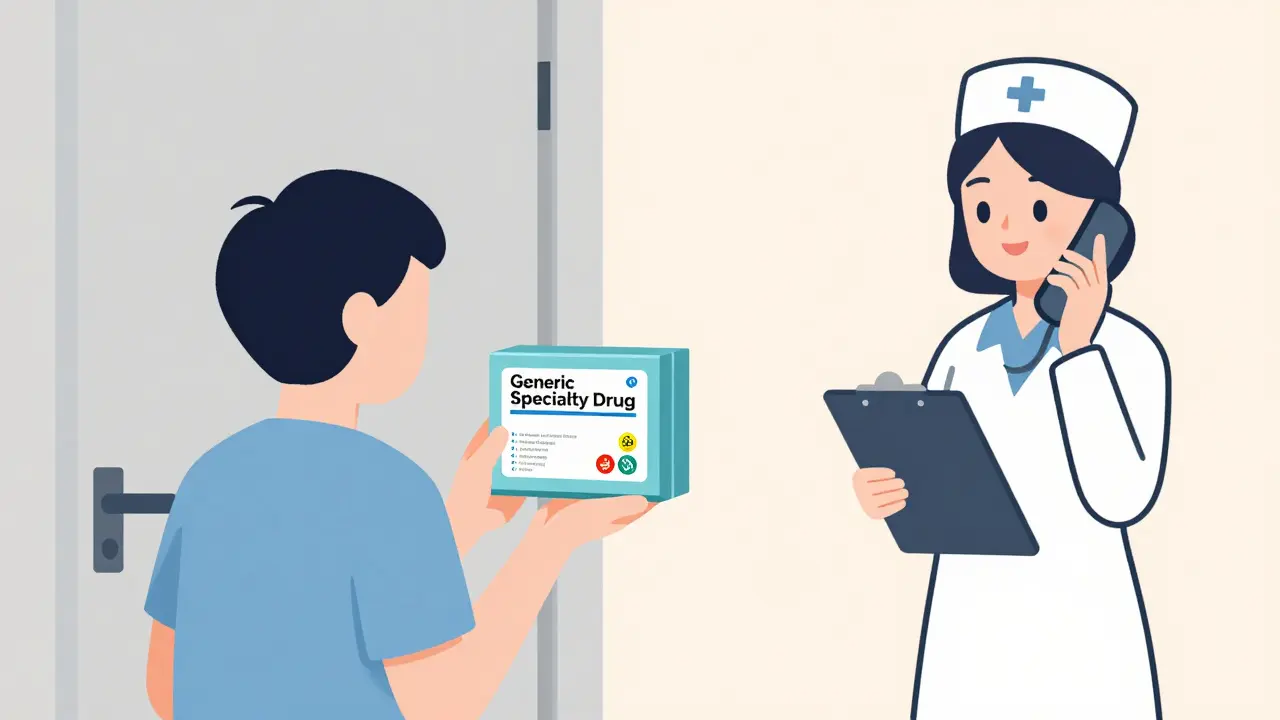
When a patient gets a generic version of a complex medication like methotrexate or etanercept, you might assume it’s just like picking up any other generic pill at the corner pharmacy. But that’s not how it works. For specialty drugs - even the generic ones - the process is completely different. It’s not about cost. It’s about care. And the provider’s role in dispensing these medications is more critical than ever.
What Makes a Drug a ‘Specialty’ Drug?
Specialty drugs aren’t just expensive. They’re complex. These are medications that require special handling, storage, or administration. Many are injectable or infused. Some need refrigeration. Others come with strict safety rules called REMS (Risk Evaluation and Mitigation Strategies) because of serious side effects. The FDA requires these protocols to protect patients. Even when a brand-name drug goes generic, it doesn’t automatically become a regular prescription. If the manufacturer requires distribution through a specialty pharmacy - which most do - then generic specialty drugs still must go through that same channel. That means no Walgreens or CVS pickup. No drive-through window. No same-day fill. This isn’t a loophole. It’s by design. Manufacturers set these rules because these drugs need more than just a pharmacist handing over a bottle. They need education, monitoring, and follow-up.Why Can’t Retail Pharmacies Handle Generic Specialty Drugs?
Retail pharmacies are built for speed. They fill 50 prescriptions an hour. Specialty pharmacies? They fill 5 - and spend an hour on each one. A patient getting a generic version of a biologic like adalimumab (Humira) doesn’t just need the pill. They need to know how to inject it. They need help with insurance. They need someone to call and ask if they’re having side effects. They need lab results tracked. They need to know what to do if the drug doesn’t work. That’s not retail pharmacy work. That’s clinical care. And specialty pharmacies are staffed with pharmacists who specialize in rheumatoid arthritis, cancer, or hepatitis C. They don’t just dispense. They manage. Even when the drug is cheaper - sometimes half the price of the brand - the service doesn’t change. The same nurse who trained you on your brand-name drug is still the one calling you when you get the generic. The same care coordinator is still tracking your blood work. The same delivery team is still shipping it in temperature-controlled packaging.The Workflow: How Generic Specialty Drugs Actually Get to Patients
Here’s what happens step by step:- Prescription arrives - Usually electronically from a specialist’s office. Not from a primary care provider.
- Insurance verification - The pharmacy checks if the plan covers the generic version. Even generics need prior authorization. Sometimes, insurers fight it, thinking they can push the patient to the brand.
- Financial assistance - Many patients can’t afford copays, even on generics. Specialty pharmacies help apply for manufacturer coupons or patient assistance programs.
- Patient education - A pharmacist or nurse calls the patient. They explain how to store it, how to inject it, what side effects to watch for, and when to call back.
- Dispensing and shipping - The drug is packed in a cooler with ice packs. It’s shipped overnight. No pickup. No waiting.
- Follow-up - Within 48 hours, someone calls again. Did you get it? Did it hurt? Are you feeling okay?
Cost Isn’t the Issue - Service Is
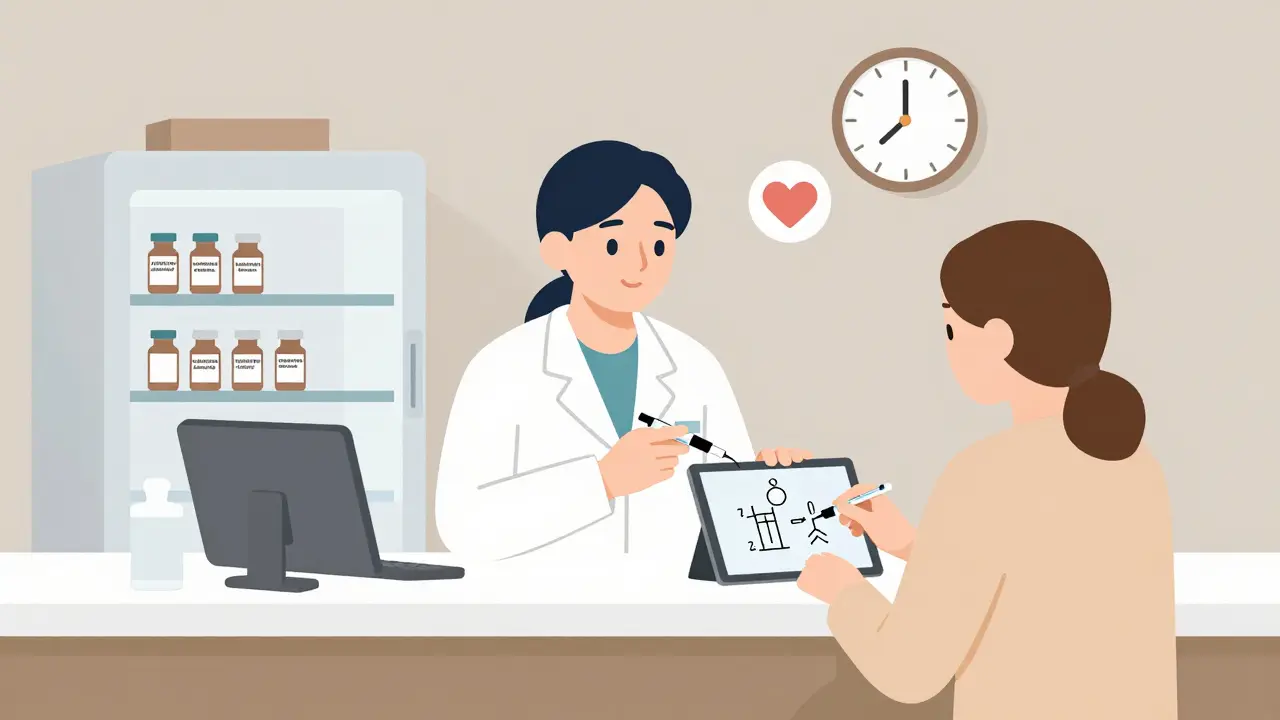
A lot of patients are confused when they switch from a brand-name specialty drug to its generic version - and still get billed the same way. One Reddit user wrote: “I went from a $15 copay at Walgreens for methotrexate to $75 through the specialty pharmacy. Why?” The answer? Because it’s not just the drug. It’s the service. The $75 isn’t for the pill. It’s for the nurse who called you twice. The care coordinator who scheduled your blood test. The delivery team that tracked the package in real time. Specialty pharmacies charge a dispensing fee - usually between $250 and $500 per prescription - on top of the drug cost. That fee doesn’t disappear just because the drug is generic. The work doesn’t change. Industry analyst John Prince put it simply: “The distinction between brand and generic becomes almost irrelevant in specialty pharmacy because the service model - not the product cost - determines the distribution channel.”Biosimilars: The New Wave of Generic Specialty Drugs
Not all generics are created equal. For biologic drugs - like those used for Crohn’s disease, psoriasis, or rheumatoid arthritis - true chemical generics don’t exist. Instead, we have biosimilars. Biosimilars are highly similar versions of biologics. They’re not exact copies because biologics are made from living cells, not chemicals. But they’re proven to work the same way. And guess what? They’re almost all distributed through specialty pharmacies. In fact, 98% of biologics and biosimilars are handled this way. The 2024 CMS rule requiring Medicare Part D to cover all FDA-approved biosimilars means more of these drugs will flow through specialty channels. That’s good for patients - biosimilars can be 15-35% cheaper than the original biologic. But it also means specialty pharmacies are bracing for a 40% increase in volume by 2026.What Patients Really Think
Patient feedback is mixed. On Trustpilot, specialty pharmacies average 3.8 out of 5 stars. High marks for clinical support (4.2/5). Low marks for delivery speed (3.1/5). Some patients love it. One user said: “My generic version of Xeljanz still comes through the same specialty pharmacy. The nurse knows my history. She remembers my dog died last year. That matters.” Others hate it. “I waited two weeks for my generic. My doctor said I needed it now. I had to go to the ER.” But here’s the key insight: Patients who stay with the same specialty pharmacy when switching from brand to generic report 68% higher satisfaction. Why? Because relationships matter. The same person who helped you survive your first chemo is still there when you get the cheaper version.
The Future: Health Systems Are Taking Over
Big hospitals and health systems are starting to run their own specialty pharmacies. Why? Because they want to control the entire process - from prescription to delivery to billing. According to ASHP’s 2024 survey, 63% of health systems plan to expand their own specialty pharmacy operations. That could mean fewer independent specialty pharmacies in the future. Some see this as progress. Others worry it’ll lead to less competition and higher prices. But one thing’s clear: Whether it’s a hospital-run pharmacy or a national player like OptumRx or CVS Specialty, the model won’t change. The service stays.Providers’ Role: More Than Just a Prescription
Providers - doctors, nurse practitioners, physician assistants - are the gatekeepers. They’re the ones who decide whether a patient gets a specialty drug in the first place. But their role doesn’t end at writing the script. They need to:- Understand that a generic specialty drug isn’t a retail drug
- Explain to patients why they can’t pick it up at Walmart
- Advocate when insurers deny coverage - even for generics
- Coordinate with the specialty pharmacy to ensure follow-up care
- Recognize that the patient’s experience with the drug is tied to the support they get
Bottom Line: It’s Not About the Drug - It’s About the Care
Generic specialty drugs aren’t cheaper versions of brand-name drugs. They’re the same drugs - same risks, same needs, same complexity - just with a lower price tag. Specialty pharmacies don’t dispense pills. They manage conditions. They build trust. They save lives. The provider’s job isn’t to choose between brand and generic. It’s to ensure the patient gets the right support - no matter what the label says. If you’re a provider, don’t assume a generic means a simple fix. If you’re a patient, don’t assume a lower price means less care. The system is broken in some ways - delivery is slow, copays are high, paperwork is endless. But the core mission hasn’t changed: complex drugs need complex care. And that care still comes from specialty pharmacies - no matter what the name on the bottle says.Why can’t I get my generic specialty drug at my local pharmacy?
Even if a specialty drug is generic, the manufacturer often requires it to be dispensed only through specialty pharmacies. This is because these drugs need special handling, patient education, monitoring, and delivery under strict conditions - things retail pharmacies aren’t set up to provide. It’s not about the drug’s price; it’s about the level of care required.
Are biosimilars the same as generic drugs?
No. Generic drugs are exact chemical copies of small-molecule drugs. Biosimilars are highly similar versions of complex biologic drugs made from living cells. They’re not identical, but they work the same way and are approved as safe and effective. Both are dispensed through specialty pharmacies because of their complexity.
Do I pay more for a generic specialty drug through a specialty pharmacy?
Sometimes, yes. Even though the drug itself is cheaper, specialty pharmacies charge a dispensing fee (usually $250-$500) and may have higher copays due to insurance restrictions. But this fee covers clinical support, delivery, and follow-up - services you don’t get at a retail pharmacy. The total cost may be lower than the brand, but the structure is more complex.
How long does it take to get a generic specialty drug?
On average, it takes 7.2 days from when the prescription is received to when it’s shipped. Oncology and hepatitis C drugs can take up to 9 days due to complex prior authorizations. Retail prescriptions are filled in under 2 hours. The delay comes from insurance checks, financial aid applications, and patient education - not from the drug itself.
Can I switch from a brand-name specialty drug to a generic without changing pharmacies?
Yes, and most patients should. Staying with the same specialty pharmacy means you keep the same care team - nurses, pharmacists, coordinators - who know your history, side effects, and needs. One survey found 68% of patients were more satisfied when they stayed with the same pharmacy during the switch to a generic or biosimilar.
Are specialty pharmacies going away because of health systems opening their own?
Not necessarily. While more hospitals are launching their own specialty pharmacies, the demand for these services is growing faster than supply. The real shift is consolidation - not elimination. Whether it’s a hospital pharmacy or a national provider like OptumRx, the need for specialized care won’t disappear. The model is here to stay.
Comments (13)
It's wild how people think generic = easy. This breakdown makes it clear it's not about the pill-it's about the whole support system. I've seen friends go through this with rheumatoid arthritis meds, and the nurse calls made all the difference. The system's slow, but it's saving lives.
This is why American healthcare is broken. You pay $75 for a generic pill because some middleman wants $500 in 'service fees.' It's not care-it's corporate greed dressed up as compassion.
From a clinical pharmacy standpoint, the distinction between generic and brand in specialty therapy is functionally irrelevant. The pharmacokinetics may be equivalent, but the risk mitigation protocols, REMS compliance, and patient monitoring workflows are identical. The dispensing fee reflects the labor-intensive nature of adherence management, not drug cost.
Why can't we just fix this? We're the richest country on earth and we make patients wait 9 days for life-saving meds? This isn't healthcare-it's a bureaucratic nightmare.
My sister switched from Humira to the biosimilar and kept the same pharmacy. The nurse remembered her dog passed last year. That’s the kind of care you don’t get at CVS. People who complain about wait times don’t understand what’s actually happening here.
Let’s be real. The entire specialty pharmacy model is a profit extraction scheme. Manufacturers force these distribution chains to maintain pricing power. The ‘service’ is a smokescreen. The real cost is in the supply chain monopolies.
Coming from Nigeria, I’ve seen how fragmented our system is. Back home, you’re lucky to get the drug at all. The fact that here, someone calls you to check if you’re okay after injecting a biologic? That’s luxury. It’s not perfect, but it’s a system that cares.
It is imperative to elucidate that the current paradigm of specialty pharmaceutical distribution is not merely an operational necessity, but a regulatory and pharmacoeconomic imperative grounded in the complexity of biopharmaceutical agents and their associated risk profiles. The conflation of generic status with accessibility is a fundamental misconception.
My mom got her generic methotrexate through a specialty pharmacy. The nurse called every week. She didn’t just deliver the drug-she kept her alive. I’d pay the fee any day.
They say it’s for safety but I think the big pharma lobby is controlling everything. Why do they need to ship it in coolers? Why not just let people pick it up? This whole thing feels like a cover for price gouging. And don’t get me started on REMS…
The integration of specialty pharmacy services within institutional health systems represents a logical evolution in value-based care delivery. The alignment of clinical, logistical, and financial stewardship under a unified governance structure enhances continuity of care and reduces fragmentation.
I waited 14 days for my drug and my doctor said I needed it yesterday I was in the ER with a flare up and they were like oh you have a specialty script?? like what even is this system??
People don’t get it. The drug doesn’t change. The care doesn’t change. The price tag on the bottle drops, but the human support stays the same. That’s not a flaw-it’s the point. The system’s slow, yeah. But it’s the only one that actually keeps people alive.